Loading Page

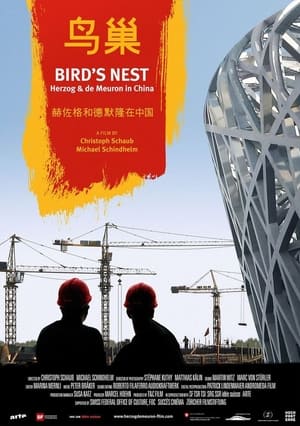
Bird's Nest - Herzog & de Meuron in China(2008)
Status: Released
Date: 2008-01-22
0%
0 Votes
Time: 1h 28m
Overview:
Schaub and Schindelm’s documentary follows two Swiss star architects, Jacques Herzog and Pierre de Meuron, on two very different projects: the national stadium for the Olympic summer games in Peking 2008 and a city area in the provincial town of Jinhua, China.
Languages: Mandarin, German, English.
Countries:
Switzerland
Movie: Bird's Nest - Herzog & de Meuron in China
Top 2 Billed Cast
HomePage
Overview
Schaub and Schindelm’s documentary follows two Swiss star architects, Jacques Herzog and Pierre de Meuron, on two very different projects: the national stadium for the Olympic summer games in Peking 2008 and a city area in the provincial town of Jinhua, China.
Release Date
2008-01-22
Average
0
Rating:
0.0 startsTagline
Genres
Languages:
普通话DeutschEnglishKeywords
Similar Movies

0%
Ray Kappe: California Modern Master - Forty Years of Modular Evolution(en)
2009-01-01
Explorations in 21st Century American Architecture Series: Ray Kappe has long been a cult figure in the architectural scene in and around Los Angeles. In 1972, he founded the influential, avant garde Southern California Institute of Architecture (SCI-ARC), where many of the younger-generation architects have studied or taught.

0%
Mies(en)
1986-01-01
No understanding of the modern movement in architecture is possible without knowledge of its master builder, Mies van der Rohe. Together with documentation of his life, this film shows all his major buildings, as well as rare film footage of Mies explaining his philosophy. Phyllis Lambert relates her choice of Mies as the architect for the Seagram building. Mies's achievements and continuing influence are debated by architects Robert A.M. Stern, Robert Venturi, and Philip Johnson, by former students and by architectural historians. Mies is seen in rare documentary footage.

50%
Maestro Plecnik(sl)
1953-01-01
Documentary showing buildings made by great architect Joze Plecnik in Prague, Wien, Ljubljana...

80%
Tokio - Die Stadtkultur von morgen(de)
2021-07-25
Tokyo, the largest city in the world, wants to create a new urban culture. It is returning to the urban traditions and building techniques of the small town. The aim is to create a new balance between megacity and small-scale garden city. Tokyo's architects are the driving force. They want to create a new urban culture with revolutionary ideas.

0%
Tadao Ando(en)
1988-01-01
Tadao Ando, a self-taught architect, proposes an international architecture that he believes can only be conceived by someone Japanese. His architecture mixes Piranesian drama with contemplative spaces in urban complexes, residences and chapels. This film presents the formative years of his impressive career before he embarked on projects in Europe and the United States.


0%
Steven Holl: The Body in Space(en)
1999-02-22
"Steven Holl: The Body in Space" explores the career of the innovative, highly renowned American architect. In this portrait Holl presents some of his most acclaimed works, including the Makuhari Housing Complex in Chiba, Japan and the Chapel of St. Ignatius in Seattle. Centered around the completion of Holl's Museum of Contemporary Art in Helsinki, the film observes his process and reasoning throughout the duration of the project

74%
200,000 Phantoms(fr)
2007-07-11
In 1914, the Czech architect Jan Letzel designed in the Japanese city of Hiroshima Center for the World Expo, which has turned into ruins after the atomic bombing in August 1945. “Atomic Dome” – all that remains of the destroyed palace of the exhibition – has become part of the Hiroshima memorial. In 2007, French sculptor, painter and film director Jean-Gabriel Périot assembled this cinematic collage from hundreds of multi-format, color and black and white photographs of different years’ of “Genbaku Dome”.

0%
Desert Utopia: Mid-Century Architecture in Palm Springs(en)
2010-01-01
Southern California’s Coachella Valley, including the communities of Palm Springs, Palm Desert, Desert Hot Springs, boasts hundreds of extraordinary midcentury modern homes, public buildings and commercial structures. Modern designers such as William F. Cody, Albert Frey, William Krisel, John Lautner, Richard Neutra, R.M. Schindler, Donald Wexler, E. Stewart Williams left their collective mark on this desert paradise. Desert Utopia: Mid-Century Architecture in Palm Springs traces the history of modern architecture in Palm Springs from the first bold forays into modernist design to the preservation challenges facing the region today. Director Jake Gorst’s film features rare archival images and footage as well as interviews with historians, homeowners and the architects who helped create this mecca of modernism.

80%
Silver Memories(en)
2000-04-08
Heralded as a palace among minor and major league baseball stadiums, Silver Stadium set a standard of excellence from opening day. From May 1929 through the 1990s Silver Stadium served as home to Rochester's historic baseball team, The Rochester Red Wings, as well as many other sporting teams. When not being used as a baseball stadium, the space served as center stage for a variety of traveling acts. Hear from the people closest to the history of this magnificent facility as they take you on a journey through The Memories of Silver.

0%
Architect Athfield(en)
1977-01-01
Examines the practical philosophy, the achievements and frustrations of one of New Zealand's most lively and innovative architects, Ian Athfield. The film provides a portrait of the architect and his work both in New Zealand and his project to design housing for 140,000 squatters from the Tondo area of Manila in the Philippines, for which Athfield won an international competition in 1975.

75%
The Amateur(it)
2017-10-02
The memory of Piero Portaluppi, a Milanese architect who reached the peak of his fame during the 20 years of the Fascist regime, comes back to life, both through the rediscovery of his work today and in a previously unpublished film diary in 16 mm, shot and edited throughout his lifetime. A man of great charm and power, Portaluppi lived through a grandiose but tragic era with ironic detachment, as if dancing across things as he created beauty. History marches on implacably, radically transforming the arena in which the eclectic artist and his large family lived and worked.

100%
Tapavica(sr)
2016-04-27
A story about the first Serbian Olympian who won bronze medal at the first Olympic games in 1896, also a world class architect.

0%
Neutra: Survival Through Design(en)
2019-02-01
This insightful documentary feature from PJ Letofsky serves as a profile of iconic Austrian-American Architect Richard Neutra, whose work and legacy have helped shape the modern understanding of design, architecture and the interconnected fabric of nature. Today, Richard's legacy lives on through his son, Dion, who has taken up his father's mantle after nearly three-decades under his mentorship.

80%
Restoring a Masterpiece: The Renovation of Eastman Theatre(en)
2010-04-13
Take a look behind the curtain to see the vast history and recent renovation of one of Rochester, New York's most famous landmarks. Architects, theater personnel, historians, community leaders, and citizens provide in depth insight from start to finish in one of the most extensive renovations the city has ever seen.

70%
The Spirit in Architecture: John Lautner(en)
1990-06-15
The Spirit in Architecture examines the work of John Lautner, one of the most visionary and profound architects, who began his career in Los Angeles in the 1930's. This illuminating journey into Lautner's world features never before seen footage from his apprenticeship with Frank Lloyd Wright at Taliesin; extensive documentation of his extraordinary buildings; and interviews with historians, critics, collaborators, clients, and Lautner himself, which put his achievements in perspective. his building's use in feature films and his Googie's coffee shop design demonstrate his contribution to popular culture.

0%
Kubota(en)
1982-07-24
A film featuring architect, sculptor, and musician Nobuo Kubota in a sound-sculpture performance. From within a cage-like structure filled with traditional musical instruments and sound-making devices fashioned from ordinary objects and toys, Kubota creates an aural/visual montage of musical notes and noises. Praised by music educators as a valuable tool for teaching creativity in sound exploration and musical innovation, the film reveals the infinite percussion possibilities of simple objects and presents a portrait of a versatile performer whose imagination has led him far beyond the confines of conventional music. Directed by Jonny Silver - 1982 | 20 min

100%
Reimagining A Buffalo Landmark(en)
2019-04-12
The Richardson Olmsted Campus, a former psychiatric center and National Historic Landmark, is seeing new life as it undergoes restoration and adaptation to a modern use.

0%
Gray Matters(en)
2016-05-27
Gray Matters explores the long, fascinating life and complicated career of architect and designer Eileen Gray, whose uncompromising vision defined and defied the practice of modernism in decoration, design and architecture. Making a reputation with her traditional lacquer work in the first decade of the 20th century, she became a critically acclaimed and sought after designer and decorator in the next before reinventing herself as an architect, a field in which she laboured largely in obscurity. Apart from the accolades that greeted her first building –persistently and perversely credited to her mentor–her pioneering work was done quietly, privately and to her own specifications. But she lived long enough (98) to be re-discovered and acclaimed. Today, with her work commanding extraordinary prices and attention, her legacy, like its creator, remains elusive, contested and compelling.

0%
Funkiskungen(sv)
2019-06-11