Loading Page

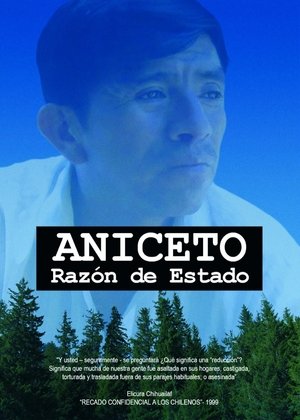
Aniceto, razón de Estado(2009)
Status: Released
Date: 2009-06-11
0%
0 Votes
Time: 0h 55m
Overview:
In the Araucanía Region, an area marked by historical relations between Mapuche and non-Mapuche people, the shooting of a police officer results in the death of a young Mapuche man. On the other hand, a community member who has been sentenced to 10 years in prison has been on a hunger strike for over one hundred days. In the background, we have the experience of Aniceto Norin, a Longko who has spent five years in prison for the crime of "Terrorist Threat," whose account allows us to understand his thoughts and the impact of assuming his role and his Mapuche identity.
Languages: Spanish.
Countries:
Movie: Aniceto, razón de Estado
HomePage
Overview
In the Araucanía Region, an area marked by historical relations between Mapuche and non-Mapuche people, the shooting of a police officer results in the death of a young Mapuche man. On the other hand, a community member who has been sentenced to 10 years in prison has been on a hunger strike for over one hundred days. In the background, we have the experience of Aniceto Norin, a Longko who has spent five years in prison for the crime of "Terrorist Threat," whose account allows us to understand his thoughts and the impact of assuming his role and his Mapuche identity.
Release Date
2009-06-11
Average
0
Rating:
0.0 startsTagline
Genres
Languages:
EspañolKeywords
Similar Movies

100%
Invasion(en)
2019-11-01
In this era of "reconciliation", Indigenous land is still being taken at gunpoint. INVASION is a new film about the Unist'ot'en Camp, Gidimt'en checkpoint, and the Wet'suwet'en Nation standing up to the Canadian government and corporations who continue colonial violence against indigenous people.

0%
Surviving Columbus(en)
1992-11-16
This Peabody Award-winning documentary from New Mexico PBS looks at the European arrival in the Americas from the perspective of the Pueblo Peoples.

100%
The Scars(eu)
2019-03-12
The personal stories lived by the Uncle, the Father and the Son, respectively, form a tragic experience that is drawn along a line in time. This line is comparable to a crease in the pages of the family album, but also to a crack in the walls of the paternal house. It resembles the open wound created when drilling into a mountain, but also a scar in the collective imaginary of a society, where the idea of salvation finds its tragic destiny in the political struggle. What is at the end of that line? Will old war songs be enough to circumvent that destiny?

0%
Dolores(es)
1984-01-01

0%
Feather Fall(en)
2025-06-02
This short documentary revisits Mi’kmaq territory, where an iconic moment was captured in 2013—igniting into a symbol of Indigenous resistance and halting fracking exploration on unceded lands.


0%
Ceremony(en)
2026-03-14
At ramshackle Nuxalk Radio in Bella Coola, an inquiry into the vanished ooligan run unravels a buried history of erasure and ignites the quiet revolution of a Nation that refuses to disappear.


70%
Stonebreakers(en)
2022-11-12
In a year of uprisings and political unrest, Stonebreakers documents the fights around monuments in the United States and explores the shifting landscapes of the nation's historical memory.

100%
Rematriation(en)
Rematriation explores scientific, cultural, economic and sociopolitical perspectives, as citizens fight to protect the last big trees in British Columbia from being felled. The lessons we take away permeate the fabric of Canadian identity.

0%
Fly on the Wall: Canada’s Residential School Legacy(en)
2021-11-04
For more than 100 years, thousands of Indigenous children died while in Canada’s residential school system. Pacheedaht Elder Bill Jones survived, but he, like many others, experienced years of beatings and sexual abuse. The scandal has finally brought the Indigenous rights struggle into focus, none more so than at Fairy Creek, an area of forest on First Nations land that protesters are desperately trying to prevent from falling into the hands of logging companies.

80%
Santiago's Path: Disappearance and Death of Santiago Maldonado(es)
2018-08-01
Santiago Maldonado disappeared in the midst of repression against a Mapuche community that claimed to Luciano Benetton for his land. His body was found 78 days later. The need for truth and justice continues

0%
Century of Smoke(lo)
2019-09-05
Laosan, a young family man, spends all his time smoking opium. For his community, lost in the heart of the Laotian jungle, opium farming is the only way to survive. But opium is also the poison that puts men to sleep and kills their desires.

0%
Blockade(fr)
2025-10-31
This short documentary follows land defenders and their allies in their fight against Law 97, a forestry reform that would have handed over the province’s remaining forests to industry. Through footage shot across multiple blockades and camps, the film shows how Indigenous resistance forced the government to withdraw the bill — a victory that mainstream media largely ignored.

0%
Genoveva(es)
2015-08-07
A photograph of an unknown Mapuche great-grandmother is the starting point of this documentary essay. Through the analysis of said picture, conversations with family members, a trip to southern Chile cities, and an actress who re-enacts the photo, we see the existing prejudice against indigenous people.

0%
Las quilas(es)
2021-06-12


0%
ARISE for the Ancient Forests | Save Fairy Creek(en)
A film initially was released alongside an injunction granted from the BC court to Teal Jones, enabling them to forcibly remove forest protectors who have been sacrificing their worlds at home to stand and defend some of the last of the 2.7% remaining old-growth on Vancouver Island. In collaboration with filmmaker, Ian MacKenzie, the short-film depicts how much we truly depend on these Ancient Forests for our survival as well.


0%
Inside the Fight to Save an Ancient Forest (and the Secrets it Holds)(en)
2021-07-01
The ancient forests of the Pacific Northwest are home to giant trees and many secrets, which science is just beginning to understand. But these forests are at risk of disappearing. In British Columbia on First Nation territory, a small band of forest defenders are risking life and liberty to protect some of the last remaining ancient forests.