Loading Page
Another Home(2025)
Status: Released
Date: 2025-01-17
0%
0 Votes
Time: 1h 23m
Overview:
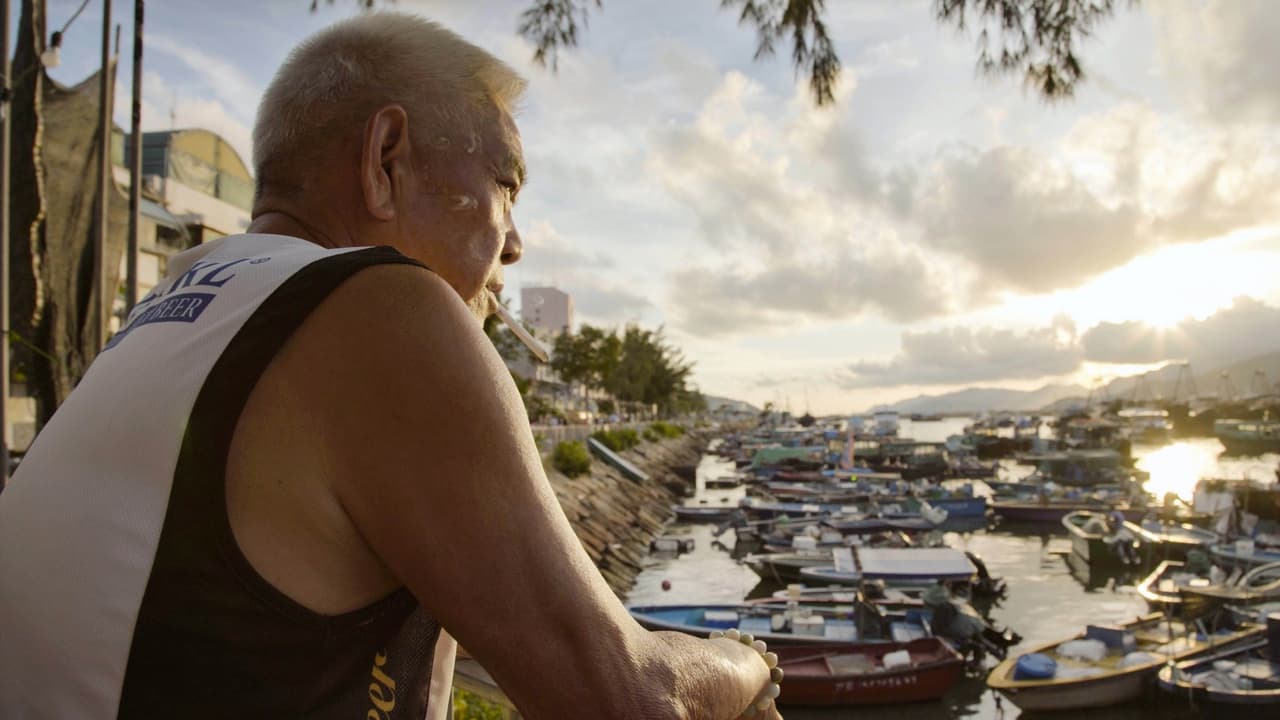
Cheung Chau, once a fishing village in Hong Kong, has transformed into a tourist spot. Ri-Tai, a food stall run by A-Cheung, reflects local life, absurdities, and societal realities. A-Cheung spends his days playing games with customers like Plumpy, forming bonds that transcend generations. However, the onset of COVID-19 disrupts this sense of community, leaving the island deserted and questioning whether Ri-Tai's simple way of life will vanish.
Languages: Cantonese.
Countries:
France,
Hong Kong,
Taiwan
ProductionCompanies: 
LA FABRICA NOCTURNA PRODUCTIONS
Movie: Another Home
HomePage
Overview
Cheung Chau, once a fishing village in Hong Kong, has transformed into a tourist spot. Ri-Tai, a food stall run by A-Cheung, reflects local life, absurdities, and societal realities. A-Cheung spends his days playing games with customers like Plumpy, forming bonds that transcend generations. However, the onset of COVID-19 disrupts this sense of community, leaving the island deserted and questioning whether Ri-Tai's simple way of life will vanish.
Release Date
2025-01-17
Average
0
Rating:
0.0 startsTagline
Genres
Languages:
广州话 / 廣州話Keywords
Similar Movies

74%
Do Not Split(en)
2020-01-24
The story of the 2019 Hong Kong protests, told through a series of demonstrations by local protestors that escalate into conflict when highly armed police appear on the scene.

70%
Rather Be Ashes Than Dust(cn)
2024-10-04
Memories of his four-year journey focused on the Hong Kong protests. Narrated in the first person, is rich with reflections and contemplations, most intertwined with feelings of guilt.

65%
Inside the Red Brick Wall(cn)
2020-11-19
In 2019, Hong Kong was swept by demonstrations against the controversial extradition bill. At the Polytechnic University, a group of students also takes a stand for freedom and democracy. Negotiations with the police are chaotic and aggressive, conducted via megaphones and politically charged music played over loudspeakers. The colorful umbrellas which the young people use to protect themselves against the brutal police actions emphasize the group’s bravado, which borders on recklessness. What begins as an energetic battle against the establishment turns into a lopsided game of cat and mouse when the police decide to surround the building. Within its red brick walls, the university building becomes a prison. Over the nearly two weeks that follow, as fear and exhaustion grow among the hundreds of students, so does the uncertainty. Should they hang on inside, or leave the building to face the armed police?

73%
Joshua: Teenager vs. Superpower(en)
2017-01-20
When the Chinese Communist Party backtracks on its promise of autonomy to Hong Kong, teenager Joshua Wong decides to save his city. Rallying thousands of kids to skip school and occupy the streets, Joshua becomes an unlikely leader in Hong Kong and one of China’s most notorious dissidents.

68%
Pseudo Secular(cn)
2016-11-12
They are frozen in place, stagnating without any direction. Around them, things change rapidly.

100%
Freedom for the Wolf(en)
2017-06-12
The Real Story of Fake Democracy. Filmed over three years in five countries, FREEDOM FOR THE WOLF is an epic investigation into the new regime of illiberal democracy. From the young students of Hong Kong, to a rapper in post-Arab Spring Tunisia and the viral comedians of Bollywood, we discover how people from every corner of the globe are fighting the same struggle. They are fighting against elected leaders who trample on human rights, minorities, and their political opponents.

83%
Revolution of Our Times(cn)
2021-11-22
Throughout Hong Kong’s history, Hongkongers have fought for freedom and democracy but have yet to succeed. In 2019, a controversial extradition bill was introduced that would allow Hongkongers to be tried in mainland China. This decision spurred massive protests, riots, and resistance against heavy-handed Chinese rule over the City-State. Award-winning director Kiwi Chow documents the events to tell the story of the movement, with both a macro view of its historical context and footage and interviews from protestors on the front lines.

67%
Blue Island(cn)
2022-04-30
Although the Chinese government promised that Hong Kong would retain separate status until 2047, in recent years the Chinese state has consolidated its power over the metropolis. Large-scale protests by the populace have been brutally suppressed. This mix of documentary, fiction, and visions of the future reveals the current state of desolate depression among the people of Hong Kong. “A desperate attempt to capture the final moments of a sinking island”, as maker Chan Tze-woon himself puts it.

0%
Hong Kong, Ga Yau(en)
2020-09-09
When Hong Kong, which has a legal system separate from China, brought the 2019 Extradition Bill, citizens took to the streets. Locals feared that the law, which would extradite Hong Kong criminals to the mainland, will be used to target dissidents & undermine the region's judicial independence. This film documents how the protest turned into a pro-democracy movement whose impact echoed in Beijing.

60%
Days After n Coming(cn)
2012-01-14
Hong Kong's high-speed rail link, the demolition of Choi Yuen Village, the impending budget and the influence of the global Occupy movement are at the centre of independent filmmaker Lo's timely measure of the city's pulse. Ostensibly the third entry in a trilogy that began with 21 years after. (2010) and to be continued (2010), which also captured public reaction to watershed moments in Hong Kong's political life since 2009. The documentary was built upon the material used in its previous installment (to be continued, 46 minutes). It disproves the notion of a passive Hong Kong in a chronicle of a generation poised for massive social change.

0%
Hong Kong Mixtape(cn)
2023-01-13
Political engagement spawned the wildest of wonderlands for Hong Kong’s creativity – but as a new law annihilates freedom of expression overnight, underground artists and creatives find themselves targets, and their works disappeared. Together we race to preserve the creative uprising amid China’s crackdown.

70%
We Have Boots(cn)
2020-06-10
The Umbrella Movement of 2014, also known as the Occupy Movement, paved the way for Hong Kong’s current upheavals, but unfolded in significantly different ways. This creative documentary focuses on the intellectual, political, and discursive underpinnings of the social and political actions of 2014, before fast-forwarding to 2019. A range of thoughtful and engaged intellectuals, students, scholars, activists, and artists including Benny Tai, Chan Kin-man, Ray Wong, and Agnes Chow (many of whom are facing imprisonment for their democratic activism) articulate a range of philosophies, viewpoints and emotions, set against Hong Kong’s spectacular urban background of skyscrapers, night lights, and street-occupying mass movements.

0%
Lessons in Dissent(en)
2014-03-29
A vivid portrait of a generation of Hong Kongers committed to creating a new more democratic Hong Kong. Schoolboy Joshua Wong dedicates himself to stopping the introduction of National Education. Whilst former classmate Ma Jai fights against political oppression on the streets and in the courts. Catapulting the viewer on to the streets of Hong Kong and into the heart of the action. The viewer is confronted with Hong Kong's oppressive heat, stifling humidity and air thick with dissent. Filmed over 18 months this is a kaleidoscopic, visceral experience of their epic struggle.

60%
June(cn)
2020-02-22
I made June when I didn’t have any inspiration to create a feature film. The documentary is about the rarely known stories in the social movement in June. At first the clips of videos were kept for sorting out my feelings, but after being edited, they were made into a documentary and became a record of history. Six scenes and voices were used to tell what happened during that month.

0%
Last Exit to Kai Tak(cn)
2018-10-27
In the aftermath of 2014's Umbrella Revolution, five Hong Kong activists are confronted with the question of what it means to be Hong Kongers.

75%
Hong Kong Moments(cn)
2020-05-28
As pro-democracy activists and armed police battle in the streets of Hong Kong, ordinary citizens are choosing sides. Historically an outlier of both western and Chinese power, Hong Kong wields its own economic force, affording the city and its people a spirit of independence that has now erupted into clouds of tear gas. Filmmaker Bing Zhou uses a nimble camera to follow a group of protagonists—two opposing political candidates, a tea shop owner, a cab driver, a police officer, a paramedic—on two separate days of conflict. On September 21, 2019, protestors from three districts join forces, resulting in unprecedented violence. Just 10 days later on October 1, the National Day of the People’s Republic of China, previously undecided onlookers show their stripes. Thoughts transform into action in this demonstration of how mercurial and personal Hong Kong’s politics have become.

60%
Trial and Error(cn)
2020-01-10
This Anti-ELAB (Anti-Extradition Law Amendment Bill) Movement documentary short takes us back to the airport occupation on 12 August 2019. Although this new form of protest soon turned into a crisis, it became an important lesson for the protesters. Compared to the tension inside the airport terminal, the long walk home at sunset on the Lantau highway, which connects the Hong Kong International Airport to the residential areas, felt like a reminiscence of a school field trip.

60%
Comrades(cn)
2020-01-10
Young people are protesting on the streets of Hong Kong in order to bring about change. Air soaked with tear gas, the dark uniforms and loud commands of the police officers in the colourful umbrella sea of the protesters. In the midst of the action, the film documents a brand new protest movement.

75%
Hong Kong: Retrocession Generation(fr)
2017-07-04
In 2017, twenty years after the British handed over Hong Kong to China in 1997, young people, more politicized than any previous generation and proud of their land, do not feel Chinese and actively fight against the oligarchs who want to subdue them to China's authoritarian power.

0%
YP1967(cn)
2017-10-04
Everyone has their secrets. Everyone has the past no one’s heard about. But what makes an entire generation sit in stunned silence with unmentionable hesitation to talk about their past? Even the past was 50 years ago. Five decades after the Hong Kong leftist riots, six ex-young prisoners speak out for the first time about their personal and unmentionable experience. Documentary film YP1967 is about their love and hate towards their country, their honour and dishonour as a convicted criminal, their condonation and condemnation of the parties involved, and their truth-seeking and reconciliation with the past.