Loading Page
India(1929)
Status: Released
Date: 1929-08-01
0%
0 Votes
Time: 0h 14m
Overview:
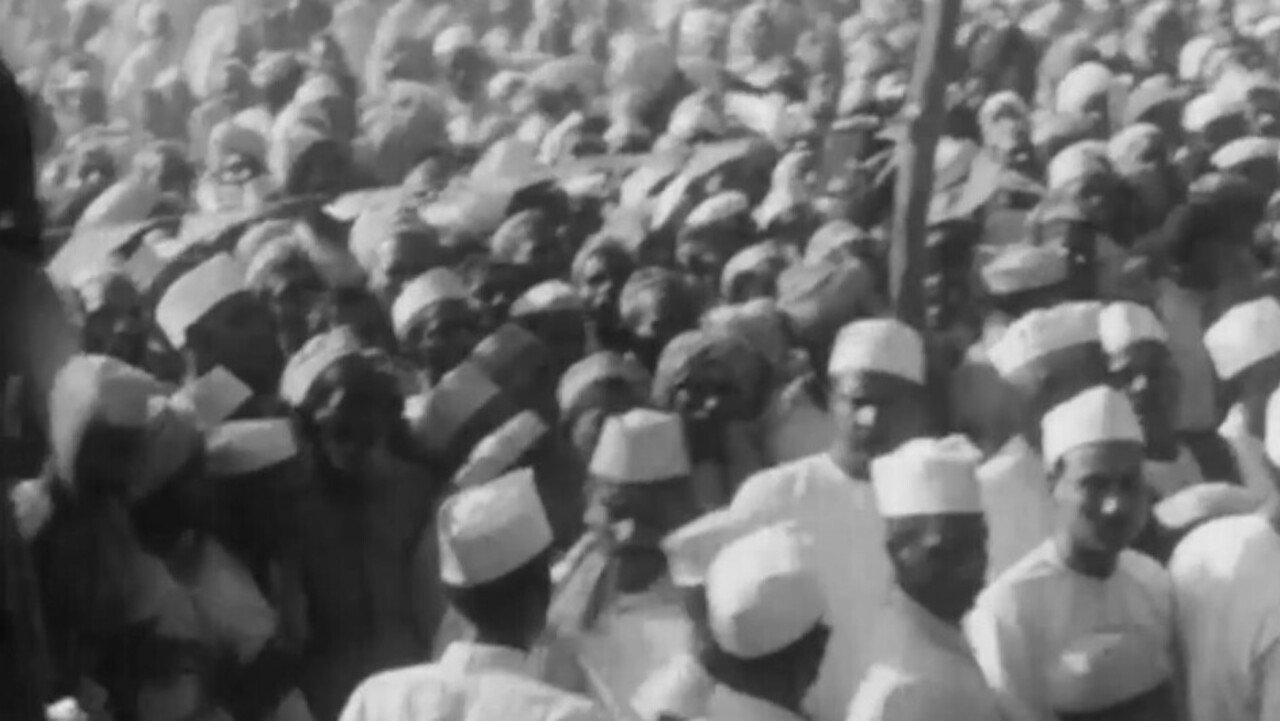
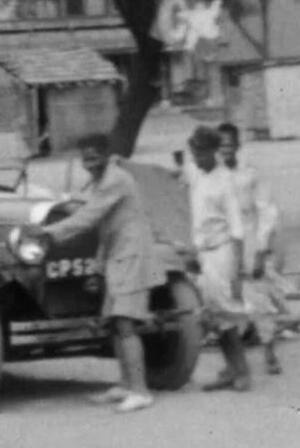
Amateur film of the passage to India - complete with guest appearance by Gandhi.
Languages: No Language.
Countries:
United Kingdom
ProductionCompanies: 
The British Council
Movie: India
Video Trailer India
All 1 videos

Amateur footage of Gandhi in 1929 - Clip
Similar Movies

100%
An immersion into the Divine Feminine(en)
2017-08-15
By drawing a parallel between the Indian Durga Puja festival and other forms of celebrating the divine feminine, Santa Shakti reveals the Sacred Power beyond languages and religions.

61%
India Cabaret(hi)
1985-01-02
An exploration of the 'respectable' and 'immoral' stereotypes of women in Indian society told from the point of view of two striptease dancers in a Bombay cabaret.


0%
Hacking at Leaves(en)
2024-04-06
Hacking at Leaves documents artist and hazmat-suit aficionado Johannes Grenzfurthner as he attempts to come to terms with the United States' colonial past, Navajo tribal history, and the hacker movement. The story hones in on a small tinker space in Durango, Colorado, that made significant contributions to worldwide COVID relief efforts. But things go awry when Uncle Sam interferes with the film's production.

69%
The Pearl Button(es)
2015-10-15
The ocean contains the history of all humanity. The sea holds all the voices of the earth and those that come from outer space. Water receives impetus from the stars and transmits it to living creatures. Water, the longest border in Chile, also holds the secret of two mysterious buttons which were found on its ocean floor. Chile, with its 2,670 miles of coastline and the largest archipelago in the world, presents a supernatural landscape. In it are volcanoes, mountains and glaciers. In it are the voices of the Patagonian Indigenous people, the first English sailors and also those of its political prisoners. Some say that water has memory. This film shows that it also has a voice.

0%
Eyewar(en)
2013-10-15
What threads of history bind Manhattan's Ground Zero to those of Nagasaki and Hiroshima? Or connect sight to truth, games to war, or the silkworm to the drone? What does the United States hold to be the role of science in warfare? How has war historically been waged in Buddhist traditions? These are some of the topics addressed in Eyewar: 80 minutes of found footage which traces the development of the digital image from the maps of the second century to the screens of the twenty-first, and the uses of the field of cybernetics from Japan in the 1940s to Chile in the 1970s and Iraq in the 1990s.

60%
The Arms Drop(da)
2014-06-04
One night in December 1995, 4 tons of weapons fall from the sky over India. A few days later a Danish man returns to Denmark with a grave secret. Only when an English arms dealer is arrested in India and faces death sentence, does the Dane appear in the large-scale international investigation of the case. With reconstructions and scenes resembling a feature film, the docu-thriller The Arms Drop tells the nerve-racking story of two men who gamble their lives on a joint mission with each their secret agenda, and the political, personal and diplomatic consequences 20 years later.

100%
Purdah(hi)
2018-03-03
The inspiring story of a young Indian Muslim woman who trades her burka for dreams of playing on the Mumbai Senior Women's Cricket Team and how the harsh realities for women in her country creates an unexpected outcome for her own family, ultimately shattering and fueling aspirations.

0%
Tiharu(en)
2013-06-08
It is quickly becoming the most populated country in the world, but India holds a dark secret. Men and women who make their homes in the poor villages throughout the central region of the country are forced to make decisions that no parents should ever have to make. Sell a child into slavery or watch your children starve to death.

0%
Millions Can Walk(en)
2014-01-30
Hundreds of thousands of Indian men and women – indigenous inhabitants and landless farmers – demand their right to existence by making a 400 kilometre protest march from Gwalior to Delhi. How can one fight for one’s rights without using violence? With such an important contemporary question, the film spreads far beyond the borders of India. It shows the multiple facets of this imposing protest march and focuses as well on the daily realities of these proud people.

45%
Step by Step(de)
2023-01-27

100%
Gerboise Bleue(fr)
2009-02-11
"Gerboise bleue", the first French atomic test carried out on February 13, 1960 in the Algerian Sahara, is the starting point of France's nuclear power. These are powerful radioactive aerial shots carried out in areas belonging to the French army. Underground tests will follow, even after the independence of Algeria. From 1960 to 1978, 30,000 people were exposed in the Sahara. The French army was recognized recognized nine irradiations. No complaint against the army or the Atomic Energy Commission has resulted. Three requests for a commission of inquiry were rejected by the National Defense Commission. For the first time, the last survivors bear witness to their fight for the recognition of their illnesses, and revealed to themselves in what conditions the shootings took place. The director goes to the zero point of "Gerboise Bleue", forbidden access for 47 years by the Algerian authorities


0%
DV China(zh)
2002-05-14
A documentary following Zhou Yuanquiang, a cultural worker in Jingdezhen, China who makes movies with untrained local actors.

0%
Indian Durbar(en)
1939-01-01
Technicolor scenes from an Indian Durbar, held for the Maharaja of Alwar in Rajasthan.

0%
Sapera(hi)
2019-03-27
In the holy city of Varanasi, 16-year-old Ali has one of the most dangerous jobs in the world – catching poisonous snakes. The boy balances life and death on a daily basis to support his family.

0%
The Sand Island Story(en)
1981-01-01
This short documentary chronicles a four-month period between 1979 and 1980 when residents of Hawaii's Sand Island "squatter" community attempted to resist eviction from the Honolulu shoreline - resulting in displacement, arrests, and the destruction of a community.

60%
The Great Indian Wars 1840-1890(en)
1991-03-19
Documentation of the encroachment of European settlers upon Native American lands and the violent reaction of the Indians in their struggle to survive.

0%
Koodal(xx)
1970-01-01
"Visionary post-war modernist Tyeb Mehta channels the nightmares of the nation in Koodal, at once the artist’s self-described “autobiography” and a profound meditation on collage, crowd control, cinematic subjectivity and the violence buried within every glorious act of foundation." -- Sarkari Shorts

83%
Invasion(en)
2020-05-01
In this era of “reconciliation”, Indigenous land is still being taken at gunpoint. Unist’ot’en Camp, Gidimt’en checkpoint and the larger Wet’suwet’en Nation are standing up to the Canadian government and corporations who continue colonial violence against Indigenous people. The Unist’ot’en Camp has been a beacon of resistance for nearly 10 years. It is a healing space for Indigenous people and settlers alike, and an active example of decolonization. The violence, environmental destruction, and disregard for human rights following TC Energy (formerly TransCanada) / Coastal GasLink’s interim injunction has been devastating to bear, but this fight is far from over.