
Living Worlds(2021)
The Search Begins
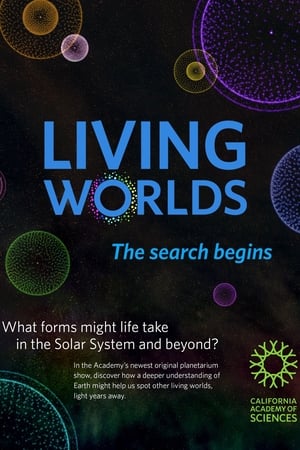
What forms might life take in the Solar System and beyond? In the Academy's newest original planetarium show, see how a deeper understanding of Earth might help us locate other living worlds, light years away.
Movie: Living Worlds
Top 1 Billed Cast

Narrator (voice)
Video Trailer Living Worlds
All 1 videos

Living Worlds Trailer | California Academy of Sciences - Trailer
Similar Movies

The Mystery of Chaco Canyon(en)
Chaco Canyon, located in northwest New Mexico, is perhaps the only site in the world constructed in an elaborate pattern that mirrors the yearly cycle of the sun and the 19-year cycle of the moon. How did an ancient civilization, with no known written language, arrange its buildings into a virtual celestial calendar, spanning an area roughly the size of Ireland?

Cielo(en)
The first feature from Alison McAlpine is a dialogue with the heavens—in this case, the heavens above the Andes and the Atacama Desert in northern Chile, where she alights on the desert- and mountain-dwelling astronomers, fishermen, miners, and cowboys who live their lives with reverence and awe for the skies.

Universet(no)

Prehistoric Astronomers(en)
Cave paintings and lunar calendars exist in the caves and remains of prehistoric hunters studied recently. What if Prehistoric Man were clever enough to develop in depth scientific knowledge? As unlikely as it may seem, new data tend to prove that Prehistoric Man actually invented Astronomy!

Shadow Chasers(fr)
This feature-length documentary is a portrait of eclipse chasers, people for whom solar eclipses - among nature's more spectacular phenomena – are a veritable obsession. The film follows 4 of them as they travel incredible distances to witness the last total eclipse of the millennium as it sweeps eastward across Europe to India. At various points along the way enthusiasts Alain Cirou in France, Paul Houde in Austria, Olivier Staiger in Germany and Debasis Sarkar in India offer their impressions of the historic event.

Searching for Planet 9(fr)
At the edge of our solar system supposedly lies an immense planet. Five to ten times the size of the Earth. Several international teams of scientists have been competing in a frantic race to detect it, in uncharted territories, far beyond Neptune. The recent discovery of several dwarf planets, with intriguing trajectories, have put astronomers on the trail of this mysterious planet. Why is this enigmatic planet so difficult to detect? What would a ninth planet teach us about our corner of the universe? Could it help us unlock some of the mysteries of our solar system?

Attacking the Devil: Harold Evans and the Last Nazi War Crime(en)
Before the internet. Before social media. Before breaking news. The victims of Thalidomide had to rely on something even more extraordinary to fight their corner: Investigative journalism. This is the story of how Harold Evans fought and won the battle of his and many other lives.

Edge of Darkness(en)
The film features amazing scenes of places never before seen gathered by key space missions that culminated with groundbreaking discoveries in 2015. It features a spectacular flight though the great cliffs on comet 67P, a close look at the fascinating bright "lights" on Ceres, and the first ever close ups of dwarf binary planet Pluto/Charon and its moons.


Wonders of the Moon(en)
Documentary which uses the latest, most detailed imagery to reveal the monthly life cycle of the moon. From Wales to Wyoming, Hong Kong to Croydon, the programme finds out how the moon shapes life on Earth, as well as exploring its mysterious dark side and discovering how the moon's journey around Earth delivers one of nature's most awe-inspiring events - a total solar eclipse. And at the end of a remarkable year of lunar activity, we find out why so many supermoons have been lighting up the night sky.

The Man Who Stole Einstein's Brain(en)
On April 18, 1955, the pathologist performing the autopsy on Albert Einstein covertly steals the genius's brain, hoping to uncover the secret of brilliance. His good intentions and scientific ambitions collide with harsh realities as his world crumbles.

Picture a Scientist(en)
A documentary that looks at systemic sexism faced by women scientists in STEM fields.

Free Will(en)
An in-depth investigation featuring world renowned philosophers and scientists into the most profound philosophical debate of all time: Do we have free will?

Passage of Venus(fr)
Photo sequence of the rare transit of Venus over the face of the Sun, one of the first chronophotographic sequences. In 1873, P.J.C. Janssen, or Pierre Jules César Janssen, invented the Photographic Revolver, which captured a series of images in a row. The device, automatic, produced images in a row without human intervention, being used to serve as photographic evidence of the passage of Venus before the Sun, in 1874.

The Brain That Changes Itself(en)
The discovery of neuroplasticity, the fact that thoughts can change the structure and function of our brains, even into old age, is one of the most important breakthroughs in our understanding of the brain in recent times. In The Brain That Changes Itself, Dr Norman Doidge explores the profound implications of the changing brain in a way that will permanently alter the way we look at human possibility and human nature. The documentary examines a blind man who sinks a basketball; a woman with half a brain who leads a normal life; learning disorders, strokes and brain traumas that are improved and cured; and chronic pain that is alleviated. The vast expanse of the brain's possibility is still unrealized.

The Real T Rex with Chris Packham(en)
A documentary examining what the Tyrannosaurus Rex was really like - both appearance and behaviour - using the recent palaeontological and zoological research.

From the Atoms to the Stars(fr)
An incredible travel through space and time between the walls of the Paris Observatory, which is celebrating its 350th birthday. Place of discoveries such as speed of light or Neptune’s existence, it is still today one of the oldest operating observatories and the greatest hub in the world for astronomy and astrophysics researches, second only to Harvard.

The Most Unknown(en)
An epic documentary film that sends nine scientists to extraordinary parts of the world to uncover unexpected answers to some of humanity’s biggest questions. How did life begin? What is time? What is consciousness? How much do we really know? By introducing researchers from diverse backgrounds for the first time, then dropping them into new, immersive field work they previously hadn’t tackled, the film pushes the boundaries of how science storytelling is approached. What emerges is a deeply human trip to the foundations of discovery and a powerful reminder that the unanswered questions are the most crucial ones to pose. Directed by Emmy-nominated and Peabody Award-winning filmmaker Ian Cheney and advised by world-renowned filmmaker Werner Herzog, The Most Unknown is an ambitious look at a side of science never before shown on screen.

Chasing the Equinox(en)
The ancients hid the secrets of their incredible knowledge of astronomy in their temples and palaces, built to align with the sun, on the same day, all over the world. Revealing our species' obsession with the sun, across thousands of years and every continent, this is architectural magic on a cosmic scale.
