Loading Page

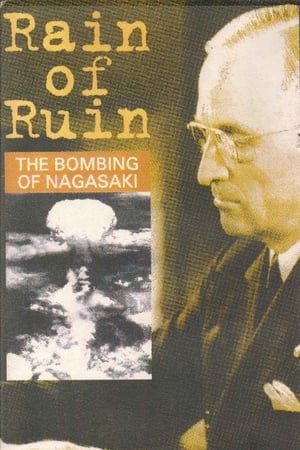
Rain of Ruin: The Bombing of Nagasaki(1995)
Status: Released
Date: 1995-08-08
0%
0 Votes
Time: 0h 56m
Overview:
Scholars and eyewitnesses provide a picture of the 75 hours between the atomic bombings of Hiroshima and Nagasaki and document the contradictions, interrelationships, and ambiguities of politics and military strategy in time of war.
Languages: English.
Countries:
United States of America
ProductionCompanies: 
Movie: Rain of Ruin: The Bombing of Nagasaki
Top 1 Billed Cast

Linda Hunt
Self - Narrator (voice)
HomePage
Overview
Scholars and eyewitnesses provide a picture of the 75 hours between the atomic bombings of Hiroshima and Nagasaki and document the contradictions, interrelationships, and ambiguities of politics and military strategy in time of war.
Release Date
1995-08-08
Average
0
Rating:
0.0 startsTagline
Genres
Languages:
EnglishKeywords
Similar Movies


82%
Night and Fog(fr)
1956-01-29
Filmmaker Alain Resnais documents the atrocities behind the walls of Hitler's concentration camps.

75%
Fascism in Colour(en)
2006-01-01
After the World War I, Mussolini's perspective on life is severely altered; once a willful socialist reformer, now obsessed with the idea of power, he founds the National Fascist Party in 1921 and assumes political power in 1922, becoming the Duce, dictator of Italy. His success encourages Hitler to take power in Germany in 1933, opening the dark road to World War II. (Originally released as a two-part miniseries. Includes colorized archival footage.)

70%
Three Minutes: A Lengthening(en)
2022-12-02
The story of the only three minutes of footage —a home movie shot by David Kurtz in 1938— showing images of the Jewish inhabitants of Nasielsk (Poland) before the beginning of the Shoah.

80%
June 1940, the Great Chaos(fr)
2010-06-14
From May 10, 1940, France is living one of the worst tragedies of it history. In a few weeks, the country folds, and then collapsed in facing the attack of the Nazi Germany. On June 1940, each day is a tragedy. For the first time, thanks to historic revelations, and to numerous never seen before images and documents and reenacted situations of the time, this film recounts the incredible stories of those men and women trapped in the torment of this great chaos.

58%
The Dead Nation(ro)
2017-08-25
A documentary-essay which shows Costică Axinte's stunning collection of pictures depicting a Romanian small town in the thirties and forties. The narration, composed mostly from excerpts taken from the diary of a Jewish doctor from the same era, tells the rising of the antisemitism and eventually a harrowing depiction of the Romanian Holocaust.

0%
Elie Wiesel Goes Home(hu)
1997-02-12
A documentary chronicling the adolescent years of Elie Wiesel and the history of his sufferings. Eliezer was fifteen when Fascism brutally altered his life forever. Fifty years later, he returns to Sighetu Marmatiei, the town where he was born, to walk the painful road of remembrance - but is it possible to speak of the unspeakable? Or does Auschwitz lie beyond the capacity of any human language - the place where words and stories run out?


80%
Liberation Diaries(it)
2025-05-06
The end of World War II brings Europe a new political system, reshapes national and personal identities. Three women from Milan, Paris and Berlin report on the days of liberation in their diaries. Their personal stories expand the historical picture and make LIBERATION DIARIES a chronicle of female self-empowerment, resistance and resilience.


66%
The Memphis Belle(en)
1944-04-13
This WW2 documentary centers on the crew of the American B-17 Flying Fortress Memphis Belle as it prepares to execute a strategic bombing raid on Nazi submarine pens in Wilhelmshaven, Germany.

56%
Price for Peace(en)
2002-05-27
This powerful and thought provoking film chronicles the compelling events in the Pacific Theater of WWII, from the bombing of Pearl Harbor in 1941 to the American occupation of Japan in 1945. It depicts the strength and courage of America's youth, while examining how these men and women dealt with being thrust into this brutal war. The film includes interviews with war veterans, both American and Japanese, from all branches of the military. It features testimony from medics, nurses, dog handlers, as well as Japanese-Americans who were imprisoned at internment camps in the United States. The film also includes a first hand account of the tragic impact of the atomic bomb on Japanese citizens. Among the veterans who appear is Zenji Abe, a Japanese veteran who flew the mission to bomb Pearl Harbor, and retired General Paul Tibbets who flew the mission to bomb Hiroshima.

0%
Classic Fighter(en)
Classic Fighter – the story of the great piston-engined fighters of World War Two. A tribute to the men who flew them, and to the men and women who guided them and kept them in the air. Made in conjunction with the Imperial War Museum, Duxford, this programme tells the story of these great war planes. Stunning air-to-air flying sequences are intercut with interviews with pilots and aircrew of the British and American air forces. Some of the fighter aircraft featured are the Supermarine Spitfire, the Hawker Hurricane, the Messerschmitt Bf109, the P-47 Thunderbolt and the P-51 Mustang.

0%
Spitfire: The Birth of a Legend(en)
2006-01-01
‘Spitfire— Birth of a Legend‘ tells the story of the Spitfire from a radical design on the drawing board to the fighter aircraft that became the symbol of Britain’s determination to fight on to victory. It celebrates the history of this acclaimed aircraft, the men who designed and built it, and those who flew and fought in it. The story, along with dramatic archive and colour film of aerial combat, graphically illustrates the appeal and fascination the Spitfire has maintained since it faced and fought the fighter and bomber formations of the Luftwaffe.

80%
Hitlers Menschenhändler: Juden als Austauschware(de)
2011-09-20
The SS chief Heinrich Himmler wanted to exchange Jews against so-called German Reich abroad, against arms sales or for cash - with the express approval of Hitler.

90%
Lise Meitner: The Mother of the Atom Bomb(de)
2013-02-02
To historians, physicist Lise Meitner deserves to be placed on a par with Einstein, Heisenberg and Otto Hahn. In the 1930s on the verge of World War II, she led a small group of scientists who discovered that splitting the atomic nucleus of uranium releases enormous energy. This extraordinary film tells the story of a woman who was far ahead of her time as a scientist and a pioneer of feminism.

75%
Willem and Frieda: Defying the Nazis(en)
2023-03-24
Willem was an artist who lived openly as a gay man at a time when few did. Frieda was a well-connected musician who became the first woman to lead an orchestra. We learn of their early lives and the selfless decisions that informed their devotion to the anti-Nazi cause, often at great personal risk. The gentle revelation of these extraordinary lives is gradually revealed through archive footage, skillfully combined with photographs and interviews with experts, journalists and family members.

70%
Art of War(en)
2009-05-03
Documentary on the main principles of Sun Tsu "Art of War" illustrated with examples from the second world war, the Vietnam war and the American civil war.

0%
Sleeping Tigers: The Asahi Baseball Story(en)
2003-04-01
After the Japanese attack on Pearl Harbor, all persons of Japanese descent in Canada were sent to internment camps. The former Asahi members survived by playing ball. Their passion was contagious and soon other players joined in, among them RCMP officials and local townspeople. As a result, the games helped break down racial and cultural barriers.

82%
Shoah(fr)
1985-04-21
Director Claude Lanzmann spent 11 years on this sprawling documentary about the Holocaust, conducting his own interviews and refusing to use a single frame of archival footage. Dividing Holocaust witnesses into three categories – survivors, bystanders, and perpetrators – Lanzmann presents testimonies from survivors of the Chelmno concentration camp, an Auschwitz escapee, and witnesses of the Warsaw Ghetto Uprising, as well as a chilling report of gas chambers from an SS officer at Treblinka.