Loading Page
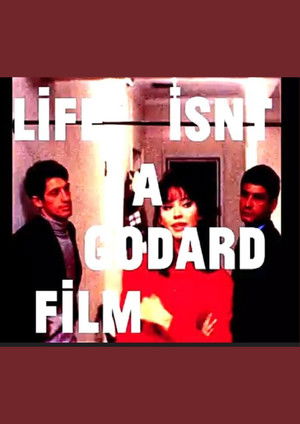
Life isn't a Godard Film(NaN)
Status: Released
Date:
100%
1 Votes
Languages: Spanish.
Countries:
Budget: $21.00
ProductionCompanies:
Jondo Films
Movie: Life isn't a Godard Film
Top 1 Billed Cast
HomePage
Overview
Release Date
Average
10
Rating:
5.0 startsTagline
Genres
Languages:
EspañolKeywords
Similar Movies

75%
The Rules of the Game(fr)
1939-07-09
A weekend at a marquis’ country château lays bare some ugly truths about a group of haut bourgeois acquaintances.

72%
Dangerous Liaisons(en)
1988-12-21
In 18th century France, Marquise de Merteuil asks her ex-lover Vicomte de Valmont to seduce the future wife of another ex-lover of hers in return for one last night with her. Yet things don’t go as planned.

75%
Moulin Rouge!(en)
2001-05-18
A celebration of love and creative inspiration takes place in the infamous, gaudy and glamorous Parisian nightclub, at the cusp of the 20th century. A young poet, who is plunged into the heady world of Moulin Rouge, begins a passionate affair with the club's most notorious and beautiful star.

66%
The Great Love(de)
1942-06-12
The attractive Oberleutnant Paul Wendlandt is stationed in North Africa as a fighter pilot. While in Berlin to deliver a report he is given a day's leave, and on the stage of the cabaret theatre "Skala" sees the popular Danish singer Hanna Holberg. For Paul it is love at first sight. When Hanna visits friends after the end of the performance, he follows her, and speaks to her in the U-Bahn. After the party in her friends' flat, he accompanies her home and chance throws them further together when an air raid warning forces them to take cover in the air raid shelter. Hanna reciprocates Paul's feelings, but after a night spent together Paul has to return immediately to the front. There now follows a whole series of misunderstandings, and one missed opportunity after another. While Hanna waits in vain for some sign of life from Paul, he is flying on missions in North Africa. When he tries to visit her in her Berlin flat, she is giving a Christmas concert in Paris.

78%
Rififi(fr)
1955-04-13
Out of prison after a five-year stretch, jewel thief Tony turns down a quick job his friend Jo offers him, until he discovers that his old girlfriend Mado has become the lover of local gangster Pierre Grutter during Tony's absence. Expanding a minor smash-and-grab into a full-scale jewel heist, Tony and his crew appear to get away clean, but their actions after the job is completed threaten the lives of everyone involved.

72%
Irreversible(fr)
2002-05-22
A woman’s lover and her ex-boyfriend take justice into their own hands after she becomes the victim of a rapist. Because some acts can’t be undone. Because man is an animal. Because the desire for vengeance is a natural impulse. Because most crimes remain unpunished.

80%
June 1940, the Great Chaos(fr)
2010-06-14
From May 10, 1940, France is living one of the worst tragedies of it history. In a few weeks, the country folds, and then collapsed in facing the attack of the Nazi Germany. On June 1940, each day is a tragedy. For the first time, thanks to historic revelations, and to numerous never seen before images and documents and reenacted situations of the time, this film recounts the incredible stories of those men and women trapped in the torment of this great chaos.

61%
Memoir of War(fr)
2017-08-17
In the last days of the Nazi-occupied France, writer Marguerite Duras awaits the return of her husband, Robert Antelme, arrested for being a Resistance fighter and then deported, while she maintains a tense relationship with her ambiguous lover and a dangerous game with a French collaborationist. Even when the Liberation arrives, she must still endure the unbearable pain of waiting.

63%
Bluebeard(fr)
1963-01-25
Paris, France, during the First World War. While thousands of soldiers die every day on the battlefields, Henri Landru, a seemingly respectable furniture dealer, married and father of four children, relentlessly feeds his own sinister factory of death.

75%
The French Revolution(fr)
1989-05-10
A history of the French Revolution beginning from the decision of the king to convene the Etats-Generaux in 1789 in order to deal with France's debt problem. Part one spans the event until August 10, 1792 (when the King Louis XVI lost all authority and was imprisoned). Part two carries the story through the end of the terror in 1794.

48%
Paul and Michelle(en)
1974-03-15
Taking place approximately three years after the events in Friends, Paul and Michelle follows the family of Paul Harrison and Michelle Latour-Harrison after they have been reunited. Paul has to cope with the difficulties he faces balancing work, college, and trying to maintain their family as well as a new love interest for Michelle.

64%
Hum Tum(hi)
2004-05-28
The encounters of two people who run into each other on several occasions under circumstances ranging from friendly to hostile to loving. Along many years and countless run-ins, the two despise each other, befriend each other, and fall in love with each other—in no particular order.

72%
Les Misérables(en)
1998-05-01
In 19th century France, Jean Valjean, a man imprisoned for stealing bread, must flee a relentless policeman named Javert. The pursuit consumes both men's lives, and soon Valjean finds himself in the midst of the student revolutions in France.


77%
Orpheus(fr)
1950-09-29
A famous poet in postwar Paris, scorned by the Left Bank youth, is in love with both his wife Eurydice and a mysterious princess. Seeking inspiration, the poet becomes obsessed and follows the princess from the world of the living to the land of the dead.

67%
Diva(fr)
1981-03-11
Jules, a young Parisian postman, secretly records a concert performance given by the opera singer Cynthia Hawkins, whom he idolises. The following day, Jules runs into a woman who is being pursued by armed thugs. Before she is killed, the woman slips an audio cassette into his mail bag...

65%
The Nasty Girl(de)
1990-02-15
When a young woman investigates her town's Nazi past, the community turns against her.

53%
The Lady Banker(fr)
1980-08-27
Ambitious Emma Eckhert successfully makes her way into a world previously reserved for men: that of high finance. She quickly becomes popular with small savers, but leads a scandalous life that will cost her.

62%
Coup de Chance(fr)
2023-09-15
Fanny and Jean have everything of an ideal couple: fulfilled in their professional life, they live in a magnificent apartment in the beautiful districts of Paris and seem to be in love as on the first day. But when Fanny crosses, by chance, Alain, a former high school friend, she is immediately capsized. They see each other again very quickly and get closer and closer.

0%
Paris Train Stations: Shaping the City(fr)
2020-10-21
Every day, Paris’ six railway stations welcome over 3,000 trains and more than a million travelers coming from France and all over Europe. The stations’ sizes are impressive: Gare du Nord is bigger than the Louvre or Notre-Dame de Paris. These railway stations are architectural landmarks and a model of urban planning despite the radical changes they’ve undergone since their construction in the middle of the 19th century. How did the railway stations manage to absorb the boom of travelers in just a few decades? What colossal works were necessary to erect and then modify these now essential buildings? From the monumental glass walls of Gare du Nord to the iconic tower of Gare de Lyon, to the first-ever all-electric train station, each has its own story, technical characteristics, and well-defined urban image.