
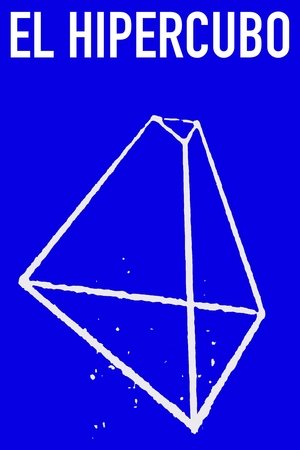
El hipercubo(1986)
Based on the thesis of Alejandro Rivero and Ernesto Pacheco, this documentary attempts to glimpse, through the senses, the fourth mathematical dimension.
Movie: El hipercubo
Top 4 Billed Cast
HomePage
Overview
Based on the thesis of Alejandro Rivero and Ernesto Pacheco, this documentary attempts to glimpse, through the senses, the fourth mathematical dimension.
Release Date
1986-01-01
Average
0
Rating:
0.0 startsTagline
Genres
Languages:
EspañolKeywords
Similar Movies

NOVA: The Great Math Mystery(en)
NOVA leads viewers on a mathematical mystery tour -- a provocative exploration of math's astonishing power across the centuries. We discover math's signature in the swirl of a nautilus shell, the whirlpool of a galaxy and the spiral in the center of a sunflower. Math was essential to everything from the first wireless radio transmissions to the prediction and discovery of the Higgs boson and the successful landing of rovers on Mars. But where does math get its power? Astrophysicist and writer Mario Livio, along with a colorful cast of mathematicians, physicists and engineers, follows math from Pythagoras to Einstein and beyond, all leading to the ultimate riddle: Is math an invention or a discovery? Humankind's clever trick or the language of the universe?

The Genius of George Boole(en)
Narrated by Oscar-winning actor Jeremy Irons, The Genius of George Boole assembles academics and industry leaders from across the globe to explore the life and importance of one of the world’s greatest unsung heroes.

Clouds Are Not Spheres(en)
Until recently geometry was 'cold', incapable of describing the irregular shape of a cloud, the slope of a mountain or the beauty of the human body. With fractal geometry, Benoit Mandelbrot gave us a language for our natural world. In this captivating documentary, the man himself explains this groundbreaking discovery.

M. C. Escher: Journey to Infinity(nl)
A portrait of the visionary Dutch artist M. C. Escher (1898-1972), according to his own words, taken from his diary, his correspondence and the texts of his lectures.

Secrets of the Surface: The Mathematical Vision of Maryam Mirzakhani(en)
Filmed in Canada, Iran, and the United States, Secrets of the Surface: The Mathematical Vision of Maryam Mirzakhani examines the life and mathematical work of Maryam Mirzakhani, an Iranian immigrant to the United States who became a superstar in her field. In 2014, she was both the first woman and the first Iranian to be honored by mathematics' highest prize, the Fields Medal. Mirzakhani's contributions are explained by leading mathematicians and illustrated by animated sequences. Her mathematical colleagues from around the world, as well as former teachers, classmates, and students in Iran today, convey the deep impact of her achievements. The path of her education, success on Iran's Math Olympiad team, and her brilliant work, make Mirzakhani an ideal role model for girls looking toward careers in science and mathematics. Written by George Csicsery


Black Holes: The Edge of All We Know(en)
Black holes stand at the limit of what we can know. To explore that edge of knowledge, the Event Horizon Telescope links observatories across the world to simulate an earth-sized instrument. With this tool the team pursues the first-ever picture of a black hole, resulting in an image seen by billions of people in April 2019. Meanwhile, Hawking and his team attack the black hole paradox at the heart of theoretical physics—Do predictive laws still function, even in these massive distortions of space and time? Weaving them together is a third strand, philosophical and exploratory using expressive animation. “Edge” is about practicing science at the highest level, a film where observation, theory, and philosophy combine to grasp these most mysterious objects.

La Costante di Archimede(it)

Outside In(en)
The computer animation Outside In explains the amazing discovery, made by Steve Smale in 1957, that a sphere can be turned inside out by means of smooth motions and self-intersections. Through a combination of dialogue and exposition accessible to anyone who has some interest in mathematics, Outside In builds up to the grand finale: Bill Thurston's "corrugations" method of turning the sphere inside out.

The Last Artifact(en)
Just outside Paris, France, inside a high-tech vault, requiring three independently controlled keys, rests a small metallic cylinder about the diameter of a golf ball. Encased within three vacuum-sealed bell jars it may not look like much, but it is one of the most important objects on the planet. It affects nearly every aspect of our lives from the moment we are born, to the food we eat, the cars we drive, and even the medicines we take. The Last Artifact follows the high-stakes race to redefine the weight of the world reveals the untold story of one of the most important objects on the planet. The kilogram, the base unit of mass in the International System of Units, helped send humans to the moon and satellites into space. This small hunk of metal is the object against which all others are measured. Yet over time, its mass mysteriously eroded by the weight of an eyelash. A change that, unbeknownst to most, unleashed a crisis with potentially dire consequences.

Eliyahu Rips: The Burning(en)
In April 1969 Ilya (Eliyahu) Rips, then a young student of mathematics, tried to burn himself in a public square in Riga, Latvia protesting against the Soviet invasion of Czechoslovakia. He was stopped and eventually sent to a psychiatric hospital for two years. Thanks to international pressure from the mathematical community in 1972 he was allowed to emigrate to Israel. Now he is considered one of the most brilliant mathematicians in the world. At the same time, for most people familiar with his name, Rips is first of all associated with the development of the so called Bible Code – a mathematical program allegedly helping to decipher hidden messages encoded in Torah – the Five Books of Moses. He is attacked by both the scientific and religious community, yet his research continues.

The End of Quantum Reality(en)
Almost one hundred years ago, the project to reduce the world to mathematical physics failed suddenly and completely: “One of the best-kept secrets of science,” physicist Nick Herbert writes, “is that physicists have lost their grip on reality.” The world, we are now told, emerges spontaneously, out of “nothing,” and constitutes a “multiverse,” where “anything that can happen will happen, and it will happen an infinite number of times.” Legendary reclusive genius Wolfgang Smith demonstrates on shockingly obvious grounds the dead end at which physics has arrived, and how we can “return, at last, to the real world.” The End of Quantum Reality introduces this extraordinary man to a contemporary audience which has, perhaps, never encountered a true philos-sophia, one as intimately at ease with the rigors of quantum physics as with the greatest schools of human wisdom.

Cern and the Sense of Beauty(it)
An exploration of the link between science and beauty through the work of scientists at CERN, in Geneva.

Free Will(en)
An in-depth investigation featuring world renowned philosophers and scientists into the most profound philosophical debate of all time: Do we have free will?

What is the Theory of Relativity?(ru)
In a compartment of the Moscow-Novosibirsk train, a young physicist meets famous film actors. The conversation accidentally comes to Einstein, and the woman begins to explain to her fellow travelers what the theory of relativity is. The actors are incidentally on their way to the shooting of a film about physicists, but they do not understand the subject at all.

The Occult Philosophy(de)
An attempt to visualize a secret knowledge about the nature of man —a philo-clip—, through the use of structures of dissociated geometry and laser beams, with direct references to the Renaissance, Leonardo da Vinci and the work of Agrippa von Nettesheim.


The Standard Deviants: The Many-Sided World of Geometry, Part 1(en)
Every year, millions of high school and college students walk into their first geometry class thinking: "Circles and squares. How tough can it be?" Then they encounter the postulates, statements and theorems! But have no fear, our simple, straightforward format will help students understand and make sense of geometry.

The Standard Deviants: The Twisted World of Trigonometry, Part 2(en)
Part 2 starts off with a quick review of graphing as well as sine, cosine and tangent. From there, this video charts new territory as we dive into amplitude, curves, double-angle formulas, sum-to-product-formulas and identities. Using computer graphics and animation, the Standard Deviants illustrate these complicated concepts far better than any blackboard!

The Standard Deviants: The Twisted World of Trigonometry, Part 1(en)
This edition of Trigonometry includes such topics as radians, the special angles, right triangles, the Pythagorean Theorem, sine, cosine, tangent, law of cosines and law of sines.