Loading Page

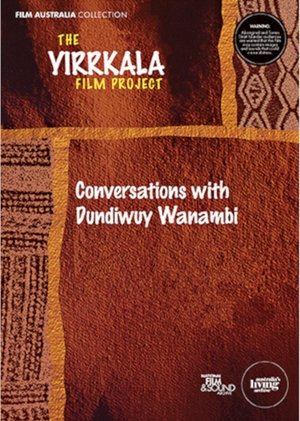
Yirrkala: Conversations with Dundiwuy Wanambi(1995)
Status: Released
Date: 1995-01-01
0%
0 Votes
Overview:
Yirrkala is an Aboriginal township on the Gove Peninsula in Northeast Arnhem Land. It was established as a Methodist mission in 1935 and over the years Yolngu from many different clans moved there. Conversations With Dundiwuy Wanambi is a personal film which reveals something of the struggles and thoughts of one elder in the face of enormous change. In the early years Dundiwuy was a heavy drinker. In a disturbing interview in a pub, Dundiwuy explains his reasons for drinking. Then, through a dream, Dundiwuy realizes he must begin to protect his family and clan. He establishes his Marrakulu clan homeland center at Gurka'wuy, south of Yirrkala. He will hold a great ceremony there. Years later Dundiwuy returns to Yirrkala. His clan is small and he did not receive the necessary support from his sons. But Dundiwuy endures, continues his struggle, and we learn in the post-script of how he has become a successful and sought-after artist.
Languages: English.
Countries:
Australia
Movie: Yirrkala: Conversations with Dundiwuy Wanambi
HomePage
Overview
Yirrkala is an Aboriginal township on the Gove Peninsula in Northeast Arnhem Land. It was established as a Methodist mission in 1935 and over the years Yolngu from many different clans moved there. Conversations With Dundiwuy Wanambi is a personal film which reveals something of the struggles and thoughts of one elder in the face of enormous change. In the early years Dundiwuy was a heavy drinker. In a disturbing interview in a pub, Dundiwuy explains his reasons for drinking. Then, through a dream, Dundiwuy realizes he must begin to protect his family and clan. He establishes his Marrakulu clan homeland center at Gurka'wuy, south of Yirrkala. He will hold a great ceremony there. Years later Dundiwuy returns to Yirrkala. His clan is small and he did not receive the necessary support from his sons. But Dundiwuy endures, continues his struggle, and we learn in the post-script of how he has become a successful and sought-after artist.
Release Date
1995-01-01
Average
0
Rating:
0.0 startsTagline
Genres
Languages:
EnglishKeywords
Similar Movies

61%
The Judge(en)
2017-09-10
A verité legal drama about Judge Kholoud Al-Faqih, the first woman appointed to a Shari'a court in the Middle East, whose career provides rare insights into both Islamic law and gendered justice.

0%
My Pride(fr)
2020-01-24
Spontaneous portrait of an endearing and cheerful teenager living in balance between traditionalism and modernity. She presents her regalia to us and we share her pride in being Innu.


76%
Cowspiracy: The Sustainability Secret(en)
2014-07-01
Follow the shocking, yet humorous, journey of an aspiring environmentalist, as he daringly seeks to find the real solution to the most pressing environmental issues and true path to sustainability.

90%
Im Reich Des Squatters(de)
2020-04-20

70%
The Giants(en)
2023-04-20
A portrait of environmental folk hero & gay icon Bob Brown, who took green politics to the center of power. His story is interwoven with the life cycle of the ancient trees he's fighting for.

78%
Little Girl(fr)
2020-09-25
7-year-old Sasha has always known that she is a girl. Sasha’s family has recently accepted her gender identity, embracing their daughter for who she truly is while working to confront outdated norms and find affirmation in a small community of rural France.

0%
Québec...?(fr)
1967-01-01
This short documentary film is a fascinating portrait of urban and rural Quebec in the late 1960s, as the province entered modernity. The collective work produced for the Quebec Ministry of Industry and Commerce calls on several major Quebec figures.

0%
Hacking at Leaves(en)
2024-04-06
Hacking at Leaves documents artist and hazmat-suit aficionado Johannes Grenzfurthner as he attempts to come to terms with the United States' colonial past, Navajo tribal history, and the hacker movement. The story hones in on a small tinker space in Durango, Colorado, that made significant contributions to worldwide COVID relief efforts. But things go awry when Uncle Sam interferes with the film's production.

80%
Phantasia(xx)
2024-03-13
X-ray images were invented in 1895, the same year in which the Lumière brothers presented their respective invention in what today is considered to be the first cinema screening. Thus, both cinema and radiography fall within the scopic regime inaugurated by modernity. The use of X-rays on two sculptures from the Bilbao Fine Arts Museum generates images that reveal certain elements of them that would otherwise be invisible to our eyes. These images, despite being generally created for technical or scientific purposes, seem to produce a certain form of 'photogénie': they lend the radiographed objects a new appearance that lies somewhere between the material and the ethereal, endowing them with a vaporous and spectral quality. It is not by chance that physics and phantasmagoria share the term 'spectrum' in their vocabulary.


0%
Attiuk(fr)
1963-07-19
The people of Unamenshipu (La Romaine), an Innu community in the Côte-Nord region of Quebec, are seen but not heard in this richly detailed documentary about the rituals surrounding an Innu caribou hunt. Released in 1960, it’s one of 13 titles in Au Pays de Neufve-France, a series of poetic documentary shorts about life along the St. Lawrence River. Off-camera narration, written by Pierre Perrault, frames the Innu participants through an ethnographic lens. Co-directed by René Bonnière and Perrault, a founding figure of Quebec’s direct cinema movement.

80%
The Bounty Hunter of Mongolia(fr)
2021-10-30
In the Darhat valley in northern Mongolia, the horses of nomadic tribes are stolen by bandits who then sell them to Russian slaughterhouses. Shukhert, a brave horseman, relentlessly pursues them through the Mongolian taiga, bordering Siberia.

100%
Gerboise Bleue(fr)
2009-02-11
"Gerboise bleue", the first French atomic test carried out on February 13, 1960 in the Algerian Sahara, is the starting point of France's nuclear power. These are powerful radioactive aerial shots carried out in areas belonging to the French army. Underground tests will follow, even after the independence of Algeria. From 1960 to 1978, 30,000 people were exposed in the Sahara. The French army was recognized recognized nine irradiations. No complaint against the army or the Atomic Energy Commission has resulted. Three requests for a commission of inquiry were rejected by the National Defense Commission. For the first time, the last survivors bear witness to their fight for the recognition of their illnesses, and revealed to themselves in what conditions the shootings took place. The director goes to the zero point of "Gerboise Bleue", forbidden access for 47 years by the Algerian authorities

62%
South(en)
2020-02-17
What kind of power is accessible through the discovery of a voice? Morgan Quaintance interlinks two anti-racist and anti-authoritarian liberation movements in South London and Chicago’s South Side with his own biography to explore what happens when speech is ignored, and the voice fades.

69%
Atomic Homefront(en)
2017-11-17
Revealing St. Louis, Missouri's atomic past as a uranium processing center for the atomic bomb and the governmental and corporate negligence that lead to the illegal dumping of Manhattan Project radioactive waste throughout North County neighborhoods.

0%
Amazonia Inc(en)
2019-01-01
This documentary explores an unknown civilization of the Brazilian Amazon, who risk their lives to protect their forest. In order to save the exploitation of the environment by big corporations, they have to create legal institutions.

69%
The Pearl Button(es)
2015-10-15
The ocean contains the history of all humanity. The sea holds all the voices of the earth and those that come from outer space. Water receives impetus from the stars and transmits it to living creatures. Water, the longest border in Chile, also holds the secret of two mysterious buttons which were found on its ocean floor. Chile, with its 2,670 miles of coastline and the largest archipelago in the world, presents a supernatural landscape. In it are volcanoes, mountains and glaciers. In it are the voices of the Patagonian Indigenous people, the first English sailors and also those of its political prisoners. Some say that water has memory. This film shows that it also has a voice.

100%
The Sun Queen(en)
2023-04-04
Chemical engineer and inventor Maria Telkes worked for nearly 50 years to harness the power of the sun, designing and building the world's first successful solar-heated modern residence and identifying a new chemical that could store solar heat like a battery. Telkes was undercut and thwarted by her (male) boss and colleagues at MIT, but she persevered. Upon her death in 1995 Telkes held more than 20 patents, and now she is recognized as a visionary pioneer in the field of sustainable energy whose work continues to shape how we power our lives today.