Loading Page
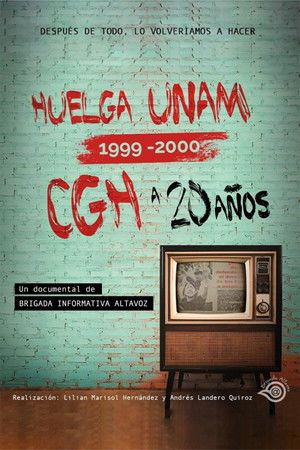
Huelga UNAM 1999 - 2000: CGH a 20 Años(2019)
Status: Released
Date: 2019-10-27
0%
0 Votes
Article 3: All education provided by the State shall be free of charge.
Overview:
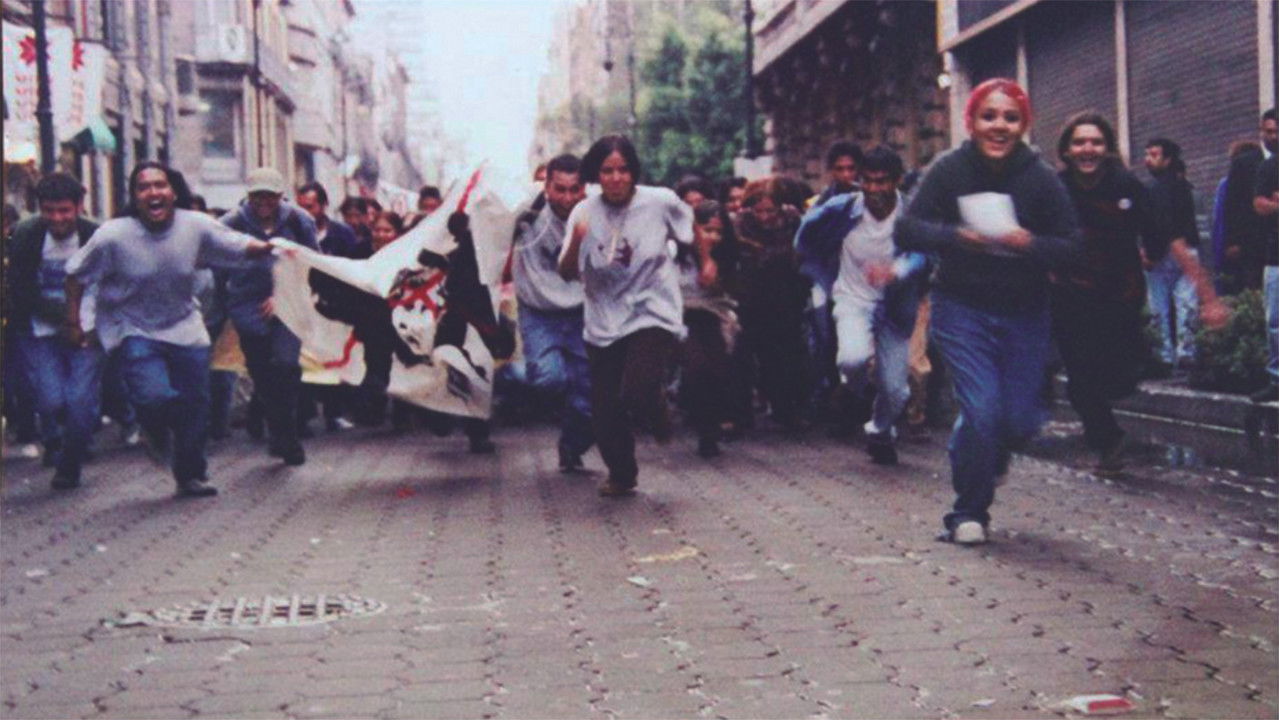
Faced with attempts to privatize public education, the General Strike Council (CGH) brings Latin America's largest university to a standstill. The goal is clear: to keep UNAM free, facing as its main obstacles media lynching, internal divisions, and imminent federal repression. A chronicle of ten months of the largest student strike in Mexico's history.
Languages: Spanish.
Countries:
Mexico
ProductionCompanies:
Brigada Informativa Altavoz
Movie: Huelga UNAM 1999 - 2000: CGH a 20 Años
Top 10 Billed Cast
Leda Silva Victoria
Self

Marjory González Vivanco
Self
Sayuri Herrera Román
Self
Ernesto Armada Ramírez
Self

Joaquín López Millán
Self
Jesús Lozano Ruiz
Self
Salvador Hernández
Self
Ricardo Pérez Flores
Self

Alejandro Echavarría "El Mosh"
Self (archive footage)

Ernesto Zedillo
Self (archive footage)
HomePage
Overview
Faced with attempts to privatize public education, the General Strike Council (CGH) brings Latin America's largest university to a standstill. The goal is clear: to keep UNAM free, facing as its main obstacles media lynching, internal divisions, and imminent federal repression. A chronicle of ten months of the largest student strike in Mexico's history.
Release Date
2019-10-27
Average
0
Rating:
0.0 startsTagline
Article 3: All education provided by the State shall be free of charge.
Genres
Languages:
EspañolKeywords
Similar Movies

0%
Axolotl(es)
2025-05-14
Through a choral diversity of testimonies, the documentary explores the myth of the axolotl, transporting us from the story of a chinampero whose lifestyle reflects the environmental decay of Mexico City, to the efforts of a group of scientists racing against the consequences of the extinction of our symbols and ecological heritage.

0%
The Mermaid(es)
2024-08-21
A trip that the author makes to a distant beach trying to find the place where his grandfather made a painting years ago.


0%
Jaripeo(en)
2026-01-25
Set against the vibrant spectacle of the jaripeo, a symbol of Mexican cowboy tradition and machismo, this story unveils a hidden world of queer desire and quiet rebellion. As glances and gestures disrupt the rigid norms of masculinity, the rodeo becomes a stage for our protagonists to navigate identity, community, and the search for belonging in an oppressively traditional space.

0%
TRANSIT(de)
2010-09-30
In this documentary Angela Zumpe searches for traces of her brother, who moved from west to east Germany in 1968 to live in the DDR but killed himself eight months after.

0%
ALHIVE(es)
2024-10-18
One morning, Leonardo Galicia wakes up with a dull pain and an intense fever. After a pandemic experience that made him aware of his mortality, the last thing Leonardo expected was an HIV-reactive result. The illness caused by the virus takes hold of Leonardo's body and forces him to take an indefinite break while recovering in a hospital. There, he meets a mysterious young man, Augusto. By sharing common thoughts, hopes, and dreams, the two will find refuge in each other's arms.

0%
We Are Still Here(es)
2018-10-02
Ana and Claudia get trapped in a bathroom during the military occupation of the university. Claudia is caught by a soldier, leaving Ana alone for days in the bathroom, trying to survive and find hope. Based on the experiences of Alcira Soust during the military occupation of Ciudad Universitaria during the movements of 1968.

57%
SnowwhiteRosered(de)
1991-10-24
Documentary about the twin sister Jutta and Gisela Schmidt. In the late sixties the two women rebelled against middle class society as if they gave vent to a new kind of art. They became active in the underground communist party KPD and showed a heart-felt interest in the colour red, the aesthetics of the revolution. Soon, though, the twins quit their experiments in Germany. They left their husbands and went to Rome, where they met the fabulously wealthy Paul Getty III, and soon things got really out of hand.

0%
The Black Dog(es)
2023-07-26
Since Rosa was little, people used to say around town that her grandfather was a black dog. The legend, belonging to the Valley of Oaxaca, spoke of a man who had the ability to turn into a black dog and roam the streets at night. Through images of the town, interviews with the brothers and animated interventions, the documentary tells the story of the myth and its importance in the collective memory.

50%
Ayotzinapa(es)
2015-06-19
This film is a story, testimony and documentation of the forced disappearance of 43 student teachers, which exposes the criminal complicity between the police and military authorities, between the political and economic elites and criminal organizations in Mexico, which appear to be different forces, but respond to similar interests.

0%
One Way Trip(es)
2020-10-12
Two young women try to adapt to a new city: nostalgia, loneliness, friendship and family are mixed throughout the emotional process of both characters. A reflection on the sense of belonging and the experience of being a foreigner.

0%
Sports(ja)
1932-07-15
The film is about a protest provoked when the university decided to restrict access to sports facilities to athletes, cutting out all other students. This is, strictly speaking, not a Prokino film. It was produced by the Waseda University Film Circle, which was organized by Kawazoe Shiro. Feature film directors Yamamoto Satsuo and Taniguchi Senkichi were apparently students at Waseda at the time and participated in the production.

69%
The Shout(es)
1968-12-12
In the summer of revolt 1968, student Leobardo López Aretche captured the protests in Mexico City, and the state’s brutal response, up close – and like many of his subjects and fellow comrades, would pay a high price for his audacity. Fifty years later, his movie is no longer a secret.

70%
When a City Rises(cn)
2021-04-23
Behind the gas masks of Hong Kong’s democracy movement, the often very young activists are just as diverse as the youths of the rest of the world. But they share a demand for democracy and freedom. They have the will and the courage to fight – and they can see that things are going in the wrong direction in the small island city, which officially has autonomy under China but is now tightening its grip and demanding that ‘troublemakers’ be put away or silenced. Amid the violent protests, we meet a 21-year-old student, a teenage couple and a new father.

0%
De Quanta Terra Precisa o Homem?(pt)
2022-10-20
The unlikely encounter between Eduardo Moreira, a former banker, and the MST, the main social movement for agrarian reform in Latin America.

0%
Road Not Taken(zh)
2016-12-10
After the failed Umbrella Revolution in 2014, lives go back to normal, but the scenes of the great protest are like yesterday for Billy and Popsy, students in the University of Hong Kong who took part in the movement. One of them now becomes a student leader, while the other chooses a low-profile life as a private tutor. Amid the rapid social changes, when the Communist Beijing government is extending their influence to Hong Kong to take away the freedom and democracy, how would the youths see their future? Do they still see hopes, when both peaceful protests and radical actions seem to be futile?


0%
Copal Dreams(es)
2019-06-05
The communities of San Martin Tilcajete and San Antonio Arrazola in Oaxaca, Mexico are best known for being the main source of the "Alebrijes" (wood carving) in the state; a relatively new but powerful tradition in mexican folklore. In both communities, there is a family that claims they're father started this tradition in all the state of Oaxaca.