
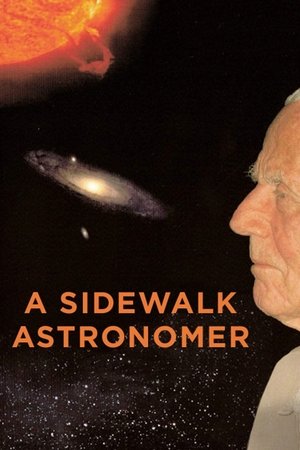
A Sidewalk Astronomer(2005)
A film about Astronomy, Cosmology, & John Dobson.
John Dobson, an 89 year old with a white ponytail and knack for comedy, is the inventor of the Dobsonian telescope mount, which revolutionized astronomy by making large, inexpensive telescopes and deep space observing available to amateur astronomers around the world.
Movie: A Sidewalk Astronomer
HomePage
Overview
John Dobson, an 89 year old with a white ponytail and knack for comedy, is the inventor of the Dobsonian telescope mount, which revolutionized astronomy by making large, inexpensive telescopes and deep space observing available to amateur astronomers around the world.
Release Date
2005-04-22
Average
0
Rating:
0.0 startsTagline
A film about Astronomy, Cosmology, & John Dobson.
Genres
Languages:
EnglishKeywords
Similar Movies

The Mystery of Chaco Canyon(en)
Chaco Canyon, located in northwest New Mexico, is perhaps the only site in the world constructed in an elaborate pattern that mirrors the yearly cycle of the sun and the 19-year cycle of the moon. How did an ancient civilization, with no known written language, arrange its buildings into a virtual celestial calendar, spanning an area roughly the size of Ireland?

Cielo(en)
The first feature from Alison McAlpine is a dialogue with the heavens—in this case, the heavens above the Andes and the Atacama Desert in northern Chile, where she alights on the desert- and mountain-dwelling astronomers, fishermen, miners, and cowboys who live their lives with reverence and awe for the skies.

Prehistoric Astronomers(en)
Cave paintings and lunar calendars exist in the caves and remains of prehistoric hunters studied recently. What if Prehistoric Man were clever enough to develop in depth scientific knowledge? As unlikely as it may seem, new data tend to prove that Prehistoric Man actually invented Astronomy!

Shadow Chasers(fr)
This feature-length documentary is a portrait of eclipse chasers, people for whom solar eclipses - among nature's more spectacular phenomena – are a veritable obsession. The film follows 4 of them as they travel incredible distances to witness the last total eclipse of the millennium as it sweeps eastward across Europe to India. At various points along the way enthusiasts Alain Cirou in France, Paul Houde in Austria, Olivier Staiger in Germany and Debasis Sarkar in India offer their impressions of the historic event.

Searching for Planet 9(fr)
At the edge of our solar system supposedly lies an immense planet. Five to ten times the size of the Earth. Several international teams of scientists have been competing in a frantic race to detect it, in uncharted territories, far beyond Neptune. The recent discovery of several dwarf planets, with intriguing trajectories, have put astronomers on the trail of this mysterious planet. Why is this enigmatic planet so difficult to detect? What would a ninth planet teach us about our corner of the universe? Could it help us unlock some of the mysteries of our solar system?

Wonders of the Moon(en)
Documentary which uses the latest, most detailed imagery to reveal the monthly life cycle of the moon. From Wales to Wyoming, Hong Kong to Croydon, the programme finds out how the moon shapes life on Earth, as well as exploring its mysterious dark side and discovering how the moon's journey around Earth delivers one of nature's most awe-inspiring events - a total solar eclipse. And at the end of a remarkable year of lunar activity, we find out why so many supermoons have been lighting up the night sky.

Passage of Venus(fr)
Photo sequence of the rare transit of Venus over the face of the Sun, one of the first chronophotographic sequences. In 1873, P.J.C. Janssen, or Pierre Jules César Janssen, invented the Photographic Revolver, which captured a series of images in a row. The device, automatic, produced images in a row without human intervention, being used to serve as photographic evidence of the passage of Venus before the Sun, in 1874.

What on Earth is Wrong With Gravity(en)
That might seem a bizarre statement, coming a century after Einstein showed that gravity is the result of matter warping space and time around it.

From the Atoms to the Stars(fr)
An incredible travel through space and time between the walls of the Paris Observatory, which is celebrating its 350th birthday. Place of discoveries such as speed of light or Neptune’s existence, it is still today one of the oldest operating observatories and the greatest hub in the world for astronomy and astrophysics researches, second only to Harvard.

Solar Odyssey(fr)
Europe and the United States are working together on an unprecedented journey to learn more about the impact of the Sun on our planet, to really know what its atmosphere is like and how it affects our environment; since solar radiation increasingly affects our lives and telecommunications.

Chasing the Equinox(en)
The ancients hid the secrets of their incredible knowledge of astronomy in their temples and palaces, built to align with the sun, on the same day, all over the world. Revealing our species' obsession with the sun, across thousands of years and every continent, this is architectural magic on a cosmic scale.

Margherita. La voce delle stelle(it)

Black Holes: Messages from the Edge of the Universe(de)
It is the birth of neutrino astronomy. For the first time, astrophysicists can detect extra-terrestrial neutrinos in ice on the South Pole. The fundamental questions of science remain unanswered., how did the universe come to be? What keeps our world together? The newly discovered extra-galactic neutrinos may hold the keys to answering these questions.

Alien Planets Revealed(en)

The UFO Movie THEY Don't Want You to See(en)
In an age when misinformation, alternative facts, and conspiracy theories have become mainstream, UFOs have risen to become one of the most-talked about pop culture phenomena. With all of this noise, how can we expect anyone to know how much of this is true? What is in our skies? What do we know, and how do we know it? And most importantly: Are we being visited?

Star Men(en)
Four exceptional astronomers celebrate 50 years of work and friendship on a return road trip in the southwestern United States, recapturing youthful adventures and recounting each other's influences on the most exciting period in astronomy’s history. Roger the instrument-maker, Donald the theoretician, Nick the visionary, and Wal the observer. Together they represent the most productive period astronomy has ever had. They helped build the world’s biggest observatories and made revolutionary discoveries about the evolving universe, discoveries that have the power to change the way humanity sees itself. Alison Rose’s film is a funny, insightful, humbling and intimate portrait of friendship, as the men reflect on how their profound work on the universe has reflected back on the individual, affecting their sense of religious faith, how life may have purpose, and what is knowable and unknowable.

Pythéas, l'astronome voyageur(fr)

Stargazing Challenges(en)
Blue Peter presenters Helen Skelton and Barney Harwood want to learn more about the solar system so they challenge scientists Helen Czerski and Jem Stansfield to find out more. They look at how to make telescopes and rockets, and use a toilet roll to measure the distances between planets.


Mythscape: Remembering The End Of The World(en)
Based on more than two decades of systematic research and cross-cultural comparison by comparative mythologist David Talbott, Remembering the End of the World reconstructs a cosmic drama when planets hung in the sky close to the earth–an epoch of celestial wonder giving way to overwhelming terror. This highly visual presentation offers new answers to enigmas that have baffled experts for centuries. Why did every ancient civilization celebrate a former “Age of the Gods”, an age claimed to have ended in earth threatening disaster? What was meant by the lost “Golden Age?” Why did ancient sky worshipers refer to Saturn as “the sun?” Why was Venus worshiped as the “Mother Goddess?” And why did both Old and New World astronomers celebrate the planet Mars as a great warrior whose battles shook the heavens?