Loading Page

A Sense of Loss(1973)
Status: Released
Date: 1973-01-01
0%
0 Votes
Time: 2h 15m
Overview:
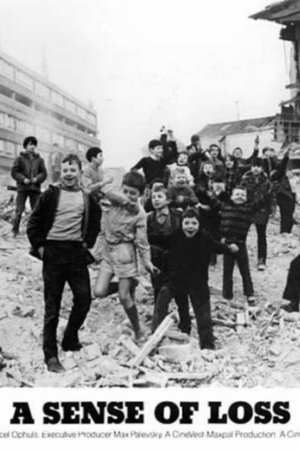
Shot over six weeks in December 1971, and January 1972, the film consisted of interviews with Protestants, Catholics, politicians, and some soldiers, combined with TV news clips of bombings and violence. The deaths of four individuals formed the central focus of the film, which Ophüls described as ‘an old, middle-aged, humanistic, social-democratic attempt to give people an idea that life after all is not that cheap’. The BBC refused to transmit the completed film on the grounds that it was ‘too pro-Irish’ (Sunday Times, 5 Nov. 1972). (via http://cain.ulst.ac.uk/othelem/media/docs/freespeech.htm)
Languages: English, French.
Countries:
Ireland,
Switzerland,
United States of America
ProductionCompanies:
Maxpal
Movie: A Sense of Loss
Top 4 Billed Cast
Bernadette Devlin
Self
HomePage
Overview
Shot over six weeks in December 1971, and January 1972, the film consisted of interviews with Protestants, Catholics, politicians, and some soldiers, combined with TV news clips of bombings and violence. The deaths of four individuals formed the central focus of the film, which Ophüls described as ‘an old, middle-aged, humanistic, social-democratic attempt to give people an idea that life after all is not that cheap’. The BBC refused to transmit the completed film on the grounds that it was ‘too pro-Irish’ (Sunday Times, 5 Nov. 1972). (via http://cain.ulst.ac.uk/othelem/media/docs/freespeech.htm)
Release Date
1973-01-01
Average
0
Rating:
0.0 startsTagline
Genres
Languages:
EnglishFrançaisKeywords
Similar Movies


55%
The Bubble(en)
2018-07-12
Diving deep into the true causes of the Great Recession, the financial crisis of the 2010s, renowned economists, investors and business leaders explain what America is facing if we don't learn from our past mistakes. Is the economy really improving or are we just blowing up another Bubble?

71%
The Final Year(en)
2018-01-19
Featuring unprecedented access inside the White House and State Department, The Final Year offers an uncompromising view of the inner workings of the Obama Administration as they prepare to leave power after eight years.

67%
The Brave Class(es)
2017-06-02
Three college students start a social experiment to prove that reality changes according to the words we use to describe it. Through research, activist actions, and artistic interventions, they analyze the importance of language in the way we understand the world. The documentary includes analysis from more than 20 international experts and leaders in the fields of political communication and information.

70%
The Red Princess(fr)
2022-04-04
Who is Kim Yo-jong? In a context of maximum tensions between North Korea and the United States, Pierre Haski paints an unprecedented portrait of the little sister of Kim Jong-un, whose influence in Pyongyang is growing stronger day by day.

75%
Fascism in Colour(en)
2006-01-01
After the World War I, Mussolini's perspective on life is severely altered; once a willful socialist reformer, now obsessed with the idea of power, he founds the National Fascist Party in 1921 and assumes political power in 1922, becoming the Duce, dictator of Italy. His success encourages Hitler to take power in Germany in 1933, opening the dark road to World War II. (Originally released as a two-part miniseries. Includes colorized archival footage.)

0%
American Crusaders(en)
2007-01-01
A harrowing exploration of the rapid rise of American religious fanaticism after 9/11. This film explores an emerging ultra Right Wing mass movement seeking dominion over all aspects of contemporary American society. The film weaves archival video, contemporary Christian Nationalist movement propaganda (recruiting videos, apocalyptic/military videogame imagery, etc.) and original investigative material) to create an intense examination of the totalistic mindset and its will to power.

66%
The 50 Year Argument(en)
2014-06-07
Follows the waves of literary, political, and cultural history as charted by the The New York Review of Books, America’s leading journal of ideas for over 50 years. Provocative, idiosyncratic and incendiary, the film weaves rarely seen archival material, contributor interviews, excerpts from writings by such icons as James Baldwin, Gore Vidal, and Joan Didion along with original verité footage filmed in the Review’s West Village offices.

10%
Leninland(ru)
2013-11-30
At the peak of Perestroika, in 1987, in the village of Gorki, where Lenin spent his last years, after a long construction, the last and most grandiose museum of the Leader was opened. Soon after the opening, the ideology changed, and the flow of pilgrims gradually dried up. Despite this, the museum still works and the management is looking for ways to attract visitors. Faithful to the Lenin keepers of the museum as they can resist the onset of commercialization. The film tells about the modern life of this amazing museum-reserve and its employees.

59%
Home Movies(en)
2017-07-09
In this home movie collection of gay men, memory serves as an act of hope, power, and above all, resilience.

100%
Countdown to Eternity(en)
1999-01-01
Bible expert Bill Gallatin explores biblical prophecies from the Book of Revelation that have transpired, with a discussion of whether these events signify that we are now living in the End Times preceding the return of Jesus Christ. Gallatin touches on events such as the increasingly acute difficulties in the Middle East, numerous environmental catastrophes, earthquakes and more, explaining how they connect to scriptural writings.

80%
Orange Revolution(en)
2007-04-01
Filmmaker Steve York explores the controversial 2004 Ukrainian presidential election, during which candidate Viktor Yushchenko suffered a near-fatal poisoning and his unpopular opponent, Viktor Yanukovych, was declared the winner. In the aftermath, more than a million people -- including the ailing Yushchenko -- took to the streets of Kiev, protesting the results that contradicted exit polls showing Yushchenko with an impressive lead.

80%
The Other Side of Everything(sr)
2017-09-11
For Serbian filmmaker Mila Turajlic, a locked door in her mother's apartment in Belgrade provides the gateway to both her remarkable family history and her country's tumultuous political inheritance.

90%
Novena(en)
2013-08-14
In 2012, Stephen Vaughan and Kay Ferreter are invited to address the congregation at St. Joseph's Redemptorists Church in Dundalk, Ireland for the Solemn Novena Festival. In a powerful speech, the pair describe their experiences being gay and lesbian in Ireland, feeling excluded by Catholic doctrine, and the importance of a more inclusive church.

67%
Accidental Anarchist(en)
2017-07-23
Carne Ross was a government highflyer. A career diplomat who believed Western Democracy could save us all. But working inside the system he came to see its failures, deceits and ulterior motives. He felt at first hand the corruption of power. After the Iraq war Carne became disillusioned, quit his job and started searching for answers.


70%
De Gaulle, the Last King of France(fr)
2017-03-27
Charles de Gaulle, the first president (1958-1969) of the Vth Republic, France’s current system of government, left his mark on the country . He was statesman of action and has been compared to a monarch. This film depicts the general’s personality through the great events of his presidential term, at a time when the world was undergoing considerable changes.


42%
The Term. Beginning of a Big Story(ru)
2014-07-09
The documentary project The Term was conceived in May 2012. When the directing trio commenced mapping the Russian sociopolitical landscape, Vladimir Putin had just settled into the Kremlin for his third term. The original experimental format of “documentary bulletins,” which were published daily online, allowed for wide-ranging content; in the feature film version, however, the filmmakers focused solely on the members of various opposition groups. Nevertheless, the work’s neutral position remains and viewers have to interpret the objectively presented situations for themselves. The main characteristics of this strongly authentic movie include close contact with the protagonists, precise editing, and an effectively controlled release of information.

70%
Puppet Masters(pl)
2010-03-15
Unfulfilled promises of politicians, victims of the system, backstage of election campaign.