Loading Page
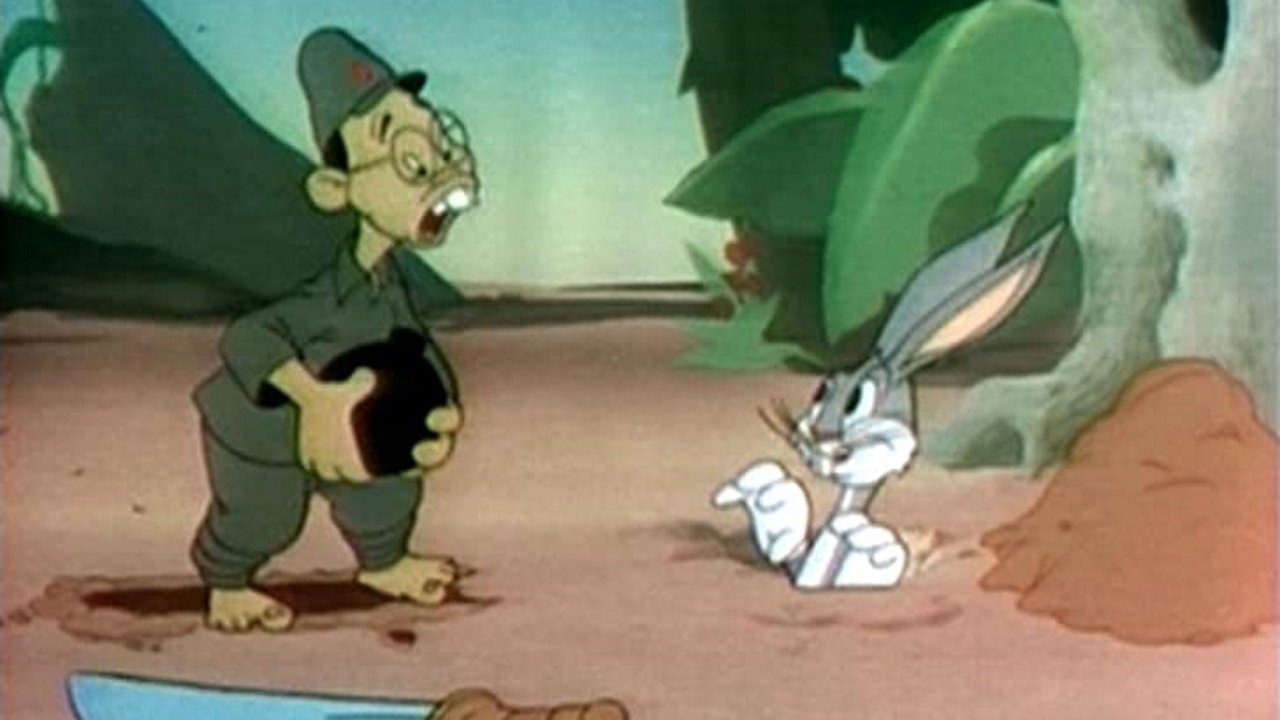
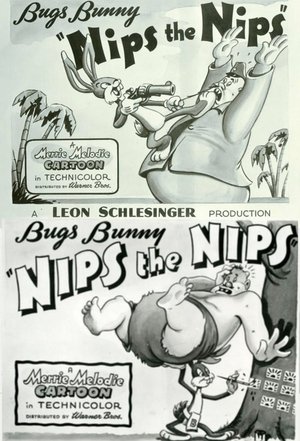
Bugs Bunny Nips the Nips(1944)
Status: Released
Date: 1944-04-21
52%
18 Votes
Time: 0h 8m
Overview:
Bugs fights stereotyped Japanese during World War II.
Languages:
Countries:
United States of America
ProductionCompanies: 

Leon Schlesinger Productions
Movie: Bugs Bunny Nips the Nips
Top 2 Billed Cast

Mel Blanc
Bugs Bunny (voice)

Bea Benaderet
Additional Characterizations
HomePage
Overview
Bugs fights stereotyped Japanese during World War II.
Release Date
1944-04-21
Average
5.167
Rating:
2.6 startsTagline
Genres
Languages:
Keywords
Recommendations Movies

67%
Rugrats in Paris: The Movie(en)
2000-11-17
A group of rambunctious toddlers travel a trip to Paris. As they journey from the Eiffel Tower to Notre Dame, they learn new lessons about trust, loyalty and love.

72%
Mano Po(tl)
2002-12-25
During the Chinese Revolution in 1949, young Chinese copra trader named Fong-Huan marries Elisa, a young and pretty Filipina. The couples children, Daniel and Linda, were raised in a mixture of Chinese and Filipino-Hispanic tradition. These richly cultured people are the ancestors of a dysfunctional third-generation family whose daughters tell their own stories of joy, struggle, and the complex realities in the life of Filipino Chinese families.


68%
iCarly: iGo to Japan(en)
2008-11-08
Carly, Sam and Freddie kick off their adventure in Japan on a tin can of a plane packed with caged possums and piloted by Spencer's odd acquaintance.

100%
Sunset Dreams in Thailand(en)
2023-01-01
Enjoy a beautiful sunset from Sai Kaew Beach in Thailand as you listen to relaxing music and the gentle sounds of waves rolling into shore.

64%
Sister Act 2: Back in the Habit(en)
1993-12-09
Deloris Van Cartier is again asked to don the nun's habit to help a run-down Catholic school, presided over by Mother Superior. And if trying to reach out to a class full of uninterested students wasn't bad enough, the sisters discover that the school is due to be closed by the unscrupulous chief of a local authority.


72%
Secret of the Wings(en)
2012-08-17
Tinkerbell wanders into the forbidden Winter woods and meets Periwinkle. Together they learn the secret of their wings and try to unite the warm fairies and the winter fairies to help Pixie Hollow.

66%
Sonic Soldier Borgman: Lover's Rain(ja)
1990-12-27
Picking up several years after the dissolution of the original Borgman team, this volume reunites the three remaining members--rocket scientist Ryo, his girlfriend Anise, and police officer Chuck Sweager--for the emotionally-driven episode "Lover`s Rain," which finds the trio facing an army of the undead bent on a rampage of murder and destruction.

59%
Serial Killers: The Real Life Hannibal Lecters(en)
2001-01-01
This documentary examines a selection of real life serial killers and compares them to the fictional Hannibal Lecter.

70%
Pixie Hollow Games(en)
2011-12-24
Rosetta and new arrival Chloe band together to try to break the garden fairies' legendary losing streak in the Pixie Hollow Games, a sports spectacle filled with pixie pageantry, fantastic fairy events and hilarious surprises.

62%
Sonic the Hedgehog: Freedom Fighters Unite(en)
2009-05-05
Sonic Conversion: the Freedom Fighters develop a De-Robotisizer and try it out on Bunnie. Dulcy: After Dulcy exhibits strange behavior, Sally discovers she's going through a rites of passage state of her adolescence. The Void: After Sonic is almost sucked inside the Void, he finds a huge ring which Sally believes is an ancient relic but which turns out to be a trick of Nagus. Spyhog: After Antoine saves Sally's life during a raid, Sonic can't stand his bragging and zips in to see Uncle Chuck, who finds out his bug in Robotnik's hardware is malfunctioning.

54%
Casper's Haunted Christmas(en)
2000-10-31
Kibosh, supreme ruler of all ghosts, decrees that casper must scare at least one person before Christmas Day so Casper visits Kriss, Massachusetts where he meets the Jollimore family and sets out to complete his mission. As usual, kindhearted Casper has a ghastky time trying to scare anyone; so The Ghostly Trio, fed up with his goody-boo-shoes behavior, secretly hires Casper's look-alike cousin Spooky to do the job-with hilarious results.

64%
Brink!(en)
1998-08-28
Andy "Brink" Brinker and his in-line skating crew--Peter, Jordy, and Gabriella--who call themselves "Soul-Skaters" (which means they skate for the fun of it, and not for the money), clash with a group of sponsored skaters, Team X-Bladz--led by Val--with whom they attend high school in southern California. When Brink discovers his family is in financial trouble, he goes against the wishes of his parents and his friends and joins Team X-Bladz. Brink tries to lead a double life but will be able to pull it off?

63%
Lady and the Tramp II: Scamp's Adventure(en)
2001-02-18
Lady and Tramp's mischievous pup, Scamp, gets fed up with rules and restrictions imposed on him by life in a family, and longs for a wild and free lifestyle. He runs away from home and into the streets where he joins a pack of stray dogs known as the "Junkyard Dogs." Buster, the pack's leader, takes an instant disliking to the "house-dog" and considers him a rival. Angel, a junkyard pup Scamp's age, longs for the safety and comfort of life in a family and the two become instant companions. Will Scamp choose the wild and free life of a stray or the unconditional love of his family?

60%
Forest(en)
2005-03-24
Video installation, 2005, at LOKAAL_01 Breda 2007, Burning Marl, curator Frederik Vergaert in Seppenshuis Zoersel, 2005. A woman walking through 3 video images. Three screens display how the day’s light passes by: from the early morning light until late at night. Along with the woman the artist walks through the forest, in the same rhythm, the same pace. Off-screen she looks through the camera, fragmenting time. The age-old androgynous trees are a vertical constant along which the woman moves, as if in an interval between visibility and invisibility, between sound and silence, while the light keeps on evolving metabletically.

60%
A Mom for Christmas(en)
1990-12-17
A department store mannequin comes to life during the holiday season for a motherless little girl who wishes she had a mom for Christmas, and proceeds to charm her hard-working dad, too.

50%
FRED 3: Camp Fred(en)
2012-07-28
Schools out, and Fred Figglehorn's dream of water slides, horseback riding and monkey butlers during the summer turns into a nightmare of gruel and poisonous berries when his mom signs him up to an unsanitary camp.

60%
Mahou Shoujo Sonico Magica(ja)
2011-04-01
This is an April Fool's joke by Nitroplus. On 01.04.2011, an official website for Mahou Shoujo Sonico Magika, a parody of SoniComi (a game by Nitroplus), was opened with the announcement of it being a TV anime. On the same day, the opening video for the so called TV anime was released on YouTube by NitroPlusChannel. This opening is essentially the entire anime. The title is a clear reference to Mahou Shoujo Madoka Magika, a TV anime which screenplay was written by a Nitroplus staffer Urobuchi Gen, who also got credited for screenplay for this anime on the official page. No screenplay was ever written, of course.
Similar Movies

74%
Fate/stay night: Heaven's Feel I. Presage Flower(ja)
2017-10-14
Ten years after the Fourth Holy Grail War, a devastating clash between Masters and Servants, another war erupts. Shirou Emiya, whose father fought in the first battle, was leading a peaceful life with the warmhearted Sakura Matou. But when hidden forces begin to stir, Shirou resolves to fulfill his father’s dying wish, protect Sakura, and fight for the Holy Grail.

59%
Cocolors(ja)
2017-11-15
Aki isn’t a brave little boy, but he’s dedicated nonetheless to safeguarding his sickly, mute friend Fuyu. They and their little gang live deep underground, in the concrete warrens to which survivors have fled following the eruption of Mt. Fuji. The community is in decline, however, as illness and despair take their toll. Fuyu dreams of the outside world, which he is too frail to ever reach. But what colour is the sky out there?

10%
Foxes of Chironup(ja)
1987-08-15
Foxes Ken and Chin become the proud parents of cubs, Koro and Kan, who enjoy a carefree life on the northern Japanese island of Chironup. They befriend a fisherman and his wife but are forced to run for their lives when soldiers on a military exercise decide to take home some fox pelts as souvenirs. A sweet little film that obliquely symbolizes the plight of Japan's aboriginal Ainu people and the northern islands that have been contested with Russia since they were occupied by Stalin's soldiers in 1945.

75%
Liz and the Blue Bird(ja)
2018-04-21
In their last year of high school, two girls in the brass band club perform a song inspired by a fairy tale that parallels their friendship.

71%
My Favorite War(lv)
2020-09-25
Ilze Burkovska, a little girl who is obsessed with stories of World War II and will be a filmmaker in a distant future, lives in Latvia under the totalitarian boot of the Soviets and the ominous shadow of the many menaces and horrors of the Cold War.

50%
Guadalcanal(en)
1943-12-31
A stop-motion animated account of the 1942 Battle of Guadalcanal in World War II. Preserved by the Academy Film Archive in 2004.

0%
The Roots of Japanese Anime Until the End of WWII: 1930-1942(ja)
2008-01-01
A rare glimpse of early Japanese sound anime and prewar Japanese culture, The Roots of Japanese Anime features the masterworks of such pioneers of Japanese animation as Noburo Ofuji, Yasuji Murata, and Kenzo Masaoka, in addition to Mitsuyo Seo’s Momotaro’s Sea Eagle, the notorious war cartoon billed as Japan’s first feature anime. These movies represent the brilliance and variety of anime, ranging from beautiful Japanese paper animation to powerful multiplane cel cartoons. They also evoke the fascinating complexity of Japan, a nation that is then both marching towards war, enlisting kids in militarist nationalism, yet also delighting in a mixture of modern popular culture, ancient folk tales, irreverent comedy, and the everyday life of prewar Japanese children.

76%
Kubo and the Two Strings(en)
2016-08-18
Kubo mesmerizes the people in his village with his magical gift for spinning wild tales with origami. When he accidentally summons an evil spirit seeking vengeance, Kubo is forced to go on a quest to solve the mystery of his fallen samurai father and his mystical weaponry, as well as discover his own magical powers.

45%
Bonobono: Secret of the Kumomo Tree(ja)
2002-08-10
Bonobono: Kumomo no Ki no Koto was the second theatrical Bonobono movie, released by Amuse Pictures in theaters in Japan on August 10, 2002. It was done completely in 3D.

74%
The Boy and the Heron(ja)
2023-07-14
While the Second World War rages, the teenage Mahito, haunted by his mother's tragic death, is relocated from Tokyo to the serene rural home of his new stepmother Natsuko, a woman who bears a striking resemblance to the boy's mother. As he tries to adjust, this strange new world grows even stranger following the appearance of a persistent gray heron, who perplexes and bedevils Mahito, dubbing him the "long-awaited one."

79%
My Hero Academia: Two Heroes(ja)
2018-08-03
All Might and Deku accept an invitation to go abroad to a floating and mobile manmade city, called 'I-Island', where they research quirks as well as hero supplemental items at the special 'I-Expo' convention that is currently being held on the island. During that time, suddenly, despite an iron wall of security surrounding the island, the system is breached by a villain, and the only ones able to stop him are the students of Class 1-A.

79%
The Boy and the Beast(ja)
2015-07-11
Kyuta, a boy living in Shibuya, and Kumatetsu, a lonesome beast from Jutengai, an imaginary world. One day, Kyuta forays into the imaginary world and, as he's looking for his way back, meets Kumatetsu who becomes his spirit guide. That encounter leads them to many adventures.

75%
Super Electromagnetic Machine Voltes V(ja)
1977-07-05
Chōdenji Machine Voltes V (超電磁マシーン ボルテスV Chōdenji Mashīn Borutesu Faibu?, Super Electromagnetic Machine Voltes Five) more popularly known as Voltes V, is a Japanese anime television series that was first aired on TV Asahi starting June 4, 1977. It was created by Saburo Yatsude (a pseudonym referring to a committee within Toei Company) and directed by Tadao Nagahama. Voltes V is the second part of the Robot Romance Trilogy of the Super Robot genre which includes Chōdenji Robo Combattler V and Tōshō Daimos. Like Combattler V, the series was animated by Sunrise and produced by Toei Company. The series was animated by Sunrise on Toei's behalf. This super robot along with the other two aforementioned super robots first appeared the USA as a part of Mattel's Shogun Warriors line of import toys, released in the late 1970s.

70%
Little Gray Neck(ru)
1948-01-01
Defending a friend, duckling is attacked by fox and must learn to survive.

75%
Home on the Range(en)
1940-03-23
A cow and her calf are bedding down for the night. The calf is frightened by a shadow, until it's revealed to be a jackrabbit. He follows the rabbit deep into the woods. Neither of them notices the wolf following.

60%
Hakuouki: Wild Dance of Kyoto(ja)
2013-08-24
There's a war going on in ancient Kyoto. A war fought in shadows, between the forces of the Shogunate's armed enforcers, the Shinsengumi, and the vampire-like Ronin warriors known as the Rasetsu or Furies. And trapped in the middle is a young woman disguised as a man. Seeking her missing father, Chizuru Yukimura comes to Kyoto only to find her fate forever intertwined with the destinies of Shinsengumi Vice commander Toshizo Hijikata and his elite force of swordsmen. Because Chizuru's father has created a secret elixir that enhances the user's strength, speed and healing, and the furies will do anything and kill anyone in order to control that power!

67%
Cencoroll Connect(ja)
2019-06-29
Student Yuki has never seen one of the giant monsters she always hears about on the news and that threaten her city. But when she meets the lethargic Tetsu one day, things change suddenly. Because Tetsu moves around the houses with a creature called Cencoroll, which he can control with mind control and which can transform into a wide variety of objects. But not only Yuki is fascinated by Cencoroll: the boy Shu tries to take Cencoroll from Tetsu with the help of his own telepathy monster, whereupon the four engage in a bitter fight, in which Yuki also intervenes and the entire city is converted into a battle arena.

36%
Nimbus libéré(fr)
1944-01-01
A Jewish radio announcer broadcasts the imminent arrival in France of Allied liberators; US planes flown by Mickey Mouse, Donald Duck, and Popeye, (and defended by air gunners Goofy and Felix the Cat) receive orders to drop bombs on French civilians below.

74%
Crayon Shin-chan: Crash! Scribble Kingdom and Almost Four Heroes(ja)
2020-09-11
The kingdom that floats above in the sky, that uses free doodles as an energy source, “Rakuga Kingdom.” However, now in the face of a lack in energy, they are on the brink of ruin. In order to force the creation of doodles, the kingdom’s army begins its attack on Kasukabe on the surface! Meanwhile, as the drawings begin to move, the hero who is bestowed the hidden treasure of the kingdom, the “Miracle Crayon”—is none other than the “super happy-go-lucky 5-year-old,” Nohara Shinnosuke!! Together as the “Almost Four Heroes,” Shinnosuke and the drawn doodles try to take back Kasukabe! Amongst that, they discover the weakness of the doodles, where they dissolve upon contact with water! To make matters worse, a raincloud that looks to start pouring at any moment hovers above… What awaits their encounter with the doodles and the end of their adventure—will it be smiles, or tears!?

78%
La stella di Andra e Tati(it)
2018-04-13
Little Andra and Tati Bucci, Italian Jews from Fiume, were 6 and 4 years old when, on March 29, 1944, they were deported to Auschwitz together with their mother, grandmother, aunt, and little cousin Sergio. They managed to survive the initial selections in the concentration camp because Dr. Mengele mistook them for twins and decided to take them to the Kinderblock, the barracks for children destined for eugenics experiments. The bond they formed with each other and the compassion of a female camp guard allowed the little sisters to survive until the liberation of the camp on January 27, 1945.