Loading Page

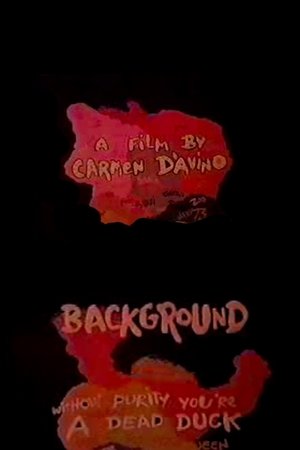
Background(1973)
Status: Released
Date: 1973-01-01
55%
2 Votes
Time: 0h 20m
Overview:
Background is a 1973 American short documentary film directed by Carmen D'Avino. It was nominated for an Academy Award for Best Documentary Short. The original version was preserved by the Academy Film Archive in 2012.
Languages: English.
Countries:
United States of America
ProductionCompanies:
D'Avino & Fucci-Stone Productions
Movie: Background
Top 1 Billed Cast
HomePage
Overview
Background is a 1973 American short documentary film directed by Carmen D'Avino. It was nominated for an Academy Award for Best Documentary Short. The original version was preserved by the Academy Film Archive in 2012.
Release Date
1973-01-01
Average
5.5
Rating:
2.8 startsTagline
Genres
Languages:
English
Recommendations Movies

60%
Torture Money(en)
1937-01-02
In this MGM Crime Does Not Pay series short, police go after a fraud operation that stages automobile accidents to collect insurance money.

55%
Muxˣ(de)
2025-05-01
Mux spent many years in a coma in a clinic with a constant stream of television. But at least he survived a serious car accident! Now he has woken up, and he has a plan: during his time in hospital, he came up with the idea of a fairer society. From now on, Mux sees it as his task to save the world from neoliberalism and goes to France, the motherland of revolutions, with his long-term nurse Karsten and a self-written manifesto.

60%
Strange Object(en)
2020-10-07
An archival investigation into the imperial image-making of the RAF ‘Z Unit’, which determined the destruction of human, animal and cultural life across Somaliland, as well as Africa and Asia.

34%
Garden of the Dead(en)
1972-09-13
Convicts on a chain gang sniff formaldehyde fumes to get high. They attempt a prison break and are shot down by the guards. After being buried, they rise from the dead, killing all in their path with shovels and hoes.

50%
The Peasants(az)
1939-12-28
A historical revolutionary film depicting the struggle of peasants and the Baku proletariat against landowners and Musavatists in 1919.

100%
Collage(fr)
2021-05-05
Considerations on collage as a cognitive act in artists’ cinema. A pedagogical film adrift: 35mm photographs and other materials collected over the last fifteen years by artist Stefano Miraglia meet a text written by Baptiste Jopeck and the voice of Margaux Guillemard.

76%
Shadows(pl)
1988-08-22
During the Second World War, tens of thousands of blonde, blue-eyed Polish children were snatched from their parents and given to German families. Lebensborn was part of Hitler's plan to expand the Aryan master race within the Third Reich. Eight-year old Jerzy returns home at the end of the war to a joyful reunion with his long-lost mother and grandfather. But problems arise as he is taunted by his peers and, longing for his missing father, burns with resentment for his new communist stepfather.

50%
Awakening(cn)
1994-09-24
A famous "feng shui" master (fortune teller) gets a wake-up call when a distraught ex-customer threatens to expose him as a fraud.

50%
Dependence(ja)
2006-09-01
Hayato comes back to his home village after father breaks his legs and cannot walk anymore. He brings his wife Ami along with him, who had a miscarriage and has been dysfunctional and depressed ever since. Hayato hangs with his old friends and enjoys the life of the village, but Ami is a city girl and is growing lonelier. She finds comfort in the arms of Hayato's father. It's not long before everybody in the small village is aware of their relationship... except Hayato... A drama about betrayal and the illogical nature of love and happiness.

56%
Suerte Te De Dios(es)
1961-05-11
Two construction workers discover a stash of gold coins hidden in the walls of a building they're demolishing.

67%
Paths of the Soul(bo)
2016-07-23
Eleven Tibetans prostrate themselves every few steps during a 1,200-mile pilgrimage that lasts for seven months.

59%
Gunpowder(ru)
1985-03-25
At the end of September 1941, Soviet artillery troops in besieged Leningrad realize that pretty soon they will fire their last shot, and after that the defense of the city will be doomed. The film is based on a true event: a small group of fearless soldiers transported a large supply of gunpowder through enemy lines to Leningrad.

100%
When New Year Comes on Shabbat(en)
2012-10-26
A cinematic collage about people caught between two worlds. An empathetic look at a physical journey and the melodramas of a journey that is spiritual. Nikita Pavlov emigrated from Russia to Israel because he always wanted to experience life in another country. Street protests, political activism, and his daughters first steps are captured without any chronological context, separated only by Pavlovs thoughts and ideas. A cinematic diary that attempts to piece together a hypothetical picture of the filmmakers future.


95%
Skin of a Mandarin(et)
2023-11-09
The film delicately follows 25-year-old Anna, whose mother has died suddenly. She wants to send her Orthodox mother on her last journey according to customs, but she runs into bureaucratic rules that do not allow Anna to dress her departed mother herself. This conflict brings her together with Maria, a 45-year-old funeral home worker, who in this story represents the hidden fears of death and grief on a deep emotional level.

80%
Undone(en)
2021-04-15
It is a remarkable story of personal endeavour following professional surfer, Laura Enever who leaves a comfortable place on the WSL Championship Tour to explore the unpredictable world of big-wave surfing.


78%
Suck It Up Buttercup(en)
2015-11-24
A former honor student spirals down the deep, dark hole of an addiction to prescription pills.
Similar Movies

0%
The Costume Designer(en)
1950-07-13
This short focuses on the job of the costume designer in the production of motion pictures. The costume designer must design clothing that is correct for the film historically and geographically, and must be appropriate for the mood of the individual scene. We see famed costume designer Edith Head at work on a production. The Costume Designer was part of The Industry Film Project, a twelve-part series produced by the film studios and the Academy. Each series episode was produced to inform the public on a specific facet of the motion picture industry. Preserved by the Academy Film Archive in 2012.

64%
Bambi Meets Godzilla(en)
1969-07-10
A deer, disillusioned by the consumerism that defines his life. A lizard, ostracized from society, forever wandering. A chance meeting in the middle of a field. Who will survive? And who will transcend existence? Preserved by the Academy Film Archive in 2009.

75%
Harlan County U.S.A.(en)
1977-01-23
This film documents the coal miners' strike against the Brookside Mine of the Eastover Mining Company in Harlan County, Kentucky in June, 1973. Eastover's refusal to sign a contract (when the miners joined with the United Mine Workers of America) led to the strike, which lasted more than a year and included violent battles between gun-toting company thugs/scabs and the picketing miners and their supportive women-folk. Director Barbara Kopple puts the strike into perspective by giving us some background on the historical plight of the miners and some history of the UMWA. Preserved by the Academy Film Archive in partnership with New York Women in Film & Television in 2004.

76%
Hearts and Minds(en)
1974-12-20
Many times during his presidency, Lyndon B. Johnson said that ultimate victory in the Vietnam War depended upon the U.S. military winning the "hearts and minds" of the Vietnamese people. Filmmaker Peter Davis uses Johnson's phrase in an ironic context in this anti-war documentary, filmed and released while the Vietnam War was still under way, juxtaposing interviews with military figures like U.S. Army Chief of Staff William C. Westmoreland with shocking scenes of violence and brutality.

75%
Burden of Dreams(en)
1982-10-01
The Amazon rain forest, 1979. The crew of Fitzcarraldo (1982), a film directed by German director Werner Herzog, soon finds itself with problems related to casting, tribal struggles and accidents, among many other setbacks; but nothing compared to dragging a huge steamboat up a mountain, while Herzog embraces the path of a certain madness to make his vision come true.

0%
Steel Town(en)
1944-01-01
Documentary examining the steel industry in Youngstown, Ohio during World War II. Focuses on steel production, including the smelting process, slagging and the blast furnace. Workers reflect upon their lives and the importance of their jobs. Emphasizes the importance of teamwork in the mills and on the plant's labor relations committee to help win the war. Preserved by the Academy Film Archive in 2012.


60%
No No Nooky T.V.(en)
1987-01-01
NO NO NOOKY TV posits sexuality to be a social construct in a "sex-text" of satiric graphic representation of "dirty pictures." Made on an Amiga Computer and shot in 16mm film, NO NO NOOKY TV confronts the feminist controversy around sexuality with electronic language, pixels and interface. Even the monitor is eroticized in this film/video hybrid that points fun at romance, sexuality, and love in our post-industrial age. Preserved by the Academy Film Archive in 2017.

100%
Frannie's Christmas(en)
1993-03-26
As Christmas approaches, Frannie Stein learns from her snide friend Gloria Oestriger that there is no Santa Claus. Frannie's disbelieving, but her father confirms the horrible truth. Frannie enlists the help of her younger brother, Kenny, and they go to a graveyard to dig up some parts, which they assemble in the Stein basement. Soon, they've finished their creation and are ready for revenge on Gloria. Who says there's no Santa? Preserved by the Academy Film Archive in 2012.

65%
The Tune(en)
1992-09-04
Del is a song writer for the obnoxious Mr. Mega, and in love with Didi, Mega's secretary. His quest to write a hit tune brings him to the wacky world of Flooby Nooby, where he just might learn to write songs from the heart.

66%
The Man Who Skied Down Everest(en)
1975-09-19
This Oscar-winning documentary tells the story behind Japanese daredevil Yuichiro Miura's 1970 effort to ski down the world's tallest mountain.

50%
Guadalcanal(en)
1943-12-31
A stop-motion animated account of the 1942 Battle of Guadalcanal in World War II. Preserved by the Academy Film Archive in 2004.

50%
Food and Magic(en)
1943-11-18
A sideshow barker uses magic and visual aids to alert the public that proper food management is both a resource and a weapon that could be to America's advantage if conserved properly in winning the then current World War. Preserved by the Academy Film Archive, Academy War Film Collection, in 2008.

65%
Asparagus(en)
1979-03-17
A symbolic reflection on issues of female sexuality, art and identity constructs.

64%
Primary(en)
1960-11-08
Primary is a documentary film about the primary elections between John F. Kennedy and Hubert Humphrey in 1960. Primary is the first documentary to use light equipment in order to follow their subjects in a more intimate filmmaking style. This unconventional way of filming created a new look for documentary films where the camera’s lens was right in the middle of what ever drama was occurring. Preserved by the Academy Film Archive in partnership with The Film Foundation in 1998.

70%
Chicken Real(en)
1970-01-01
One of Les Blank's industrial films, which follows a Holly Farms "broiler" chicken from factory incubation to the county fair barbecue pit. A hilarious, disturbing and surreal look at a large-scale chicken farm producing 156 million chickens a year! Film includes lots of chicken songs and music recorded live in the Blue Ridge Mountains of North Carolina. Preserved by the Academy Film Archive in 2013.

75%
A Grand Day Out(en)
1990-05-18
Wallace and Gromit have run out of cheese, and this provides an excellent excuse for the duo to take their holiday to the moon, where, as everyone knows, there is ample cheese.

78%
The Wrong Trousers(en)
1993-12-17
Wallace rents out Gromit's former bedroom to a penguin, who takes up an interest in the techno trousers created by Wallace. However, Gromit later learns that the penguin is a wanted criminal.

76%
A Close Shave(en)
1996-03-07
Wallace's whirlwind romance with the proprietor of the local wool shop puts his head in a spin, and Gromit is framed for sheep-rustling in a fiendish criminal plot.