Loading Page

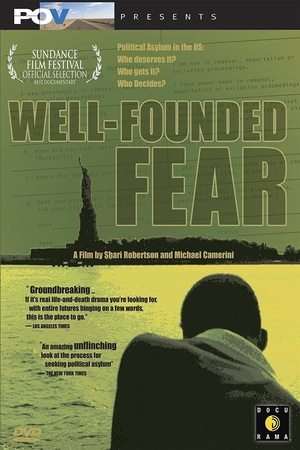
Well-Founded Fear(2000)
Status: Released
Date: 2000-01-01
0%
0 Votes
Time: 2h 0m
Overview:
Examines how the Immigration and Naturalization Service decides who will be granted asylum in the United States. The applicant must have a "well-founded fear" of persecution in his or her home country. Despite true and terrifying stories of torture and mistreatment, it's often up to how well the translator presents the case and how sensitive are the ears of the asylum officer to decide a person's fate.
Languages:
Countries:
United States of America
Movie: Well-Founded Fear
HomePage
Overview
Examines how the Immigration and Naturalization Service decides who will be granted asylum in the United States. The applicant must have a "well-founded fear" of persecution in his or her home country. Despite true and terrifying stories of torture and mistreatment, it's often up to how well the translator presents the case and how sensitive are the ears of the asylum officer to decide a person's fate.
Release Date
2000-01-01
Average
0
Rating:
0.0 startsTagline
Genres
Languages:
Keywords
Similar Movies


80%
Elsewhere, Everywhere(fr)
2021-12-01
A computer screen, images from the four corners of the world. We cross borders in one-click while another trip’s story reach us in bits, through text messages, chats, phone conversations, and an immigration office’s questionnaire. It’s the journey of Shahin, a 20-year-old Iranian boy who, fleeing his country alone, lands in Greece, then winds his way to England where he claims asylum.

0%
Escort(nl)
2016-03-10
Young, inexperienced members of the Dutch Boarder Patrol undergo an intensive training on escorting refused asylum seekers to their homeland.


0%
Graven Image(en)
2017-12-01
Using over 100 years of archival footage, director Sierra Pettengill explores the history of the largest Confederate monument, Georgia’s Stone Mountain.

0%
Los Lecheros(en)
2017-11-16
The fates of undocumented immigrant workers and Wisconsin's $43 billion dairy industry are closely intertwined - and both are grappling with their options for survival as fears of ICE raids and deportations under the Trump administration grow.

73%
The Jump(lt)
2020-10-09
In the Cold War years of the 1970s, an American patrol boat meets a Soviet ship off the east coast of the United States for talks about fishing rights in the Atlantic. In the midst of this, while Russian commanders are aboard the U.S. Coast Guard vessel where the talks are being held, a Lithuanian sailor jumps across the ten feet of icy water separating the boats. Crash-landing on the deck of the American ship, he desperately begs for asylum. Though they try, the Americans ultimately fail to provide protection and the Soviets are allowed to capture him and brutally return him to their vessel. Thus begins a stranger-than-fiction story of imprisonment, discovery, fame, and freedom. Through rare archival footage and a dramatic first-person re-enactment of that fateful day by Simas Kudirka, the would-be defector himself, this tale of one of the biggest Cold War muddles takes us on a journey of uncanny twists of fate, and the emotional sacrifices of becoming a universal symbol of freedom.

82%
Things We Won't Say About Race That Are True(en)
2015-03-19
Trevor Phillips confronts some uncomfortable truths about racial stereotypes, as he asks if attempts to improve equality have led to serious negative consequences.

0%
Baggages(fr)
2017-12-08
This documentary focuses on immigrant teens between the ages of 12 and 17 who share the story of their migration and their adaption to life in Canada through theatre. Young but wise, these children describe their experiences with emotion and authenticity.

0%
The Iron Triangle: Willets Point and the Remaking of New York(en)
2017-11-11
Targeted for several failed redevelopment plans dating back to the days of Robert Moses, Willets Point, a gritty area in New York City known as the “Iron Triangle,” is the home of hundreds of immigrant-run, auto repair shops that thrive despite a lack of municipal infrastructure support. During the last year of the Bloomberg Administration, NYC’s government advanced plans for a “dynamic” high-end entertainment district that would completely wipe out this historic industrial core. The year is 2013, and the workers of Willets Point are racing against the clock to forestall their impending eviction. Their story launches an investigation into New York City’s history as the front line of deindustrialization, urban renewal, and gentrification.

60%
Out of Ireland(en)
1995-06-09
Over the course of two centuries, seven million men, women and children abandoned their homeland for America's shores. In just one horrifying decade, two million left to escape a famine that left another million dead. This is the moving chronicle of the Irish immigrant experience.

62%
The Shelter(fr)
2014-08-10
It is winter at an emergency shelter for the homeless in Lausanne. Every night at the door of this little-known basement facility the same entry ritual takes place, resulting in confrontations which can sometimes turn violent. Those on duty at the shelter have the difficult task of “triaging the poor”: the women and children first, then the men. Although the total capacity at the shelter is 100, only 50 “chosen ones” will be admitted inside and granted a warm meal and a bed. The others know it will be a long night.


0%
Asylum(en)
1998-01-01
This feature documentary follows three newly arrived people in Canada and their experiences with the Canadian Refugee process. As claims are assessed and paperwork is double checked, we begin to examine exactly who can be considered a refugee.

0%
The Hearing(de)
2024-01-25
Four rejected asylum seekers relive the hearing on their reasons for fleeing their home countries, shedding light on the core of the asylum procedure. Will the interviewees be able to describe their traumatic experiences in a way that satisfies the official criteria?

0%
Landfall(es)
2020-04-15
Hurricane María abated, the news crews packed up and left Puerto Rico, and the interest of the international community turned elsewhere. What happened next?

20%
The Hearing(fr)
2023-05-26
After crossing 11 countries irregularly to seek asylum in Canada, Peggy, Simon and their three children are waiting for the hearing that will determine whether they get refugee status or not. Having fled political repression in the Democratic Republic of the Congo, the family tries to rebuild a peaceful life in Montreal, in spite of the constant threat of deportation. Between ghosts from the past, hopes for the future, a complex legal maze and seemingly endless trial, the film delves into the struggle of the Nkunga Mbala family to remain in Canada. Offering unprecedented access to their hearing before the Immigration and Refugee Board, the film unveils the opaque process of claiming asylum in Canada.

70%
Detained(sv)
2015-04-10
A documentary from within the Swedish Migration Board's locked repository where people are in custody awaiting forced deportation. Prisoner and guard are in close proximity around the clock. Converses during sleepless nights and playing football during hot summer days. We follow Sophie, 29, who loves her job at the repository, Sami, 20, the young rebel who is locked up but free inside, and Aina, 47, who were separated from her children and kept locked up while the police are stepping up efforts to enforce their expulsion order.