Loading Page

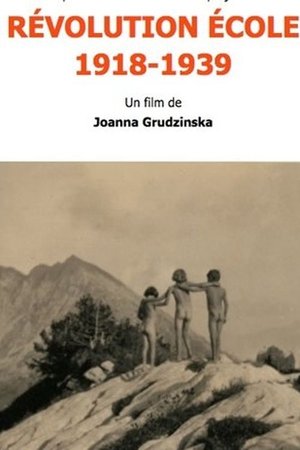
Révolution école(2016)
Status: Released
Date: 2016-09-07
0%
0 Votes
Time: 2h 5m
Overview:
In a Europe traumatized by the First World War, educationalists point the finger of blame: the school, which produced “brave soldiers”. The task now is to build peace and develop a new education for a generation of children who, it is hoped, will never wage war again. How can we educate them without surveillance and punishment? How can we help them to emancipate themselves? To make children happy is to make them better adults, according to those who embarked on the adventure. Their names are Rudolf Steiner, Maria Montessori, Célestin Freinet, Alexander S. Neill, Ovide Decroly, Paul Geheeb or Janusz Korczak, each of them inventing educational methods. A Swiss pedagogue, Adolphe Ferrière, brought them together in the Ligue internationale de l'éducation nouvelle.
Languages: French.
Countries:
Movie: Révolution école
HomePage
Overview
In a Europe traumatized by the First World War, educationalists point the finger of blame: the school, which produced “brave soldiers”. The task now is to build peace and develop a new education for a generation of children who, it is hoped, will never wage war again. How can we educate them without surveillance and punishment? How can we help them to emancipate themselves? To make children happy is to make them better adults, according to those who embarked on the adventure. Their names are Rudolf Steiner, Maria Montessori, Célestin Freinet, Alexander S. Neill, Ovide Decroly, Paul Geheeb or Janusz Korczak, each of them inventing educational methods. A Swiss pedagogue, Adolphe Ferrière, brought them together in the Ligue internationale de l'éducation nouvelle.
Release Date
2016-09-07
Average
0
Rating:
0.0 startsTagline
Genres
Languages:
FrançaisKeywords
Similar Movies


72%
The Echo(es)
2024-02-20
In the remote village of El Echo that exists outside of time, the children care for the sheep and their elders. While the frost and drought punish the land, they learn to understand death, illness and love with each act, word and silence of their parents. A story about the echo of what clings to the soul, about the certainty of shelter provided by those around us, about rebellion and vertigo in the face of life. About growing up.

57%
Our People Will Be Healed(en)
2017-09-07
Legendary documentary filmmaker Alanis Obomsawin provides a glimpse of what action-driven decolonization looks like in Norway House, one of Manitoba's largest First Nation communities.


100%
The Truth About Reading(en)
2024-02-24
The Truth About Reading looks at the illiteracy problem in America, highlighting people who learned to read as adults, and sharing proposed solutions for working towards a future where every child learns to read proficiently.

82%
Dad... Can I Borrow the Car?(en)
1970-09-30
A live-action short, using many avant-garde film techniques, that looks at American car culture in the late 1960s. The main section deals with the many trials and obstacles a teenager must face on the path to being able to drive. Surviving the driver's education class is only the first step, as the teenager must then pass his driving test, and then finally get permission to borrow the family car.

0%
Kindergarten(en)
1963-06-09
One day in a kindergarten classroom at Van Horne Public School in Montreal. The teacher encourages children to turn their curiosity into questions and organizes group activities and play periods.

0%
Cree Way(en)
1977-01-01
This short documentary examines an innovative educational program developed by John and Gerti Murdoch to teach Cree children their language via Cree folklore, photographs, artifacts, and books that were written and printed in the community. Made as part of the NFB’s groundbreaking Challenge for Change series, Cree Way shows that local control of the education curriculum has a place in Indigenous communities.

40%
The Hobart Shakespeareans(en)
2005-09-06
Rafe Esquith, 1992 American Teacher of the Year and National Medal of Arts recipient, teaches 5th-grade children whose parents don't speak English at a school in a dangerous, poor, drug-infested 100% Latino/Asian neighborhood in Los Angeles.

33%
It's Elementary: Talking About Gay Issues in School(en)
1996-05-21
Depicts what happens when students K-8 discuss LGBT-related topics in age-appropriate ways. Shot in six public and private schools (in San Francisco and New York City, as well as Madison, Wisconsin, and Cambridge, Massachusetts), It’s Elementary models excellent teaching about family diversity, name-calling, stereotypes, community building, and more.

68%
First Case, Second Case(fa)
1979-02-01
A documentary about a teacher who sends a group of pupils out of the classroom when one of them does not own up to talking behind the master's back.

82%
Galore(fr)
2020-08-28
A grandmother living in a small Kenyan village completes her final year of primary school at the old age of 94.

0%
Alexa Boulton: Cinema(fr)
2023-01-20
Alexa Boulton interviews the students and teachers of Kelvin High School to uncover the possibilities for the future of cinema

0%
Dare to Say No!(en)
1988-09-15
Shows children various reasons why they need to resist peer pressure, refuse drugs, and refuse to follow the crowd just to fit in

67%
He Named Me Malala(en)
2015-09-12
A look at the events leading up to the Taliban's attack on the young Pakistani school girl, Malala Yousafzai, for speaking out on girls' education and the aftermath, including her speech to the United Nations.

83%
Inhabit: A Permaculture Perspective(en)
2015-03-02
Inhabit is a feature length documentary introducing permaculture: a design method that offers an ecological lens for solving issues related to agriculture, economics, governance, and on. The film presents a vast array of projects, concepts, and people, and it translates the diversity of permaculture into something that can be understood by an equally diverse audience. For those familiar, it will be a call to action and a glimpse into what's possible - what kind of projects and solutions are already underway. For those unfamiliar, it will be an introduction to a new way of being and a new way of relating to the Earth. For everyone, it will be a reminder that humans are capable of being planetary healing forces.

56%
Douce France(fr)
2021-06-16
Amina, Sami and Jennyfer are high school students in the Paris suburbs, in 93. At the initiative of 3 of their teachers, they embark on an unexpected investigation into a gigantic leisure park project which involves concreting agricultural land near their homes. But can we have the power to act on a territory when we are 17 years old? Funny and intrepid, these new citizens take us to meet residents of their neighborhood, property developers, farmers and even elected officials of the National Assembly. A joyful quest that challenges conventional wisdom and revives our connection to the land!

95%
Caterpillars(fr)
2020-09-12
Elvis Sabin’s assured debut follows Albert and André, two Central African Aka Pygmies, as they attempt to establish a new education system in their forest community. The last in their village still attending school, they are determined to pass their knowledge on, holding classes for other Aka children every afternoon. But their project requires funding and they are counting on the year’s caterpillar (known as “Makongo”) harvest to provide much needed income. Evocatively capturing the visual and sonic textures of the forest, Makongo is a layered ethnographic study of two men working to build a sustainable future for their community.

68%
The Academy of Muses(es)
2015-08-08
On returning from class, a teacher is questioned by his wife, who distrusts his pedagogic project: an “Academy of the Muses” inspired by classical references, which is supposed to contribute to regenerating the world through poetry. The controversial project triggers a series of situations dominated by words and desire.

63%
The UFO Movie THEY Don't Want You to See(en)
2023-08-20
In an age when misinformation, alternative facts, and conspiracy theories have become mainstream, UFOs have risen to become one of the most-talked about pop culture phenomena. With all of this noise, how can we expect anyone to know how much of this is true? What is in our skies? What do we know, and how do we know it? And most importantly: Are we being visited?