Loading Page

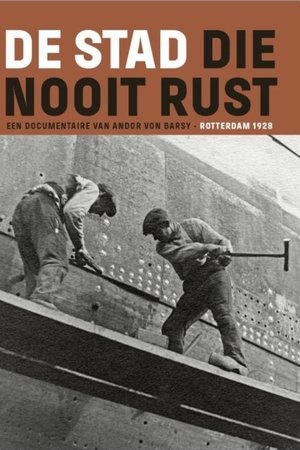
The City that Never Rests(1928)
Status: Released
Date: 1928-01-01
0%
0 Votes
Time: 0h 56m
Overview:
Shots of pre-war Rotterdam, both the city and the port.
Languages: No Language.
Countries:
Netherlands
Movie: The City that Never Rests
Video Trailer The City that Never Rests
All 1 videos

Andor von Barsy - De Stad Die Nooit Rust - Trailer
Similar Movies

68%
Resurface(en)
2017-04-23
A suicidal war veteran finds like-minded souls in a surf therapy program that helps traumatized soldiers heal while riding the waves.

53%
Safeguarding Military Information(en)
1942-01-16
World War II propaganda short which focuses on the dangers of inadvertent dispersal of military information.

80%
The Battle of France(fr)
1964-06-03
A montage of newscasts tracing the events of the "damned war" and the German invasion of 1940.

0%
The 600: The Soldier’s Story(en)
2019-08-24
The story of 600 men who protected and rescued civilians during the Rwandan genocide before helping to liberate their country in 1994.

70%
Victims 1918(fi)
2008-01-25
A documentary on the executions that took place during and after the Finnish civil war in 1918.

60%
The Pity of War(en)
2014-02-28
Professor Niall Ferguson argues that Britain's decision to enter the First World War was a catastrophic error that unleashed an era of totalitarianism and genocide.

67%
We Are Many(en)
2014-06-08
The story of the biggest demonstration in human history, which took place on 15th February 2003, against the impending war on Iraq.

67%
Accidental Anarchist(en)
2017-07-23
Carne Ross was a government highflyer. A career diplomat who believed Western Democracy could save us all. But working inside the system he came to see its failures, deceits and ulterior motives. He felt at first hand the corruption of power. After the Iraq war Carne became disillusioned, quit his job and started searching for answers.

75%
Colombia in My Arms(fi)
2022-11-30
After 52 years of armed conflict the FARC guerrillas are about to hand over their arms in exchange for political participation and social inclusion of the poor. Ernesto is one of them. The much celebrated Colombian peace agreement throws Ernesto and the polarised society around him into chaos in which everyone is afraid of the future and their own survival.

0%
Y1: Silence of the Deep(el)
2020-05-19
14 September 1943: The legendary submarine Y1 “Katsonis” was sunk north of the island of Skiathos by the German submarine chaser UJ 2101. Through the book of XO Elias Tsoukalas who escaped capture and had to swim for nine hours to reach shore, secret documents, and crew members’ diaries, the documentary unfolds the human stories woven around the submarine. Seventy-five years later, with the support of the Hellenic Navy, we search for the submarine sunk at 253 metres depth and film the wreck for the very first time.

0%
Eyewar(en)
2013-10-15
What threads of history bind Manhattan's Ground Zero to those of Nagasaki and Hiroshima? Or connect sight to truth, games to war, or the silkworm to the drone? What does the United States hold to be the role of science in warfare? How has war historically been waged in Buddhist traditions? These are some of the topics addressed in Eyewar: 80 minutes of found footage which traces the development of the digital image from the maps of the second century to the screens of the twenty-first, and the uses of the field of cybernetics from Japan in the 1940s to Chile in the 1970s and Iraq in the 1990s.

76%
Bitter Lake(en)
2015-01-24
An experimental documentary that explores Saudi Arabia's relationship with the U.S. and the role this has played in the war in Afghanistan.

60%
Captives(uk)
2016-03-15
The search for a government soldier taken captive on February 20, 2014 in Kyiv takes protester Sashko to the front lines on the East of Ukraine. There he meets Ivan, a Ukrainian volunteer harbouring a secret that could undermine a fragile cease-fire…

80%
Korespondent Bryan(pl)
2010-09-01
The film is based solely on footage shot in Warsaw in 1939 by Julien Hequembourg Bryan. This American filmmaker and photographer documented life in Poland, the Soviet Union and Nazi Germany between 1935 and 1939. Following the outbreak of the Second World War, he arrived in Warsaw, where he shot a number of films documenting the city under siege, and is said to be the only foreign correspondent in the Polish capital at the time. Bryan also took the first colour photographs of wartime Warsaw.

0%
Unforgiven: Rwanda(en)
What is a socially acceptable conversation when your family's killer sits down to dinner? 'Unforgiven' explores the interactions between murderers, rapists, thieves and their victims in this documentary exploring the power of restorative justice, forgiveness and reconciliation 20 years after the Rwandan Genocide.

0%
Stitching Palestine(ar)
2017-03-28
Twelve Palestinian women sit before us and talk of their life before the Diaspora, of their memories, of their lives and of their identity. Their narratives are connected by the enduring thread of the ancient art of embroidery. Twelve resilient, determined and articulate women from disparate walks of life: lawyers, artists, housewives, activists, architects, and politicians stitch together the story of their homeland, of their dispossession, and of their unwavering determination that justice will prevail. Through their stories, the individual weaves into the collective, yet remaining distinctly personal. Twelve women, twelve life-spans, and stories from Palestine; a land whose position was fixed on the map of the world, but is now embroidered on its face.

78%
The Deminer(en)
2018-09-23
In the chaotic aftermath of the fall of Saddam Hussein, Fakhir, a father of eight, is serving in the Iraqi army. All around him, he sees innocent civilians getting injured by landmines, so he determines to disarm them with his own hands, using just a pocketknife and some wire cutters. He clears thousands of roadside bombs, mines and car bombs, knowing that every time he cuts a wire it could cost him his life—which he seems to find less important than the lives of others. In 2014, by this time having lost a leg, he starts working for the Kurdish Peshmerga, disarming boobytraps left behind by Daesh in and around Mosul. An enthusiastic home video maker, Fakhir collects hundreds of hours of footage of his day-to-day work.


