
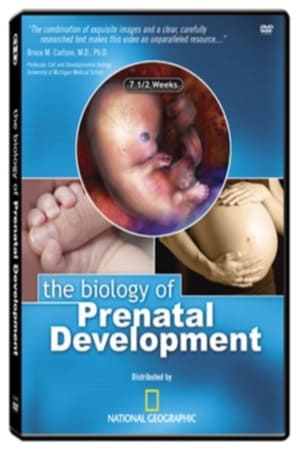
The Biology of Prenatal Development(NaN)
The Biology of Prenatal Development, explains the science and communicates the wonder of human development from fertilization through birth. Using six medical imaging technologies, the program features extraordinarily rare direct videography of the living human embryo and early fetus inside the womb from 4½ to 12 weeks following fertilization.
Movie: The Biology of Prenatal Development
HomePage
Overview
The Biology of Prenatal Development, explains the science and communicates the wonder of human development from fertilization through birth. Using six medical imaging technologies, the program features extraordinarily rare direct videography of the living human embryo and early fetus inside the womb from 4½ to 12 weeks following fertilization.
Release Date
Average
5
Rating:
2.5 startsTagline
Genres
Languages:
Keywords
Similar Movies

National Geographic: The Incredible Human Body(en)
Cutting-edge medical technology and riveting, life-or-death personal dramas combine in this unprecedented, emotionally compelling exploration of The Incredible Human Body.

The Botany of Desire(en)
Featuring Michael Pollan and based on his best-selling book, this special takes viewers on an exploration of the human relationship with the plant world — seen from the plants' point of view. Narrated by Frances McDormand, the program shows how four familiar species — the apple, the tulip, marijuana and the potato — evolved to satisfy our yearnings for sweetness, beauty, intoxication.

Second Nature: Gender and Sexuality in the Animal World(en)
From homosexual penguins and sex-transitioning fish to pregnant male seahorses and sexually dominant female bonobos, thousands of species defy our expectations of gender and sexuality. Director Drew Denny takes the nature documentary to a whole new level in this eye-opening and entertaining expedition to the places David Attenborough overlooks, where giant duck penises and corkscrew vaginas take center stage. Debunking myths that females are “inferior” and being queer is somehow “unnatural,” Second Nature explores the 1500+ animal species that engage in same-sex sexual behavior and parenting, change sex, form matriarchies, and more.

Resistance(en)
Are the medicines and every day products we use putting us at risk RESISTANCE sheds light on the global crisis of antibiotic resistance and uncovers how our extensive use of bacteria-killing antibiotics has created a new kind of disease, resistant to the medicines created to destroy it.

The Genius of Charles Darwin(en)
A documentary series from Channel 4, hosted by professor Richard Dawkins, well-known darwinist. The series mixes segments on the life and discoveries of Charles Darwin, the theory of natural selection and evolution, and Dawkins' attempts at convincing a group of school children that evolution explains the world around us better than any religion.

The Private Life of Plants(en)
David Attenborough takes us on a guided tour through the secret world of plants, to see things no unaided eye could witness. Each episode in this six-part series focuses on one of the critical stages through which every plant must pass if it is to survive:- travelling, growing, and flowering; struggling with one another; creating alliances with other organisms both plant and animal; and evolving complex ways of surviving in the earth's most ferociously hostile environments.

Genesis(en)
An African narrator tells the story of earth history, the birth of the universe and evolution of life. Beautiful imagery makes this movie documentary complete.

Inside the Living Body(en)
Take a fascinating journey inside the bizarre world of a living human being with this compelling documentary from National Geographic, where microscopic cameras and other state-of-the-art technologies reveal perspectives that will blow your mind. Tracking the body of a female from infancy to old age, viewers will observe the digestion of a meal, the development of the cardiac system and other mesmerizing aspects of the body's inner workings.

What Darwin Never Knew(en)
Earth teems with a staggering variety of animals, including 9,000 kinds of birds, 28,000 types of fish, and more than 350,000 species of beetles. What explains this explosion of living creatures—1.4 million different species discovered so far, with perhaps another 50 million to go? The source of life's endless forms was a profound mystery until Charles Darwin brought forth his revolutionary idea of natural selection. But Darwin's radical insights raised as many questions as they answered. What actually drives evolution and turns one species into another? To what degree do different animals rely on the same genetic toolkit? And how did we evolve?

Origins of Life(fr)
A documentary that explores the natural world of the sea, from the single-celled organism to more complex forms of life, OCEAN ORIGINS was originally filmed in the IMAX large format, which adds a crispness and clarity to the images. This documentary film seeks to examine the process of evolution by looking at the many creatures of the sea that can illustrate the way multi-cellular life emerged over the course of four billion years. OCEAN ORIGINS is a creative film that uses fascinating documentary footage to look at scientific theories and principles in an interesting manner

The Brain(en)
THE BRAIN is an astonishing voyage of discovery into our last biological frontier. Although today s computers can make calculations in one-100th of a second and technology can transport us outside the bonds of Earth, only now are we beginning to understand the most complex machine in the universe. Using simple analogies, real-life case studies, and state-of-the-art CGI, this special shows how the brain works, explains the frequent battle between instinct and reason, and unravels the mysteries of memory and decision-making. It takes us inside the mind of a soldier under fire to see how decisions are made in extreme situations, examines how an autistic person like Rain Man develops remarkable skills, and takes on the age-old question of what makes one person good and another evil. Research is rushing forward. We’ve learned more about the workings of the brain in the last five years than in the previous one hundred.

The Kingdom: How Fungi Made Our World(en)
You find fungi in Antarctica and in nuclear reactors. They live inside your lungs and your skin is covered with them. Fungi are the most under appreciated and unexplained organisms, yet they could cure you from smallpox and turn cardboard boxes into forests. They could even transform Mars into Eden. There are vastly more fungi species than plants and each and every one of them play a crucial role in life’s support systems. Join us on a journey into the mysterious world of Fungi to witness their beauty, unravel their mysteries and discover how this secret kingdom is essential to life on Earth, and may in fact hold the key to our future.

Destiny in Space(en)
Travel alongside the astronauts as they deploy and repair the Hubble Space Telescope, soar above Venus and Mars, and find proof of new planets and the possibility of other life forming around distant stars.

Blue Planet(en)
From the unique vantage point of 200 miles above Earth's surface, we see how natural forces - volcanoes, earthquakes and hurricanes - affect our world, and how a powerful new force - humankind - has begun to alter the face of the planet. From Amazon rain forests to Serengeti grasslands, Blue Planet inspires a new appreciation of life on Earth, our only home.

Charles Darwin and the Tree of Life(en)
Darwin's great insight – that life has evolved over millions of years by natural selection – has been the cornerstone of all David Attenborough’s natural history series. In this documentary, he takes us on a deeply personal journey which reflects his own life and the way he came to understand Darwin’s theory.

The Secret of Life on Earth(en)
A breathtaking adventure across five continents and through time to reveal nature's most vital secret. Watch a flying fox gorge itself on a midnight snack of figs. Climb into the prickly jaws of insect-eating plants. Witness a mantis disguised as a flower petal lure its prey to doom.

Darwin's Darkest Hour(en)
In 1858 Charles Darwin struggles to publish one of the most controversial scientific theories ever conceived, while he and his wife Emma confront family tragedy.

Bodysong(en)
Documentary footage from various sources, set to music. Showing the whole of human life, from birth to death and beyond.

The Journey of Man: A Genetic Odyssey(en)
Many geneticists and archaeologists have long surmised that human life began in Africa. Dr. Spencer Wells, one of a group of scientists studying the origin of human life, offers evidence and theories to support such a thesis in this PBS special. He claims that Africa was populated by only a few thousand people that some deserted their homeland in a conquest that has resulted in global domination.

The Magical World of Moss(fr)
They have no roots, no seeds, no flowers, but mosses show immense survival capacities and can suspend their biological activity for long periods. Today, researchers are exploring the exceptional resistance of these archaic organisms. British ecologists have even resurrected a "zombie" moss that has been trapped in the permafrost for 1,500 years. Associated with decay and disliked in Europe, mosses are deified in Japan. With 25,000 species worldwide, bryophytes - their scientific name - are the seat of real ecosystems, and can develop in inhospitable landscapes, through an extravagant reproduction cycle.