
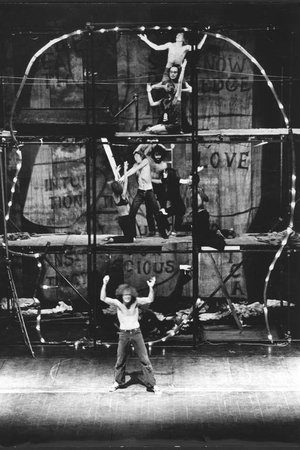
The Living Theatre - a video retrospective(2013)
The Living Theatre is an experimental company founded in New York in 1947 by Julian Beck (New York 1925-1985), painter and poet, and the actress and stage director Judith Malina (Kiel 1926), a student of Erwin Piscator. From the very beginning the group’s activities bore the stamp of social and political commitment, imbued with a strong libertarian matrix. A video montage of films and videos from The Living Theatre Archives.
Movie: The Living Theatre - a video retrospective
Top 2 Billed Cast
HomePage
Overview
The Living Theatre is an experimental company founded in New York in 1947 by Julian Beck (New York 1925-1985), painter and poet, and the actress and stage director Judith Malina (Kiel 1926), a student of Erwin Piscator. From the very beginning the group’s activities bore the stamp of social and political commitment, imbued with a strong libertarian matrix. A video montage of films and videos from The Living Theatre Archives.
Release Date
2013-03-31
Average
0
Rating:
0.0 startsTagline
Genres
Languages:
EnglishKeywords
Similar Movies

Performing the Goddess(bn)
"Chapal Bhaduri, a leading lady of Bengal’s traditional folk traveling theatre-in-the-round, the Jatra, spent his life playing women. This film is an intimate biography that brings you face to face with this unique individual, sharing what it means to him to become a woman night after night, talking of the woman inside his body, of troubled sexuality, of a long partnership with his older lover, of the loneliness of living on the edges of conventional society–and showing how he metamorphoses into the goddess to perform her story." - The Bangalore International Centre

Signals Through the Flames(en)
Signals Through the Flames is at once a history and a celebration of the Living Theatre. Founded in the late 1940s by husband-and-wife performers Julian Beck and Judith Malina, the Living Theatre was for many years the predominent American outlet for the avant-garde movement. There were occasional self-imposed exiles to Europe in the 1950s and 1960s, but the group returned full-force during the Aquarius Age to entertain a new generation of theatregoers.

Inside/Outside(en)
Truth becomes the source of creativity; actions are a result of being, not thinking. This film, INSIDE/OUTSIDE is based upon Monika’s processes over many years. Robert Golden has had the privilege of meeting and photographing some of Monika’s late work. Although her teaching is for performers, Robert has said that her gift of understanding humanity has been gifted in some small ways to him. Monika’s inspirational way of working, helps actors to find a unity between their inner psyche and its outer expression. The 46-minute film shows a precise description of her work. Monika explains it in detail along with thoughts about movement, performance and theatre. The insightful and entertaining book and film are relevant to actors, dancers, Laban yoga, Feldenkrais, Pilates and other sports and movement systems and to people working with children.

Who Killed the Federal Theatre?(en)
Part journalistic investigation and part performance documentary, "Who Killed The Federal Theater?" tells the story of the Federal Theatre Project within the context of a volatile period in the political, social and cultural history of the United States. The film features interview segments with playwrights, including Arthur Miller, and with actors, directors, designers, and historians. It also incorporates rare archival materials and dramatic sequences, including professionally re-created scenes from Federal Theatre productions that transport viewers back in time to a bygone era in American history and entertainment.

Discovering Hamlet(en)
Journey into "Hamlet"-the play and the man-through the experiences of some of the major actors and directors who have brought Shakespeare's great tragedy to life. Christopher Plummer, David Tennant, John Nettles, John Simm, Sir Trevor Nunn, Franco Zeffirelli, Philip Saville, and others explore the enduring appeal of the Prince of Denmark more than 400 years after his stage debut.


Merci Zaza - La Folle Histoire de la Cage aux Folles(fr)
A look back at "La Cage aux Folles", which ran non-stop for five years, from February 1973, on the stage of the Théâtre du Palais Royal in Paris. At a time when homosexuality was considered a crime by the law, Poiret and Serrault achieved great success in boulevard theater. Their success continued on the silver screen, with three Oscar nominations and a Broadway musical. Combining never-before-seen archives from the play, extracts from the film, confessions by Poiret and Serrault, and interviews with witnesses, this is the story of a wild epic.

Me, brother and the name Hrušínský(cs)
According to family legend, the name Hrušínský was born after Rudolf and Jan Hrušínský's grandfather Rudolf Böhm was caught stealing pears on a theater stage. The German name Böhm suddenly became Hruškovský and shortly after that Hrušínský. Grandfather Rudolf, later known as Rudolf Hrušínský the eldest, adopted the surname as his own and began using it in 1935. However, the history of the Hrušínský acting family goes back much further. It is therefore not surprising that the brothers Rudolf and Jan also took the same path. The documentary charts their acting beginnings alongside their father Rudolf Hrušínský Sr., from their first roles, through theater engagements at the Drama Studio in Ústí nad Labem and the Drama Club in Prague, to unforgettable film and television roles, when three generations of Hrušínskýs often met in front of the camera.


The King of Laughter(it)
In early 20th-century Naples, a theatrical parody lands beloved thespian and playwright Eduardo Scarpetta in court, facing a malicious lawsuit that could compromise his freedom of expression and the economic security of his extended family—including his son's, young Eduardo De Filippo.

The Trials of Oscar Wilde(en)
England, 1890s. The brutal and embittered Marquis of Queensberry, who believes that his youngest son, Bosie, has an inappropriate relationship with the famous Irish writer Oscar Wilde, maintains an ongoing feud with the latter in order to ruin his reputation and cause his fall from grace.

Song of the Rivers(de)
An allegorical documentary about the workers of the world, whose common destinies and hopes for peace are symbolically united by the rivers that run through their respective lands. The film was shot on the Volga, the Mississippi, the Nile, the Yangtze, the Amazon and the Ganges and combines these images of five continents with the music of Dmitri Shostakovich and the poetry of both Bertolt Brecht and Paul Robeson.

O Gigante(pt)
Compilation of images by cameraman William Gericke (credited as producer and cinematographer), who for 50 years traveled around Brazil and recorded some rare images of the country's history in the 20th century.

Algeria, Special Weapons Sections(fr)
This documentary by director Claire Billet and historian Christophe Lafaye details the massive and systematic use of chemical weapons during the Algerian War. Algerian fighters and civilians, sheltering in caves, were gassed by "special weapons sections" of the French army. The gas identified on military documents is CN2D, whose widespread use forced insurgents to flee "treated" sites, at the risk of dying there. The method is reminiscent of the "enfumades" used by the French expeditionary force during the conquest of Algeria in the 19th century. Between 8,000 and 10,000 such operations are believed to have taken place on Algerian soil between 1956 and 1962. This historical aspect is little known due to the difficulty of accessing archives, many of which are still classified, raising questions about memory, historical truth, and justice.

The Ornament of the World(en)
Filmed in Cordoba, Granada, Seville, and Toledo, this documentary retraces the 800-year period in medieval Spain when Muslims, Christians, and Jews forged a common cultural identity that frequently transcended their religious differences, revealing what made this rare and fruitful collaboration possible, and what ultimately tore it apart.

Whale Wisdom(en)
Whales have long been a profound mystery to us. They live in a world so removed from our own that we can barely imagine their lives. Their environment is different, their senses are different, their relationships are different. How might such almost alien creatures see the world?

Beneath the Olive Tree(en)
The departure point for this film is a series of notebooks created during the Greek civil war of 1946-49 and first discovered years later, under an olive tree. Inside their pages, diary-like, deported women recount their experiences in Greek concentration camps. Many of them were active in the resistance under Nazi occupation. Actress Olympia Dukakis, who serves as the film’s narrator, was also the individual who originally called director Toska’s attention to the unique documents.

Froth(ru)
From the Barents Sea, a chill wind seems to blow constantly across a semi-deserted town at the edge of the world. Nevertheless, a little community holds out here. In a flawlessly filmed portrait of this extraordinary place, the theme linking the residents is their determination to chart their own course. Bardak was a marine, but his garrison broke up and his comrades sought a better life elsewhere. He stayed behind among the many empty buildings that are slowly but surely being consumed by the elements. Meanwhile, Dima, a young poacher, flouts as many rules as he can, but gives friendly directions to lost tourists and reads lovingly to his little daughter. Ferryman Alexander is locked in a silent generational battle with his teenage daughter Masha; her eyes are on the outside world. Further along, a little team of ships from the Second World War turns up, and a woman steadfastly runs a weather station.