Loading Page

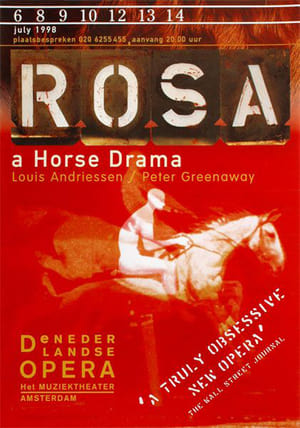
The Death of a Composer: Rosa, a Horse Drama(1999)
Status: Released
Date: 1999-09-04
33%
3 Votes
Time: 1h 30m
Overview:
"Rosa", with a libretto by Peter Greenaway and score by Louis Andriessen, is the first in a projected series of 10 operas, each dealing with the death of a famous composer - some real, others fictional. "Rosa" falls into the latter category; it tells the story of Juan Manuel de Rosa, a Brazilian who went to study music in America but spent most of his time in the cinema instead, becoming particularly entranced by Westerns. Now 32 years old and residing in an abandoned Uruguayan slaughterhouse, Rosa has become one of Hollywood's foremost composers, specialising in Westerns. He also has a beautiful 19-year-old fiancee, Esmeralda, but he pays her little heed, instead lavishing his attentions on a black mare named Bola. One day, a group of men attired as cowboys arrive at the abattoir and kill both Rosa and Bola; an investigation is conducted, with particular suspicion!
Languages: English.
Countries:
Netherlands
ProductionCompanies: 
Movie: The Death of a Composer: Rosa, a Horse Drama
Top 8 Billed Cast

Peter Greenaway
Narrator
Video Trailer The Death of a Composer: Rosa, a Horse Drama
Video: Rosa, a horse drama - excerpts

Rosa, a horse drama - excerpts

Rosa: a Horse drama - 50 jaar De Nationale Opera
All 2 videos

Rosa, a horse drama - excerpts - Featurette

Rosa: a Horse drama - 50 jaar De Nationale Opera - Clip
Recommendations Movies

69%
Destroy All Monsters(ja)
1968-08-01
At the turn of the century, all of the Earth's monsters have been rounded up and kept safely on Monsterland. Chaos erupts when a race of she-aliens known as the Kilaaks unleash the monsters across the world.

77%
Musangwe: Fight Club(en)
2007-10-01
The first rule is that there are no rules. For the bare-knuckle combatants competing in Musangwe fights, anything goes - you can even put a curse on him. The sport, which dates back centuries, has become a South African institution. Any male from the age of nine to ninety can compete. We follow a group of fighters as they slug it out in the ring. Who will be this year's champion?

56%
Zombie Fight Club(zh)
2014-10-23
It's the end of the century at a corner of the city in a building riddled with crime - Everyone in the building has turned into zombies. After Jenny's boyfriend is killed in a zombie attack, she faces the challenge of surviving in the face of adversity. In order to stay alive, she struggles with Andy to flee danger.


77%
Vivre Sa Vie(fr)
1962-09-20
Twelve episodic tales in the life of a Parisian woman and her slow descent into prostitution.

76%
GCW Fight Club(en)
2021-10-09
GCW presents Fight Club straight from the Showboat Hotel in Atlantic City, NJ! The event features the GCW World Championship match where Mox defends against Gage in a match that we have been waiting for during the last decade. Who will be the new GCW World Champion?

77%
Panda! Go Panda!(ja)
1972-12-17
Cheerful Mimiko has a wonderfully strange family—a Panda for her Papa; and his son Panny, calls her Mom! When Panny follows Mimiko to school, he must pretend to be a teddy bear so Mimiko won't get into trouble. Despite his efforts to behave, Panny causes trouble in school and now the school is after Panny! Then, Panny makes a new friend, Tiny, a baby tiger who's wandered off from the circus.

62%
The Frozen North(en)
1922-08-28
A mix of guns and mistaken identity leads to chaos in this satirical parody of William S. Hart's melodramatic westerns, finding Buster in the frozen north - "the last stop on the subway".


76%
Drunken Angel(ja)
1948-04-27
In postwar Tokyo, a blunt, alcohol-soaked doctor diagnoses a swaggering young yakuza with tuberculosis, forging an uneasy bond that’s tested when the gangster’s ruthless former boss returns and drags him back toward the swampy underworld he can’t escape.

74%
Florence Fight Club(ru)
2015-06-21
Intertwined stories from the gladiator/athletes participating to the Calcio Storico Fiorentino yearly championship.

60%
Strange Object(en)
2020-10-07
An archival investigation into the imperial image-making of the RAF ‘Z Unit’, which determined the destruction of human, animal and cultural life across Somaliland, as well as Africa and Asia.

42%
Kiss Kis Ko(hi)
2004-10-29
In the background of a lot interest being shown in music groups, a group of young Indian men, calling themselves "Band of Boys", decide to perform publicly, to share their talents India-wide, as well as to make a career for themselves. They run into problems - it seems the public is only interested seeing a group of sexy young girls perform. This group must now compromise to include a young, sexy girl to be included in their band.

70%
L'Argent(fr)
1983-05-18
A forged 500-franc note is passed from person to person and shop to shop, until it falls into the hands of a genuine innocent who doesn't see it for what it is—which will have devastating consequences on his life.

76%
The Testament of Dr. Mabuse(de)
1933-04-21
After a detective is assaulted by thugs and placed in an asylum run by Professor Baum, he observes the professor's preoccupation with another patient, the criminal genius Dr. Mabuse the hypnotist. When Mabuse's notes are found to be connected with a rash of recent crimes, Commissioner Lohmann must determine how Mabuse is communicating with the criminals, despite conflicting reports on the doctor's whereabouts, and capture him for good.

65%
The Harder They Come(en)
1972-08-01
Ivanhoe Martin arrives in Kingston, Jamaica, looking for work and, after some initial struggles, lands a recording contract as a reggae singer. He records his first song, "The Harder They Come," but after a bitter dispute with a manipulative producer named Hilton, soon finds himself resorting to petty crime in order to pay the bills. He deals marijuana, kills some abusive cops and earns local folk hero status. Meanwhile, his record is topping the charts.

72%
Three Sexy Meals(ko)
2016-11-09
Yong-hwa (Sang-woo), Marshall (Lee Eun-mi-I), Ddeok-bae (Do Mo-se) and Bang-wool (Park Joo-bin) steal from Chairman Kang and hide out in a pension in the country. They depend on each other and enjoy every day until Ddeok-bae accidentally loses their bag of money and Bang-wool falls ill. Chairman Kang is closing in on them and the four of them use their specific 'techniques' to start a 12 hour adult program. Will they succeed?

79%
Pixote(pt)
1980-09-26
10-year-old Pixote endures torture, degradation, and corruption at a local youth detention center where two of its members are murdered by policemen who frame Lilica, a 17-year-old trans hustler. Pixote helps Lilica and three other boys escape and they start to make their living by a life of crime which only escalates to more violence and death.
Similar Movies

50%
Owen Wingrave(en)
2001-01-01
Margaret Williams directs this 2001 production of adaptation of Benjamin Britten's television opera based on a short story by Henry James. Performers featured include Gerald Finley, Peter Savidge and Josephine Barstow. The conductor is Kent Nagano. As pertinent now as then, OWEN WINGRAVE was composed by Benjamin Britten at the height of the Vietnam War. The opera poses the question: Is pacifism an act of cowardice? Or rather a desire to escape from the spiral of war and create world peace? To what extent do we determine our own futures? Should we let past events inform the decisions we make? Britten’s characters grapple with timeless issues in this gripping psychodrama.

90%
Don Giovanni(it)
1987-07-18
Live performance from Salzburger Festspiele in 1987. Herbert von Karajan conducting the Wiener Philharmoniker and Wiener Staatsopernchor. Stage director Michael Hampe. Starring Samuel Ramey and Anna Tomowa-Sintow.

100%
The Metropolitan Opera: Lulu(de)
2015-11-21
William Kentridge’s multi-layered production of Berg’s masterpiece stars charismatic soprano Marlis Petersen in the title role—the enigmatic and alluring woman who is equal parts femme fatale, innocent girl, and abused victim. The men around her, whose lives she forever alters, are Johan Reuter as newspaper publisher Dr. Schön; Daniel Brenna as his composer son, Alwa; Paul Groves as the Painter; and Franz Grundheber as Schigolch. Susan Graham sings Countess Geschwitz, and Lothar Koenigs conducts Berg’s landmark score.


0%
Les Boréades(fr)
2003-03-01
Director Robert Carsen and his creative team flood the stage with summer blossoms, drifts of autumn leaves, winter snows and thunderous spring storms. The cast of 140 are attired in elegant costumes inspired by late 1940s Dior. This mythical tale of a young queen, Alphise, determined to abdicate rather than contemplate an enforced marriage to a descendant of Boreas, is nothing less than highly-charged.

20%
Les Paladins(fr)
2005-03-13
Inspired by a fable by La Fontaine, [composer Jean-Philippe] Rameau produced perhaps his most brilliant music for his penultimate great work, blending reality and the surreal on several levels.

100%
La Bohème(it)
1977-03-14
Puccini’s heartbreaking story of young love in the garrets of Belle Epoque Paris has attracted many famous singers through the years. But with James Levine at the helm and the starry duo of Luciano Pavarotti and Renata Scotto as Rodolfo and Mimi, every bit of emotion in the score pours across the footlights and seduces the audience. In this case, the audience was in the millions since this was the very first in the “Live from the Met” series of telecasts. The evocative production is by Fabrizio Melano, designed by Pier Luigi Pizzi.


30%
7 Deaths of Maria Callas(en)
2022-07-24
A meditation on the female body as a source of both power and pain that focuses on the tragic figure of renowned American-Greek opera singer Maria Callas (1923-77), whose stunning soprano voice captivated audiences around the world in the mid-20th century while her life was wracked by scandal and personal suffering.

54%
The Phantom of the Opera(en)
1983-01-29
The Budapest Opera House's diva commits suicide after the owner ruins her career for having rejected his advances but her conductor-husband, believed killed in a fire, plans his revenge on all those he deems responsible for her suicide.

0%
Giuseppe Verdi: Simon Boccanegra(it)
1995-01-26
This evocative production by Giancarlo Del Monaco sumptuously captures the look and feel of 14th century Genoa and is a perfect compliment to Verdi’s setting of this story of searing conflict between public duty and private grief. Plácido Domingo is Gabriele Adorno, sworn enemy of the doge of Genoa, Simon Boccanegra (Vladimir Chernov). Gabriele is in love with the beautiful Amelia (Kiri Te Kanawa at her most affecting) who turns out to be none other than the long-lost daughter the doge. James Levine’s authoritative conducting of the Met orchestra and chorus reveals the dark power of Verdi’s score. Performed January 26th, 1995.

0%
Verdi: Don Carlo(it)
2018-10-06
Elizabeth of Valois is promised in marriage to Don Carlos of Spain, as part of a peace treaty between the two kingdoms. They meet and fall in love – but no sooner have they declared their love than news comes that the terms of the treaty have changed: Elizabeth is to marry Carlos’s father Philip instead. Politics and religion are dangerously entwined in Giuseppe Verdi’s Don Carlo. Performed on November 30th, 2016, at the Opéra national du Rhin, Strasbourg.

0%
Royal Opera House: Madama Butterfly(en)
2024-03-26
Cio-Cio-San, the young Japanese bride of American naval officer Lieutenant Pinkerton, finds her romantic idyll shattered when he deserts her shortly after their marriage. She lives in hope that one day he will return.

0%
Jarrell: Bérénice(fr)
2018-09-26
Titus and Berenice love each other; under the watchful eye of Antiochus, the hopeless lover, they try yet refuse to understand each other. Taking up the “majestic sadness” of these alexandrines, among the greatest verses in the French language, Michael Jarrell amplifies the power of words, making them a vehicle for spaces and identities that, from Rome to Jerusalem, are unceasingly questioned.

0%
Berg: Wozzeck(de)
2017-04-24
Separated and fragmented, the scenes combine in a series of tableaux to tell the story of Wozzeck, an ordinary soldier whose only solace is the love of his companion Marie. However, the latter’s fidelity is not unfailing and Wozzeck is haunted by torment. His officers and comrades in arms do little to improve the situation. The omnipresent tension in this profoundly romantic work unifies the fifteen scenes with their complex tonalities alternating between Verist notes and the force of ritualised actions. Christoph Marthaler’s production provides an atmosphere of contemporaneity strongly accentuated by the choice of a single set, where the men’s despair is submerged in Berg’s dearly sought-after sobriety.

0%
Tchaikovsky: Eugene Onegin(ru)
2017-05-16
Inspired by Pushkin's masterpiece of Russian literature, Tchaikovsky’s opera provides a sublime portrait – both ironic and sympathetic – of a character embittered by society life, rejecting love out of vanity, killing his friend the poet Lenski out of pride and spending the rest of his days in abject despair. A repertoire classic, Willy Decker’s streamlined production makes the Paris Opera echo once more to the strains of Russian romantic music. Edward Gardner conducts an exceptional cast including Peter Mattei in the title role and Anna Netrebko as Tatiana.

85%
Benvenuto Cellini(en)
2018-04-12
The Florentine sculptor and silversmith Benvenuto Cellini rapidly attained a degree of renown that went beyond the confines of Italy. Invariably embroiled in conspiracies, intrigues and quarrels, Cellini is commissioned by the Pope to cast a large sculpture of Perseus. He is loved by Teresa, but she is promised to Fieramosca, an academic artist who has not been favoured with a papal commission. Terry Gilliam’s exuberant production draws the protagonists into a delirious and joyful yet claustrophobic and megalomaniac world: a flaring up of contagious madness.

80%
Il Trovatore(it)
1988-10-15
Luciano Pavarotti brings his spectacular voice and artistry to one of the most famous of all tenor roles—Manrico, the ardent troubadour, trapped in an impossible situation by forces beyond his control. The sensational Dolora Zajick, only days after her Met debut, gives an incandescent performance as the demented gypsy Azucena, thirsting for revenge against Count Di Luna (Sherrill Milnes). Eva Marton is the passionate Leonora, desired by both Manrico and the Count, and James Levine brilliantly leads the Met’s orchestra and chorus in some of Verdi’s best-known music.

0%
Dido and Aeneas(en)
1996-11-18
Maria Ewing, as Dido, heads an outstanding cast of young British singers in a film adaptation of Henry Purcell’s much-loved tragic opera. With spectacular sets, this intense tale of heroism, passion, betrayal and ultimate tragedy is played out against a backdrop of fiery rituals, evil spells and pageantry.

0%
Tosca(it)
1978-11-27
A stellar cast brings Puccini’s spellbinding opera to life, seizing every opportunity to thrill the audience. Luciano Pavarotti is Cavaradossi, the painter and political revolutionary in love with the beautiful and famous singer Tosca (the riveting Shirley Verrett). Rome’s diabolical chief of police, Baron Scarpia (Cornell MacNeil), wants Tosca for himself—but he underestimates the fury of a woman in love. With torture, murder, and a suicide in its final moments, Tosca packs more dramatic punches than most other operas—and this classic telecast captures them all. James Conlon conducts in a production by the incomparable Tito Gobbi, one of the great Scarpias of the 20th century.