Loading Page

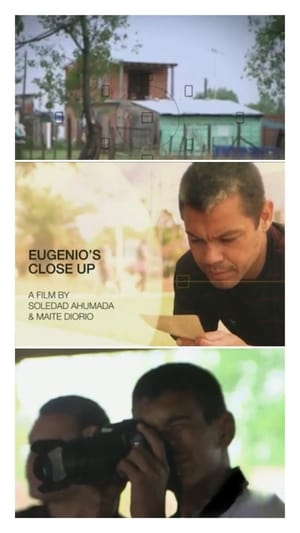
Eugenio's Close Up: Inside the Slums of Buenos Aires(2016)
Status: Released
Date: 2016-04-26
0%
0 Votes
Time: 0h 25m
Overview:
Eugenio's Close Up: Inside the Slums of Buenos Aires A professional photographer seeks to infuse his Buenos Aires slum with art, creativity and free expression. As with so many of the marginalised shanty towns of Latin America, there is a wellspring of violence and economic despair. Caught in the ever-shifting instability of Argentina's economy, there is little chance that these slums will be transformed or that their residents will be able to easily escape the country's cyclical poverty. Despite this for Eugenio, a 32-year-old photographer who still calls the slum of Villa 15 his home, there is a persistent richness to the life around him, and hope.
Languages:
Countries:
Movie: Eugenio's Close Up: Inside the Slums of Buenos Aires
Top 1 Billed Cast
HomePage
Overview
Eugenio's Close Up: Inside the Slums of Buenos Aires A professional photographer seeks to infuse his Buenos Aires slum with art, creativity and free expression. As with so many of the marginalised shanty towns of Latin America, there is a wellspring of violence and economic despair. Caught in the ever-shifting instability of Argentina's economy, there is little chance that these slums will be transformed or that their residents will be able to easily escape the country's cyclical poverty. Despite this for Eugenio, a 32-year-old photographer who still calls the slum of Villa 15 his home, there is a persistent richness to the life around him, and hope.
Release Date
2016-04-26
Average
0
Rating:
0.0 startsTagline
Genres
Languages:
Keywords
Similar Movies

75%
Messi(es)
2014-09-06
His teachers, coaches, childhood friends and Barça teammates, together with journalists, writers and prominent figures from the history of football, come together in a restaurant to analyze and pick apart Messi's personality both on and off the field, and to look back at some of the most significant moments in his life. Viewed from Álex de la Iglesia's unique perspective, Messi recreates the player's childhood and teenage years, from his very first steps, with a football always at his feet, through to the decision to leave Rosario for Barcelona, the separation from his family, and the role played in his career by individuals such as Ronaldinho, Rijkaard, Rexach and Guardiola.

0%
Resistencia Cultural(es)
2021-04-08

0%
#monalisa(en)
2020-05-29
People looking at the Mona Lisa in the Louvre – or are they just looking at themselves?

0%
Man Ray: Prophet of the Avant-Garde(en)
1997-04-09
Man Ray, the master of experimental and fashion photography was also a painter, a filmmaker, a poet, an essayist, a philosopher, and a leader of American modernism. Known for documenting the cultural elite living in France, Man Ray spent much of his time fighting the formal constraints of the visual arts. Ray’s life and art were always provocative, engaging, and challenging.

60%
Corporate Accountability(es)
2020-02-21
Images of Argentinian companies and factories in the first light of day, seen from the inside of a car, while the director reads out documents in voiceover that reveals the collusion of the same concerns in the military dictatorship’s terror.

80%
Social Genocide(es)
2004-03-18
After the fall of the military dictatorship in 1983, successive democratic governments launched a series of reforms purporting to turn Argentina into the world's most liberal and prosperous economy. Less than twenty years later, the Argentinians have lost literally everything: major national companies have been sold well below value to foreign corporations; the proceeds of privatizations have been diverted into the pockets of corrupt officials; revised labour laws have taken away all rights from employees; in a country that is traditionally an important exporter of foodstuffs, malnutrition is widespread; millions of people are unemployed and sinking into poverty; and their savings have disappeared in a final banking collapse. The film highlights numerous political, financial, social and judicial aspects that mark out Argentina's road to ruin.

60%
Debt(es)
2004-10-07
DEBT is the story of a frantic pursuit: the search for the responsible for the televised cry of hunger of Barbara Flores, an eight-year-old Argentinean girl. Buenos Aires, Washington, the IMF, the World Bank and Davos; corruption and the international bureaucratic lack of interest.


66%
Favela Gay(pt)
2014-10-07
Favela Gay tells the story of eleven individuals in their own words. Living in eight slums (favelas) in Rio de Janeiro, these members of the LGBTQ community – two transgender women, a crossdressing man, a travesti prostitute, a famous carnival dancer, two community activists, and even a young man who used to be transgender, but transitioned back – have fought prejudice and seen some of the most unsavoury sides of the city.

69%
Smash His Camera(en)
2010-07-30
A film centering on the life and work of Ron Galella that examines the nature and effect of paparazzi.

0%
Argentina... Argentina...(es)
2006-03-27

0%
Hayashi Studio(en)
2019-07-15
Who is missing in our history? Hayashi Studio investigates the hidden history of BC, as documented by a Japanese photographer, Senjiro Hayashi.

67%
Instant Dreams(en)
2017-12-14
There could hardly be a more telling contrast between the analog and digital eras than the beautifully blurry memories captured in a Polaroid picture and the thousands of pin-sharp photos on an iPhone. In this ambitious visual essay, Willem Baptist explores the visionary genius of Edwin H. Land, the inventor of the Polaroid camera. Even today, all sorts of people are keeping his instant dream alive. Former Polaroid employee Stephen Herchen moved from the United States to Europe to work in a laboratory developing the 2.0 version of Polaroid. Christopher Bonanos, the author of Instant: The Story of Polaroid, tells us, "When I heard Polaroid would stop making film, it felt like a close friend had died." Artist Stefanie Schneider, who is working with the last of her stock of Polaroid film, is using the blurring that occurs with expired film as an additional aesthetic layer in her photographic work.

0%
Living Photograph: Chris with Teacup(en)
2007-08-21
The original Living Photograph on YouTube. Starring Chris, a teacup, a red lamp and a tasteful, yet mildly uninspired window treatment.

66%
The Dread(es)
2017-12-01
The villagers of El Dorado, Argentina, shy away from doctors. Then again, they hardly need one. They have almost as many cures for ailments and illnesses as there are residents in the village. 65 year old Jorge can also cure the most dreaded ailment of them all, the much feared espanto.

70%
Witkin & Witkin(en)
2017-10-22
A pair of identical twins, one a photographer and the other a painter, have very little in common.

80%
I'm Not Everything I Want to Be(cs)
2024-10-03
After the Soviet invasion of Czechoslovakia in 1968, Libuše Jarcovjáková, a young female photographer, strives to break free from the constraints of Czechoslovak normalization and embarks on a wild journey towards freedom, capturing her experiences on thousands of subjective photographs.

70%
Disfarmer: A Portrait of America(en)
2010-05-31
Mike Disfarmer, small town portrait photographer turned posthumous art star. This is the story of an eccentric curmudgeon and artistic icon whose powerful pictures of depression-era USA have left an unlikely mark on the modern Manhattan art world.


100%
Imitating Life - The Audacity of Suzanne Heintz(en)
2019-11-10
Satirical artist and art director, Suzanne Heintz, adopted her fake family more than 15 years ago to challenge persisting stereotypes about women's lives.