
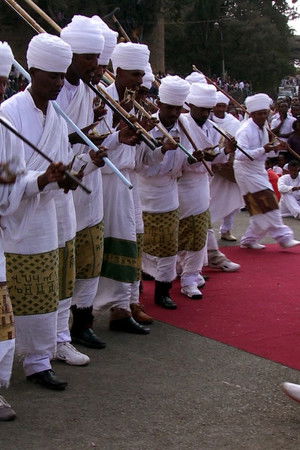
Abyssinia Ethiopia meeting point(2011)
The meeting of Getnet, an Ethiopian Jew and Salomon, an orthodox Christian, takes us into the heart of Ethiopia’s history and religious traditions. They travel 900 kilometres, showing us their universe. They finally arrive into the whirlwind of the Ethiopian Epiphany, the most spectacular event in the Horn of Africa.
Movie: Abyssinia Ethiopia meeting point
HomePage
Overview
The meeting of Getnet, an Ethiopian Jew and Salomon, an orthodox Christian, takes us into the heart of Ethiopia’s history and religious traditions. They travel 900 kilometres, showing us their universe. They finally arrive into the whirlwind of the Ethiopian Epiphany, the most spectacular event in the Horn of Africa.
Release Date
2011-09-25
Average
0
Rating:
0.0 startsTagline
Genres
Languages:
Keywords
Similar Movies

The Other Side(en)
Set against the Ethiopian abandoned children crisis, two orphan brothers are faced with the reality of never being adopted. Inspired by a true story.

The State Against Mandela and the Others(fr)
South Africa, July 11th, 1963. Several members of the African National Congress, an organization declared illegal, are arrested in Rivonia, a country house near Johannesburg. The detainees, along with Nelson Mandela, imprisoned since 1962, are charged with serious crimes for their radical activism against the apartheid regime.


This Magnificent Cake!(fr)
In 1885, Africa is a succulent cake destined to be wildly divided and everyone wants a piece. A disturbed European king, a Pygmy working in a luxury hotel, a successful but lonely businessman, an enslaved porter, a young army deserter, a ghostly clarinetist. Some benefit from colonialism and greed. Others suffer racism and violence.

Dahomey(fr)
Thousands of royal artifacts of Dahomey, a West African kingdom, were taken by French colonists in the 19th century for collection and display in Paris. Centuries later, a fraction returned to their home in modern-day Benin. This dramatized documentary follows the journey of 26 of the treasures as told by cultural art historians, embattled university students, and one of the repatriated statues himself.


Teza(am)
The Ethiopian intellectual Anberber returns to his native country during the repressive totalitarian regime of Haile Mariam Mengistu and the recognition of his own displacement and powerlessness at the dissolution of his people's humanity and social values. After several years spent studying medicine in Germany, he finds the country of his youth replaced by turmoil. His dream of using his craft to improve the health of Ethiopians is squashed by a military junta that uses scientists for its own political ends. Seeking the comfort of his countryside home, Anberber finds no refuge from violence. The solace that the memories of his youth provide is quickly replaced by the competing forces of military and rebelling factions. Anberber needs to decide whether he wants to bear the strain or piece together a life from the fragments that lie around him.

The Red Sea Diving Resort(en)
Sudan, East Africa, 1980. A team of Israeli Mossad agents plans to rescue and transfer thousands of Ethiopian Jews to Israel. To do so, and to avoid raising suspicions from the inquisitive and ruthless authorities, they establish as a cover a fake diving resort by the Red Sea.

Sweetness in the Belly(en)
Orphaned in Africa as a child, Lilly escapes to England as a refugee, fleeing civil war in Ethiopia. Lost in this cold new world, Lilly embraces the immigrant community in London, attempting to reunite people with their scattered families. But as her friend Amina discovers, Lilly's mission isn't purely selfless: a passionate lost love affair is revealed.

Uncut Gems(en)
A charismatic New York City jeweler always on the lookout for the next big score makes a series of high-stakes bets that could lead to the windfall of a lifetime. Howard must perform a precarious high-wire act, balancing business, family, and encroaching adversaries on all sides in his relentless pursuit of the ultimate win.

Beyond Borders(en)
Sarah Jordan, an American living in London in 1984, is married to the son of a wealthy British industrialist. She encounters Nick Callahan, a renegade doctor, whose impassioned plea for help to support his relief efforts in war-torn Africa moves her deeply. As a result, Sarah embarks upon a journey of discovery that leads to danger, heartbreak and romance in the far corners of the world.

Serengeti Shall Not Die(de)
The film tells of the beginnings of the Serengeti National Park in Tanzania. At the end of the 1950s, the Tanzanian National Park Administration wanted to fence in the protected area around the Ngorongoro Crater. Bernhard and Michael Grzimek were invited by the national park administration in 1957 to get a precise picture of the animal migrations and to provide the national park administration with the values they needed for their project. Using a new counting method with two airplanes, the Grzimeks found out that the migration of the herds was different than assumed.

Kenyatta(en)
Jomo Kenyatta's death in 1978 brought to an end a political career that encompassed more than 50 years of African history. Kenyatta entered politics in the mid-1920s and then spent 17 years in exile in Europe. He returned to Kenya in 1946, and was elected president of the nationalist movement, the Kenya African Union. Arrested and imprisoned in 1952 for allegedly leading 'Mau Mau', he was released in 1961 and two years later became Kenya's first Prime Minister. In power, the man whom European settlers had once reviled as "the leader to darkness and death" was eulogized by them as a pillar of stability, while former allies challenged him by creating a left-leaning political opposition. Kenyatta weaves archival and contemporary images with interviews with friends and relatives, comrades and opponents, to create a biographical portrait of a key figure in 20th century politics, and a case study of what Frantz Fanon called the pitfalls of nationalism as a political force in Africa.

Shepherds of the Earth(en)
The region of Lake Turkana, located in Kenya and Ethiopia, is considered to be “the Cradle of Humankind”. Among other finds, primate fossils from millions of years ago have been discovered in the region. But what about the region’s modern inhabitants and their relationship to their environment? Iiris Härmä, whose previous work includes the award-winning Leaving Africa, had the chance of joining Helsinki University’s researchers, Álvaro Fernández-Llamazares and Mar Cabeza, on their pre-pandemic trip to study the Daasanach people’s relationship to their environment through traditional animal tales. The researchers hope that storytelling would help to bridge the gap between people’s everyday lives and conservation efforts.

The Best of Enemies(en)
During World War II, a plane full of RAF fighter crashes in the Ethiopian desert and they are met upon by an enemy Italian patrol that allows them to go free. But, when the Brits are given orders to attack the Italians, lots of problems ensue.

Made in Ethiopia(am)
When a massive Chinese factory complex attempts a high-stakes expansion in rural Ethiopia, three women in search of prosperity have their faith in industrialization tested to the limit. Filmed over four years with singular access, Made in Ethiopia lifts the curtain on China’s historic but misunderstood impact on Africa, and explores contemporary Ethiopia at a moment of profound crisis. The film was awarded the Jury Special Mention at Tribeca Festival.

Palm Trees in the Snow(es)
Spain, 2003. An accidental discovery leads Clarence to travel from the snowy mountains of Huesca to Equatorial Guinea, to visit the land where her father Jacobo and her uncle Kilian spent most of their youth, the island of Fernando Poo.

Shooter(en)
A top Marine sniper, Bob Lee Swagger, leaves the military after a mission goes horribly awry and disappears, living in seclusion. He is coaxed back into service after a high-profile government official convinces him to help thwart a plot to kill the President of the United States. Ultimately double-crossed and framed for the attempt, Swagger becomes the target of a nationwide manhunt. He goes on the run to track the real killer and find out who exactly set him up, and why, eventually seeking revenge against some of the most powerful and corrupt leaders in the free world.

Shaft in Africa(en)
Detective John Shaft travels incognito to Ethiopia, then France, to bust a human trafficking ring.

Madagascar: The Red Island Uprising(fr)
On March 29, 1947, peasants armed with sticks and knives attacked the French garrisons in Madagascar. The revolt would end twenty months later with the death of the last insurgents, shot down by the expeditionary force. France, accustomed to memory lapses, knew nothing of this insurrection and its trail of torture and abuses. In Madagascar, well after independence, the events of 1947 were never discussed. For more than a generation, parents refused to speak of them to their children. It wasn't until the 1980s that the silence was broken.