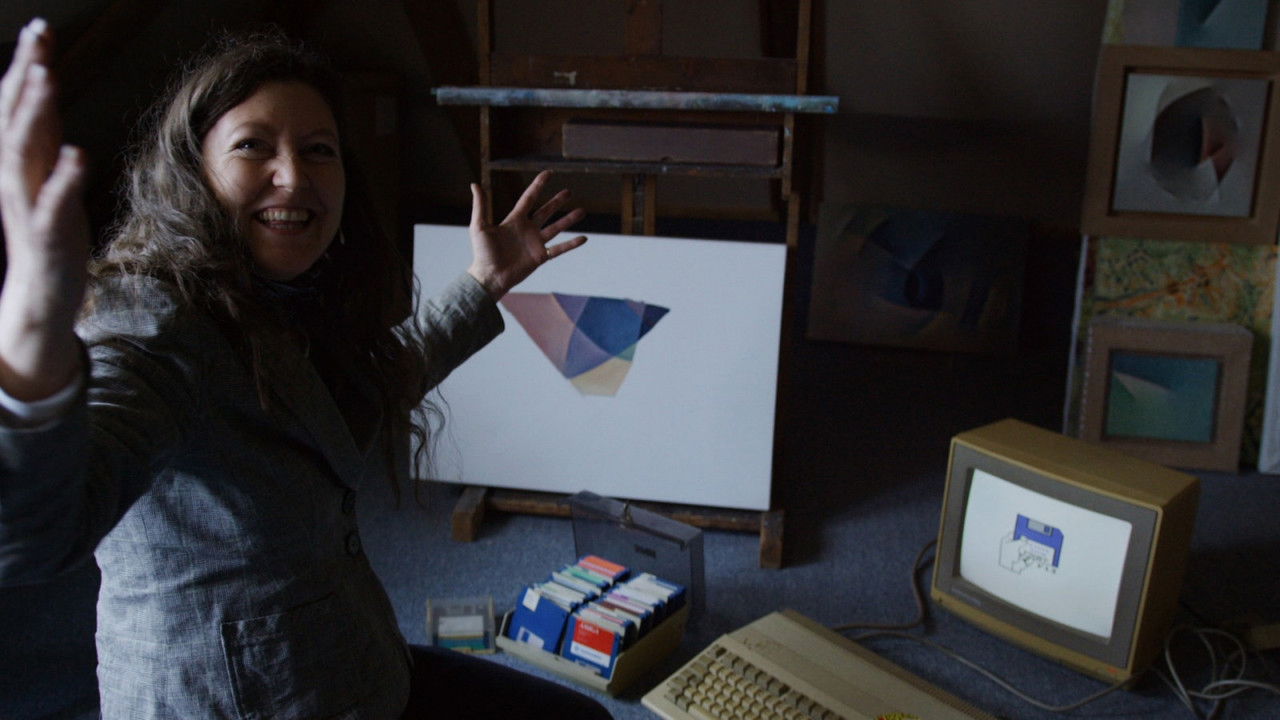

Viva video, video viva(2020)
Today, analogue video is attractive primarily thanks to the distinctive aesthetic quality of its pixelated image and raster errors. But for Czech artists who first explored the possibilities offered by video art in the late 1980s, this medium represented a path towards freedom. Through a portrait of her grandfather Radek Pilař, one of the pioneers of Czech video art, the director explores her own legacy of imperative creative fascination. Her film’s main story, i.e., the process of reconstructing the 1989 exhibition Video Day, contrasts this enchantment with life in the final days of the totalitarian regime, which different sharply with the adventures of those who decided to emigrate – whom the filmmaker also visits in order to discover forgotten works, get to know their creators, and re-establish broken ties.

Movie: Viva video, video viva
HomePage
Overview
Today, analogue video is attractive primarily thanks to the distinctive aesthetic quality of its pixelated image and raster errors. But for Czech artists who first explored the possibilities offered by video art in the late 1980s, this medium represented a path towards freedom. Through a portrait of her grandfather Radek Pilař, one of the pioneers of Czech video art, the director explores her own legacy of imperative creative fascination. Her film’s main story, i.e., the process of reconstructing the 1989 exhibition Video Day, contrasts this enchantment with life in the final days of the totalitarian regime, which different sharply with the adventures of those who decided to emigrate – whom the filmmaker also visits in order to discover forgotten works, get to know their creators, and re-establish broken ties.
Release Date
2020-02-13
Average
0
Rating:
0.0 startsTagline
Genres
Languages:
ČeskýKeywords
Similar Movies

Good Morning, Mr. Orwell(en)
In his book "1984", George Orwell saw the television of the future as a control instrument in the hands of Big Brother. Right at the start of the much-anticipated Orwellian year, Paik and Co. were keen to demonstrate satellite TV's ability to serve positive ends-- Namely, the intercontinental exchange of culture, combining both highbrow and entertainment elements. A live broadcast shared between WNET TV in New York and the Centre Pompidou in Paris, linked up with broadcasters in Germany and South Korea, reached a worldwide audience of over 10 or even 25 million (including the later repeat transmissions).

All Star Video(ja)
A compilation of avant-garde artwork and talent of the mid to late 20th century hosted by Ryuichi Sakamoto.

Grid(pt)
A ritual of grids, reflections and chasms; a complete state of entropy; a space that devours itself; a vertigo that destroys the gravity of the Earth; a trap that captures us inside the voids of the screen of light: «That blank arena wherein converge at once the hundred spaces» (Hollis Frampton).

The Enclave(en)
Commissioned for the Irish representation at the 55th Venice Biennale in 2013, The Enclave is an immersive, six-screen video art installation by Irish contemporary artist Richard Mosse. Partly inspired by Joseph Conrad’s modernist literary masterpiece Heart of Darkness, the visceral and moving work was filmed in the Democratic Republic of Congo using 16mm colour infra-red film, which captures otherwise invisible parts of the spectrum. The resulting imagery in Mosse’s work is hallucinatory and dream-like with the usual greens of jungle and forest replaced by shimmering violet. The Enclave depicts a complicated, strife-ridden place in a way that reflects its complexity, using a strategy of beauty and transfixion to combat the wider invisibility of a conflict that has claimed so many.

Wintopia(en)
IDFA and Canadian filmmaker Peter Wintonick had a close relationship for decades. He was a hard worker and often far from home, visiting festivals around the world. In 2013, he died after a short illness. His daughter Mira was left behind with a whole lot of questions, and a box full of videotapes that Wintonick shot for his Utopia project. She resolved to investigate what sort of film he envisaged, and to complete it for him.

FUCK TV(en)
After concluding the now-legendary public access TV series, The Pain Factory, Michael Nine embarked on a new and more subversive public access endeavor: a collaboration with Scott Arford called Fuck TV. Whereas The Pain Factory predominantly revolved around experimental music performances, Fuck TV was a comprehensive and experiential audio-visual presentation. Aired to a passive and unsuspecting audience on San Francisco’s public access channel from 1997 to 1998, each episode of Fuck TV was dedicated to a specific topic, combining video collage and cut-up techniques set to a harsh electronic soundtrack. The resultant overload of processed imagery and visceral sound was unlike anything presented on television before or since. EPISODES: Yule Bible, Cults, Riots, Animals, Executions, Static, Media, Haterella (edited version), Self Annihilation Live, Electricity.

Nam June Paik: Moon Is the Oldest TV(en)
The quixotic journey of Nam June Paik, one of the most famous Asian artists of the 20th century, who revolutionized the use of technology as an artistic canvas and prophesied both the fascist tendencies and intercultural understanding that would arise from the interconnected metaverse of today's world.

Projections(en)
The innovative and influential British filmmaker Derek Jarman was invited to direct the Pet Shop Boys' 1989 tour. This film is a series of iconoclastic images he created for the background projections. Stunning, specially shot sequences (featuring actors, the Pet Shop Boys, and friends of Jarman) contrast with documentary montages of nature, all skillfully edited to music tracks.


Douglas Gordon sings the best of Lou Reed & The Velvet Underground (For Bas Jan Ader)(en)
In the present work, the artists appears lying on his back, his eyes mostly closed, dreamingly listening to a walkman that plays, a recording of 'The Best of Lou Reed and the Velvet Underground'. The artist can hear the music through his earphones, but as viewers we are only privy to the sound of his voice that whispers the melody. As we listen to the hypnotic interpretion of the familiar songs - as emblematic for pop music history as 'Psycho' is for film - we are forced to mentally 'reconstruct' the remaining orchestration, instrumentation and vocals. We must attempt to reassemble something we already know to be a fact by negotiating the sticky mess of interpretation, meaning, and memory.

Green Grey Black Brown(xx)
Departing from the traditional factory lines of production on the plastic plant manufacturing industry. From there, the film expands into the realm of synthetic nature, portraying a highly engineered landscape,developed by startups. The images appear to be bound together by a dark slime—an oily, recurrent presence as a connection to the strange and gory logics of petro capitalism and global territories of extraction.Petroleum, in both refined and unrefined forms, serves as a temporal vector: it is the raw material for plastic plants, Revealing the absurd techno-solutionist vision of the future.

Re-enactment(en)
For this work Alÿs purchased a gun in Mexico City then walked through the city streets with the weapon in his hand. After eleven minutes he was arrested by the police. The following day he repeated the action, this time in cooperation with the police. By presenting a record of this dramatic action alongside footage of its reenactment, Alÿs blurs the boundaries between documentation and fiction. Questioning the concept of authenticity, this work demonstrates “how media can distort and dramatize the immediate reality of a moment,” the artist has said. Gallery label from Francis Alÿs: A Story of Deception, May 8–August 1, 2011.


![[sound of subtitles]0.00%](/apple-touch-icon.png/movie/1358727-sound-of-subtitles)

The Machine That Killed Bad People(en)
The Machine That Killed Bad People is about the cultural and political history of the Philippines leading up to the overthrow of President Ferdinand Marcos in 1986. It also addresses the role of electronic media in the struggle for power, and more broadly, American intervention in the Third World. Using a structure that emulates the way television news programs construct meaning through fragmentation, the tape interweaves clips of Filipino activists and reporters, a fictional television anchorwoman and correspondent, commentary by independent filmmaker Trinh T. Minh-ha, Fagin's off-camera voice and script, and anonymous excerpts from commercial television.

NAO_VA_EMBORA.mp4(pt)

Junior War(en)
In Junior War, a throng of highschoolers congregate at night for a party in the woods sometime in the year 2000. A band plays, the kids get drunk, the boys and girls tepidly flirt, and groups deploy into cars for the purpose of destroying mailboxes, tee-peeing houses, breaking lawn ornaments, and sparring with the police. The film is composed entirely of footage Trecartin took during his senior year of high school in exurban Ohio; as such, it baits the viewer with genealogical significance.

I Miss (The Istanbul I Don't Remember)(tr)
Someone born in the 1990s, who never actually lived in 1990s Istanbul, can only long for what they’ve seen in old videos. But how do you yearn for moments you never experienced... or why do you? In this nostalgic Istanbul we don’t remember, a digital passage unfolds from the European side to the Asian side, told only through the footage recorded on the cameras of those who once lived it.

A Bunch of Questions With No Answers(en)
A Bunch of Questions with No Answers (2025) is a 23-hour film by artists Alex Reynolds and Robert M. Ochshorn. Compiled entirely from questions posed by journalists at U.S. State Department press briefings between October 3, 2023, and the end of the Biden administration, the work removes the officials’ answers, leaving only the unresolved demands for clarity and accountability.