Loading Page

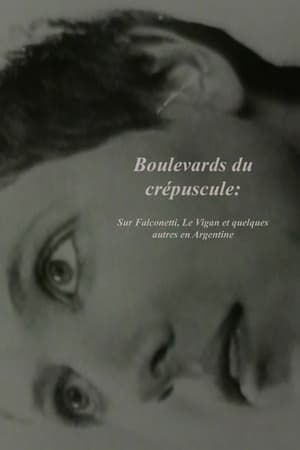
Sunset Boulevards(1992)
Status: Released
Date: 1992-08-01
0%
0 Votes
Time: 0h 59m
Overview:
In this documentary about the exile of two famous French actors in Argentina during and after World War II, the director Cozarinsky returns to Argentina after many years in France and recalls places and events from his childhood, particularly the celebration of the liberation of Paris on in August of 1944, in Buenos Aires's Plaza Francia. Featuring testimony from various authors and acquaintances of Maria (Renee) Falconetti and Robert Le Vigan, the film explores their lives and final years in Argentina.
Languages: French.
Countries:
France
ProductionCompanies: 


Movie: Sunset Boulevards
Video Trailer Sunset Boulevards
All 1 videos

Boulevards du crépuscule EXTRAIT VF - Trailer
Similar Movies

80%
Once My Mother(en)
2014-07-24
Australian filmmaker Sophia Turkiewicz investigates why her Polish mother abandoned her and uncovers the truth behind her mother's wartime escape from a Siberian gulag, leaving Sophia to confront her own capacity for forgiveness.

78%
The Rape of Recy Taylor(en)
2019-05-30
Recy Taylor, a 24-year-old black mother and sharecropper, was gang raped by six white boys in 1944 Alabama. Common in Jim Crow South, few women spoke up in fear for their lives. Not Recy Taylor, who bravely identified her rapists. The NAACP sent its chief rape investigator Rosa Parks, who rallied support and triggered an unprecedented outcry for justice. The film exposes a legacy of physical abuse of black women and reveals Rosa Parks’ intimate role in Recy Taylor’s story.

71%
Meeting the Man: James Baldwin in Paris(en)
1971-05-05
In 1970, a British film crew set out to make a straightforward literary portrait of James Baldwin set in Paris, insisting on setting aside his political activism. Baldwin bristled at their questions, and the result is a fascinating, confrontational, often uncomfortable butting of heads between the filmmakers and their subject, in which the author visits the Bastille and other Parisian landmarks and reflects on revolution, colonialism, and what it means to be a Black expatriate in Europe.

60%
Mucha: The Story of an Artist Who Created a Style(cs)
2020-10-01
Czech painter and illustrator Alphonse Mucha (1860-1939) ranks among the pioneers of the Art Nouveau movement at the end of the 19th century. Virtually overnight, he becomes famous in Paris thanks to the posters that he designs to announce actress Sarah Bernhardt’s plays. But at the height of his fame, Mucha decides to leave Paris to realize his lifetime project.

60%
Corporate Accountability(es)
2020-02-21
Images of Argentinian companies and factories in the first light of day, seen from the inside of a car, while the director reads out documents in voiceover that reveals the collusion of the same concerns in the military dictatorship’s terror.

45%
Human Lampshade: A Holocaust Mystery(en)
2012-09-29
This story follows one man's quest to uncover the origins and reveal the mysteries of a possible Holocaust artifact some historians now say never existed: lampshades made of human skin. When the flood waters of Hurricane Katrina receded, they left behind a wrecked New Orleans and a strange looking lamp that an illicit dealer claimed was 'made from the skin of Jews.'

90%
Britain's Greatest Pilot: The Extraordinary Story of Captain Winkle Brown(en)
2014-06-01
Captain Eric 'Winkle' Brown recounts his flying experiences, encounters with the Nazis and other adventures leading up to and during the Second World War. Illustrated with archive footage and Captain Brown's own photos.

53%
Safeguarding Military Information(en)
1942-01-16
World War II propaganda short which focuses on the dangers of inadvertent dispersal of military information.

84%
Nuremberg: The Nazis Facing their Crimes(fr)
2006-10-25
The documentary of the Nuremberg War Trials of 21 Nazi dignitaries held after World War II.

70%
The Half-Life of Genius Physicist Raemer Schreiber(en)
2018-07-17
Our two-hour film highlights the life and career of Dr. Schreiber with respect and clarity. Raemer, his wife Marge, and young daughter Paula would move to the high-desert of New Mexico where he and other brilliant minds would change the world forever.

75%
Fascism in Colour(en)
2006-01-01
After the World War I, Mussolini's perspective on life is severely altered; once a willful socialist reformer, now obsessed with the idea of power, he founds the National Fascist Party in 1921 and assumes political power in 1922, becoming the Duce, dictator of Italy. His success encourages Hitler to take power in Germany in 1933, opening the dark road to World War II. (Originally released as a two-part miniseries. Includes colorized archival footage.)


0%
WWII: Saving the Reality(en)
2013-01-07
See Kenneth W. Rendell's collection of over 6,000 artifacts that range from the end of World War I and the rise of Nazism to the start of World War II and the fight in Europe and the Pacific.

63%
Victory in the West(de)
1941-05-07
A Nazi propaganda film about the lead up to World War II and Germany's success on the Western Front. Utilizes newsreel footage of battles and fell into disfavour with propaganda minister Goebbels because of it's lack of emphasis on Adolf Hitler.

90%
The Great Patriotic War(ru)
1965-11-19
This communist history film recalls the heroism of Soviet soldiers fighting the Nazis in World War II. Forty of the 236 cameramen used for the feature were killed during their mission filming the Red Army.


60%
Attack! The Battle for New Britain(en)
1944-06-20
Actual footage by the United States Signal Corps of the landing and attack on Arawe Beach, Cape Glouster, New Britain island in 1943 in the South Pacific theatre of World War Two, and the handicaps of the wild jungle in addition to the Japanese snipers and pill-box emplacements.

0%
Digging The Great Escape(en)
2011-11-28
The classic movie "The Great Escape" was based on a real life escape attempt during the second world war. This documentary follows Archaeologists who are trying to find the original tunnels dug by the real prisoners of war who escaped. Some of the surviving prisoners also join the team to assist with the tunnel locations and to describe what it was really like to live that situation. In an effort to understand the technical details of how this feet of ingenuity was achieved, the team recreate some of the equipment used by the prisoners.

80%
Notre Dame de Paris: The Ordeal of the Centuries(fr)
2019-12-18
A fictional documentary on Notre Dame de Paris, produced in 2019.