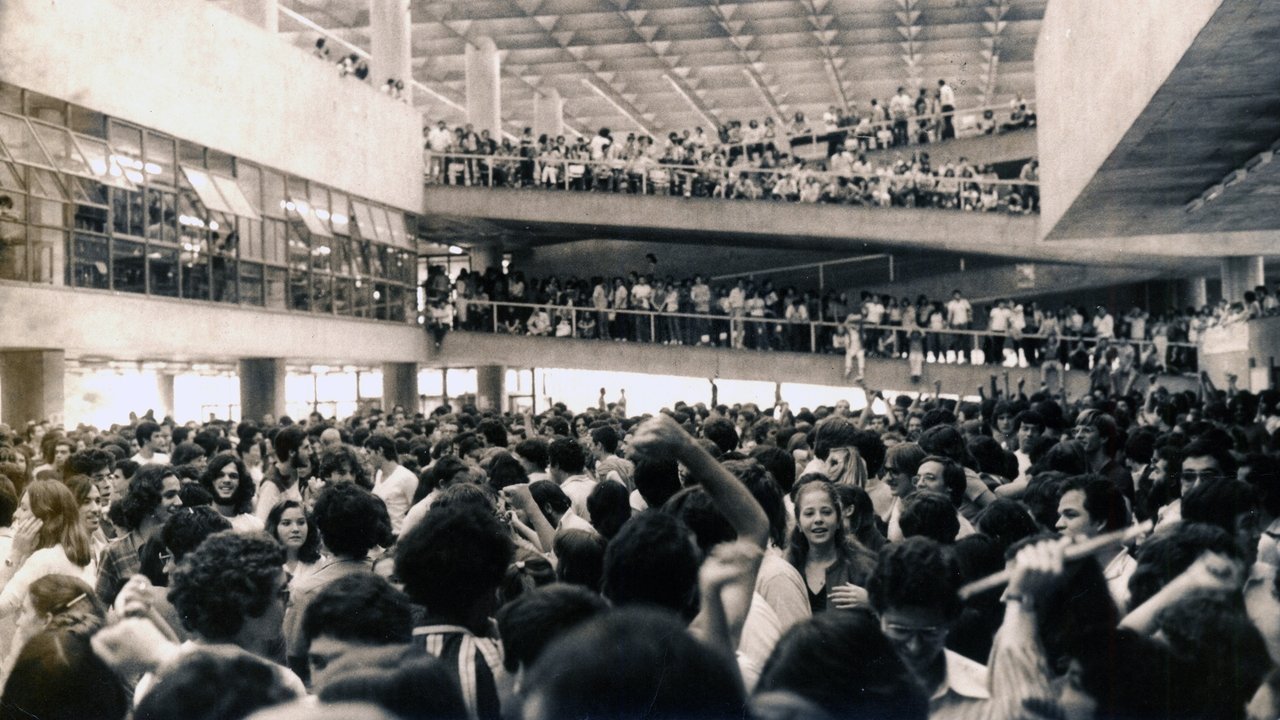

Libelu: Down With The Dictatorship(2020)
In the 1970s, they were championing the fight against Brazil’s military dictatorship. Forty years later, what’s left of Libelu? What does adult life have in store for you after the revolutionary youth?
Movie: Libelu: Down With The Dictatorship
Top 10 Billed Cast
Video Trailer Libelu: Down With The Dictatorship
All 1 videos

Libelu - Abaixo a Ditadura (Trailer Oficial) - Trailer
Similar Movies

Desarmados(pt)

The Mission(en)
When a Spanish Jesuit goes into the South American wilderness to build a mission in the hope of converting the Indians of the region, a slave hunter is converted and joins his mission. When Spain sells the colony to Portugal, they are forced to defend all they have built against the Portuguese aggressors.

We Feed the World(de)
A documentary that exposes the shocking truths behind industrial food production and food wastage, focusing on fishing, livestock and crop farming. A must-see for anyone interested in the true cost of the food on their plate.

José do Egito - O Filme(pt)

Chico, or the Country of the Lost Delicacy(pt)
A look into the 25 years of career of famous musician Chico Buarque and his influence in Brazilian culture.

Saludos Amigos(en)
A whimsical blend of live action and animation, "Saludos Amigos" is a colorful kaleidoscope of art, adventure and music set to a toe-tapping samba beat. From high Andes peaks and Argentina's pampas to the sights and sounds of Rio de Janeiro, your international traveling companions are none other than those famous funny friends, Donald Duck and Goofy. They keep things lively as Donald encounters a stubborn llama and "El Gaucho" Goofy tries on the cowboy way of life....South American-style.

Good Copy Bad Copy(en)
Good Copy Bad Copy is a documentary about copyright and culture in the context of Internet, peer-to-peer file sharing and other technological advances.

How Do You See Me?(pt)
How Do You See Me? is a Brazilian documentary feature that entwines both experienced actors and beginners to explore the hardships and the happiness that are inherent to the job when detached from the glam and glitz of the gossip industry, creating a diverse and comprehensive mosaic of what it means to be an actor in Brazil, a country so full of contradictions. The film brings forward a reality that the masses usually don't get to know: the men and women moved by a deep passion for acting and touching people. With Julio Adrião, Matheus Nachtergaele, José Celso Martinez, Cássia Kis, Nanda Costa, Babu Santana, Luciano Vidigal and Letícia Sabatella, among others.

Our Indians(pt)
Yndio do Brasil is a collage of hundreds of Brazilian films and films from other countries - features, newsreels and documentaries - that show how the film industry has seen and heard Brazilian indigenous peoples since they were filmed in 1912 for the first time: idealised and prejudiced, religious and militaristic, cruel and magic.

1968 - Without Losing Tenderness(pt)
The story of the University of Brasília, since it was only a project in Darcy Ribeiro's head until the fateful events in August 1968 when its campus was invaded by the police, during the military dictatorship, thus putting an end to its independence.

Into the Amazon(en)
A documentary re-telling of the remarkable and dangerous journey taken by President Theodore Roosevelt and legendary Brazilian explorer Cândido Rondon into the heart of the South American rainforest to chart an unexplored tributary of the Amazon.

Two Sons of Francisco(pt)
The story of Francisco, a very simple and poor man whose dream was to see his children become country music stars, and who made all the efforts to make it happen.

Marighella(pt)
Afro-Brazilian poet and politician, the legendary Carlos Marighella. Driven to fight against the erosion of civil and human rights following the CIA-backed military coup of 1964 and the brutal, racist right-wing dictatorship that followed, the revolutionary leaves behind his wife and son to take up arms, becoming a notorious enemy to the power structure.

Twenty Years Later(pt)
Eduardo Coutinho was filming a movie with the same name in the Northeast of Brazil, in 1964, when there came the military coup. He had to interrupt the project, and came back to it in 1981, looking for the same places and people, showing what had ocurred since then, and trying to gather a family whose patriarch, a political leader fighting for rights of country people, had been murdered.

Guaicurus Street(pt)
A red-light district in Belo Horizonte, Brazil. The camera is admitted into a "running house". Love for sale looks like a routine, dreary assembly line exercise here, sometimes almost like a comedy.

Surviving Progress(en)
Humanity’s ascent is often measured by the speed of progress. But what if progress is actually spiraling us downwards, towards collapse? Ronald Wright, whose best-seller, “A Short History Of Progress” inspired “Surviving Progress”, shows how past civilizations were destroyed by “progress traps”—alluring technologies and belief systems that serve immediate needs, but ransom the future. As pressure on the world’s resources accelerates and financial elites bankrupt nations, can our globally-entwined civilization escape a final, catastrophic progress trap? With potent images and illuminating insights from thinkers who have probed our genes, our brains, and our social behaviour, this requiem to progress-as-usual also poses a challenge: to prove that making apes smarter isn’t an evolutionary dead-end.

Hebe(pt)
Hebe Camargo is one of the most emblematic entertainments in Brazil. At her 60s, she went on to control her own career and, despite the criticism, the dreadful husband and the powerful and sexist bosses, she revealed herself to the public as an extraordinary woman, capable of overcoming any personal or professional crisis.

Chatô, The King of Brazil(pt)
The true story of Assis Chateaubriand, the first magnate of communications in Brazil. Due to his influence during the late 1930s up to the early 1960s, he has come to be called 'the Brazilian Citizen Kane'.


Rota ABC(pt)
Rota ABC is a documentary essay about the desires and perspectives of youth living in the industrial suburb of São Paulo, directed by Francisco Cesar Filho and produced by Anhangabaú Produções, with a soundtrack by the punk rock band Garotos Podres.