Loading Page

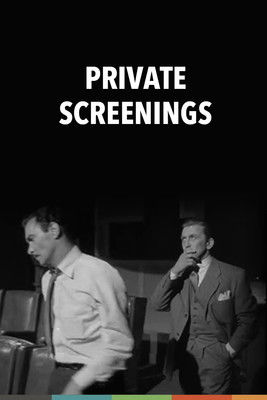
Private Screenings(2017)
Status: Released
Date: 2017-11-01
0%
0 Votes
Time: 0h 14m
Overview:
The screening room used to be a microcosm of a larger world, filled with churning emotions and explosive temperaments. Welcome to the comfortable world of the private screening rooms where what is on the screen pales in comparison to what happens among the viewers.
Languages: English.
Countries:
France,
United States of America
Movie: Private Screenings
HomePage
Overview
The screening room used to be a microcosm of a larger world, filled with churning emotions and explosive temperaments. Welcome to the comfortable world of the private screening rooms where what is on the screen pales in comparison to what happens among the viewers.
Release Date
2017-11-01
Average
0
Rating:
0.0 startsTagline
Genres
Languages:
English
Similar Movies

80%
Mon Chirac(fr)
2019-03-18
At the close of Jacques Chirac's life, politician Jean-Louis Debré has wished to make a film to celebrate his friend, to tell the story of their friendship and professional understanding, and to make an intimate portrait of the former President of France through the accounts of a few very close friends. Thanks to Jean-Louis Debré's presence, Claude Chirac and some of Jacques Chirac's closest friends, famous or unknown, agreed to talk to the camera, sometimes for the first time, to evoke their untold-before memories and tell about the moments that bonded the two men for a lifetime.

70%
De Gaulle, the Last King of France(fr)
2017-03-27
Charles de Gaulle, the first president (1958-1969) of the Vth Republic, France’s current system of government, left his mark on the country . He was statesman of action and has been compared to a monarch. This film depicts the general’s personality through the great events of his presidential term, at a time when the world was undergoing considerable changes.

65%
Dictator: One Crazy Job(fr)
2013-06-12
They’ve become the human face of inhuman barbarity. Leaders like Hitler, Idi Amin Dada, Stalin, Kim Jong Il, Saddam Hussein, Nicolae Ceausescu, Bokassa, Muammar Kadhafi, Khomeini, Mussolini and Franco governed their countries completely cut off from reality. These paranoid leaders were driven to abuse their power by the pathology of power itself. Dictators are driven by a relentless, thought-out determination to impose themselves as infallible, all-knowing and all-powerful beings. But they are also men ruled by their caprices, uncontrollable impulses, and reckless fits of frenzy, which paradoxically render them as human as anyone else. The abuses they committed were clearly atrocious, yet some of them were as outlandish as the characters portrayed in the film The Dictator. They sunk to depths worthy of Kafka: so incredibly absurd, they are outrageously funny.

80%
Der Reichstag(de)
2017-12-19
Docudrama telling the story of a building with a breath taking career that began in the empire, flourished in the Weimar Republic, perished in the Nazi dictatorship, and was rebuilt after its partial destruction.

62%
Claude Chabrol, the Maverick(fr)
2019-01-25
An account of the life and work of French filmmaker Claude Chabrol (1930-2010), a sybarite Buddha, a furtive anarchist, an insolent lover of life.

79%
Blood Money: Inside the Nazi Economy(fr)
2021-02-02
How did Nazi Germany, from limited natural resources, mass unemployment, little money and a damaged industry, manage to unfurl the cataclysm of World War Two and come to occupy a large part of the European continent? Based on recent historical works of and interviews with Adam Tooze, Richard Overy, Frank Bajohr and Marie-Bénédicte Vincent, and drawing on rare archival material.

80%
The Golden Age of Songs From Our Childhood(fr)
2020-12-25
This 135-minute documentary offers to reopen this magical parenthesis which has seen the birth of a whirlwind of artists with very different styles. From Chantal Goya to Annie Cordy, from Pierre Perret to Carlos. They knew how to bring each in their own way generations of children into their poetic universe.

66%
State Funeral(ru)
2019-10-22
The enigma of the personality cult is revealed in the grand spectacle of Stalin’s funeral. The film is based on unique archive footage, shot in the USSR on March 5 - 9, 1953, when the country mourned and buried Joseph Stalin.

75%
Jodie Foster: Hollywood Under the Skin(fr)
2021-04-03
From her precocious status as a sex symbol to her consecration as a filmmaker, Jodie Foster's story is about a feminist struggle, albeit atypical, fought on and off the screen. This film sets out to retrace her remarkable journey within the Hollywood industry.

80%
10 mai 1981 : Changer la vie ?(fr)
2021-05-11
Fourty years ago, in May 1981, with François Mitterrand's election, some people were letting themselves dream about a better life while others were predicting the coming of soviet tanks upon the Champs-Élysées. If we gladly remember the turning point of austerity in 83, there were also the wage rises, the fifth week of paid leave, the abolition of death penalty, the decriminalisation of homosexuality, or the advent of independent radio stations. Rare archives and accounts by those who were at the heart of this story give an overview of it and shed light on lesser-known aspects.

0%
Mitterrand, président culturel(fr)
2021-05-12
On the occasion of the fourty years anniversary of François Mitterand's election, a look back to the relationship between the President and artists, from admiration to manipulation.

87%
Mitterrand et la télé(fr)
2021-05-11
May 10th, 1981. François Mitterrand is elected President of the Republic. The “soviet tanks” supposedly coming upon the Champs-Élysées dressed in red, feared by some, did not march. Serge Moati takes a personal look at this episode, focusing on the relationship the president had with television, that he witnessed and played a role in.

80%
La Ligne de démarcation, une France coupée en deux (1940-1943)(fr)
2021-06-07
Between June 1940 and March 1943, the 1,200 kilometer long demarcation line broke France in two. For almost three years she controlled the daily newspaper of 40 million French people. In the north the zone occupied by Hitler's soldiers, in the south the zone administered by Marshal Pétain's Vichy regime. This film lifts the veil in this theater on the shameful mistakes of the collaboration, but also on the most courageous and noble deeds. Archive images and film recordings at places where the border used to be crossed are alternated with interviews with the last witnesses of this time.

0%
10 mai 1981, le jour du grand soir(fr)
2021-05-10

60%
The Green Fog(en)
2018-01-05
A tribute to a fascinating film shot by Alfred Hitchcock in 1958, starring James Stewart and Kim Novak, and to the city of San Francisco, California, where the magic was created; but also a challenge: how to pay homage to a masterpiece without using its footage; how to do it simply by gathering images from various sources, all of them haunted by the curse of a mysterious green fog that seems to cause irrepressible vertigo…

72%
Tunnel to Freedom(de)
2021-07-22
13 August 1961: the GDR closes the sector borders in Berlin. The city is divided overnight. Escape to the West becomes more dangerous every day. But on September 14, 1962, exactly one year, one month and one day after the Wall was built, a group of 29 people from the GDR managed to escape spectacularly through a 135-meter tunnel to the West. For more than 4 months, students from West Berlin, including 2 Italians, dug this tunnel. When the tunnel builders ran out of money after only a few meters of digging, they came up with the idea of marketing the escape tunnel. They sell the film rights to the story exclusively to NBC, an American television station.

80%
La Génération Salut les copains(fr)
2019-10-25

77%
Le Parti du cinéma(fr)
2021-02-01

57%
Who was Hitler(de)
2017-11-16
Hitler's biography told like never before. Besides brief historical localizations by a narrator, only contemporaries and Hitler himself speak: no interviews, no reenactment, no illustrative graphics and no technical gadgets. The testimonies from diaries, letters, speeches and autobiographies are assembled with new, often unpublished archive material. Hitler's life and work are thus reflected in a unique way in interaction with the image of the society in the years 1889 to 1945.

0%
The Tulsa Lynching of 1921: A Hidden Story(en)
2000-05-31
Documents the race riot of 1921 and the destruction of the African-American community of Greenwood in Tulsa, Oklahoma. With testimony by eyewitnesses and background accounts by historians.