Loading Page

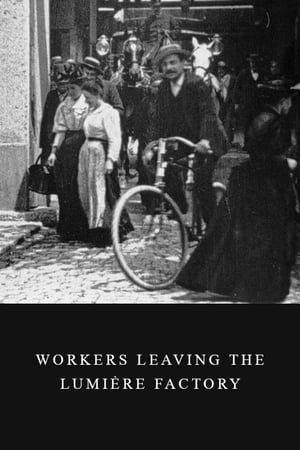
Workers Leaving the Lumière Factory(1895)
Status: Released
Date: 1895-03-22
67%
364 Votes
Time: 0h 1m
Overview:
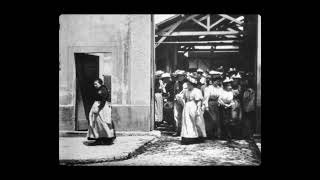
Working men and women leave through the main gate of the Lumière factory in Lyon, France. Filmed on 22 March 1895, it is often referred to as the first real motion picture ever made, although Louis Le Prince's 1888 Roundhay Garden Scene pre-dated it by seven years. Three separate versions of this film exist, which differ from one another in numerous ways. The first version features a carriage drawn by one horse, while in the second version the carriage is drawn by two horses, and there is no carriage at all in the third version. The clothing style is also different between the three versions, demonstrating the different seasons in which each was filmed. This film was made in the 35 mm format with an aspect ratio of 1.33:1, and at a speed of 16 frames per second. At that rate, the 17 meters of film length provided a duration of 46 seconds, holding a total of 800 frames.
Languages: No Language.
Countries:
France
ProductionCompanies:
Lumière
Movie: Workers Leaving the Lumière Factory
Video Trailer Workers Leaving the Lumière Factory
Video: "Workers Leaving the Lumière Factory in Lyon" (1895) Restoration 8K - Lumiére Brothers
"Workers Leaving the Lumière Factory in Lyon" (1895) Restoration 8K - Lumiére Brothers
Historical Footage of Workers Leaving the Lumiere Factory in 1895
Workers Leaving The Lumiere Factory - Lumiere Brothers 1895
All 3 videos
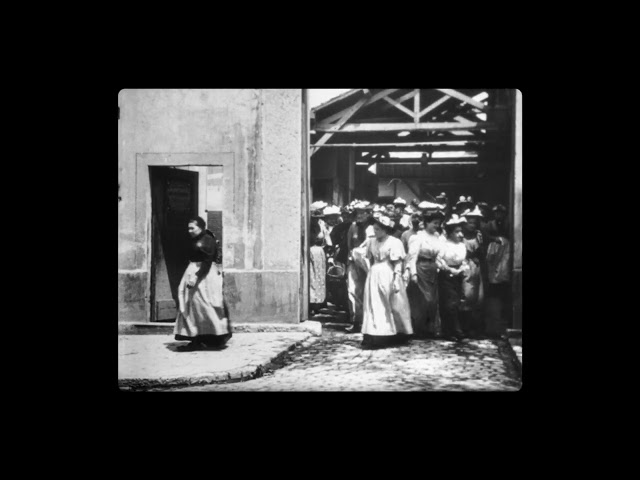
"Workers Leaving the Lumière Factory in Lyon" (1895) Restoration 8K - Lumiére Brothers - Clip
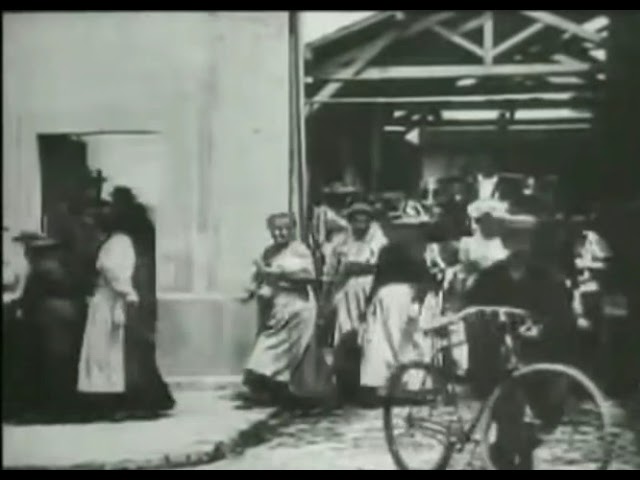
Historical Footage of Workers Leaving the Lumiere Factory in 1895 - Clip
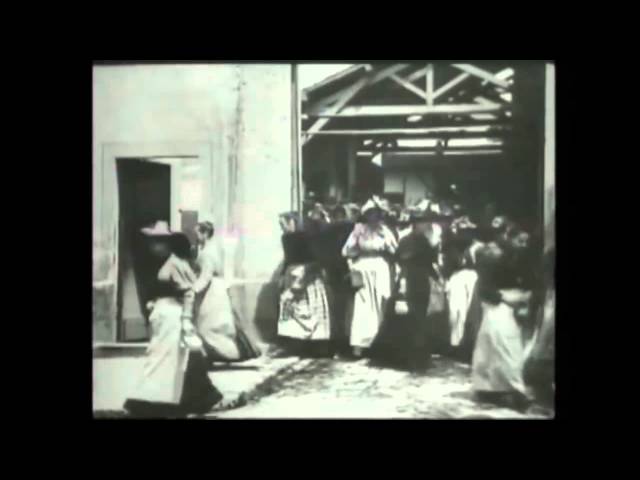
Workers Leaving The Lumiere Factory - Lumiere Brothers 1895 - Clip
Recommendations Movies

71%
The Arrival of a Train at La Ciotat(fr)
1896-06-30
A group of people are standing along the platform of a railway station in La Ciotat, waiting for a train. One is seen coming, at some distance, and eventually stops at the platform. Doors of the railway-cars open and attendants help passengers off and on. Popular legend has it that, when this film was shown, the first-night audience fled the café in terror, fearing being run over by the "approaching" train. This legend has since been identified as promotional embellishment, though there is evidence to suggest that people were astounded at the capabilities of the Lumières' cinématographe.

68%
The Sprinkler Sprinkled(fr)
1895-06-10
A gardener is watering his flowers, when a mischievous boy sneaks up behind his back, and puts a foot on the water hose. The gardener is surprised and looks into the nozzle to find out why the water has stopped coming. The boy then lifts his foot from the hose, whereby the water squirts up in the gardener's face. The gardener chases the boy, grips his ear and slaps him in his buttocks. The boy then runs away and the gardener continues his watering. Three separate versions of this film exist, this is the original, filmed by Louis Lumière.

55%
Baby's Meal(fr)
1895-12-28
A father, a mother and a baby are sitting at a table, on a patio outside. Dad is feeding Baby her lunch, while Mum is serving tea.

64%
Piggy(es)
2018-03-11
Sara is an overweight teen who lives in the shadow of a clique of cool girls holidaying in her village. Not even her childhood friend, Claudia, defends her when she's bullied at the local pool in front of an unknown man. Her clothes are stolen and Sara must get home wearing nothing but her bikini.

50%
Man Walking Around a Corner(xx)
1887-08-18
The last remaining production of Le Prince's LPCC Type-16 (16-lens camera) is part of a gelatine film shot in 32 images/second, and pictures a man walking around a corner. Le Prince, who was in Leeds (UK) at that time, sent these images to his wife in New York City in a letter dated 18 August 1887.

65%
Snowball Fight(fr)
1897-02-07
Wintertime in Lyon. About a dozen people, men and women, are having a snowball fight in the middle of a tree-lined street. The cyclist coming along the road becomes the target of opportunity. He falls off his bicycle. He's not hurt, but he rides back the way he came, as the fight continues.

49%
Playing Cards(fr)
1896-01-01
Three friends are playing cards in a beer garden. One of them orders drinks. The waitress comes back with a bottle of wine and three glasses on a tray. The man serves his friends. They clink glasses and drink. Then the man asks for a newspaper. He reads a funny story in it and the three friends burst out laughing while the waitress merely smiles.

69%
The Docks of New York(en)
1928-09-16
A blue-collar worker on New York's depressed waterfront finds his life changed after he saves a woman attempting suicide.

60%
A Nightmare(fr)
1896-12-25
A man has a fantastical nightmare involving, among other things, a grinning malevolent moon.

58%
Sack Race(fr)
1896-10-25
Shot in 1896, this playful actuality captures workers from the Lumière factory in Lyon competing in a sack race. The scene shows the participants’ comic struggles and falls, with onlookers enjoying the lighthearted contest. Beyond its humor, the film offers a glimpse of everyday leisure and camaraderie among the Lumière workforce during cinema’s earliest years.

53%
The Photographical Congress Arrives in Lyon(fr)
1895-06-12
Down the gangway, photographers leave the deck of a riverboat in large numbers.

55%
The X-Ray Fiend(en)
1897-10-01
A romantic couple are transformed into skeletons via X-Rays. The film combines two very recent innovations: Wilhelm Roentgen's discovery of X-rays in 1895, and Georges Méliès' accidental realisation of the special-effects potential of the jump-cut in 1896.

53%
La lupa(it)
1996-09-16
She was tall, dark and thin, with a proud and voluptuous bust. They called her "The she-wolf" because she seemed never to be satisfied. All the men were obsessed with her but one day the she-wolf fell madly in love with young Nanni.

52%
Horse Trick Riders(en)
1895-12-28
In the background is a house. In the foreground, a groom holds the reins of a sleek black horse that stands in profile. A tall man, dressed in a black uniform, demonstrates how to mount the horse then encourages and tries to assist a man in white. The man in white keeps falling, and soon it's apparent that he's an putting on a show. His pratfalls become more elaborate and stylish. The horse stands patient. The little groom laughs to see such sport. And finally, the man in white finds a comic accommodation. The story, though brief, has a beginning, middle, and end.

58%
Transformation by Hats(fr)
1895-01-01
Félicien Trewey uses a basic prop to create comical hats and their accompanying caricatures.

61%
Malice in Wonderland(en)
1982-08-11
A jet-propelled white rabbit flies through the vulva of a supine woman into a wonderland where people and objects turn inside out, changing shapes and identities at warp speed. Events roughly follow Lewis Carroll's "Alice in Wonderland." The caterpillar and the queen make appearances, as does Alice. Images and symbols are often sexual. At the end, Alice asks, "Who has had such a curious dream?"

58%
Line 9(es)
2017-07-09
In a city with constant movement like the subway rides, the paths of Andrés and Miguel are crossing. It seems like the beginning of a new Romance but Andrés doesn't know which direction to take.


70%
Zygote(en)
2017-07-12
The two remaining crew members of a mining operation in the Arctic Circle fight to survive against an alien creature.

72%
Zeitgeist: Addendum(en)
2008-10-02
Zeitgeist: Addendum premiered at the 5th Annual Artivist Film Festival. Director Peter Joseph stated: "The failure of our world to resolve the issues of war, poverty, and corruption, rests within a gross ignorance about what guides human behavior to begin with. It address the true source of the instability in our society, while offering the only fundamental, long-term solution."
Similar Movies

77%
I Needed Color(en)
2017-07-25
Jim Carrey exhibits his talent as a painter and reflects on the value and power of art.


66%
Stop for Bud(da)
1963-12-17
Stop for Bud is Jørgen Leth's first film and the first in his long collaboration with Ole John. […] they wanted to "blow up cinematic conventions and invent cinematic language from scratch". The jazz pianist Bud Powell moves around Copenhagen -- through King's Garden, along the quay at Kalkbrænderihavnen, across a waste dump. […] Bud is alone, accompanied only by his music. […] Image and sound are two different things -- that's Leth's and John's principle. Dexter Gordon, the narrator, tells stories about Powell's famous left hand. In an obituary for Powell, dated 3 August 1966, Leth wrote: "He quite willingly, or better still, unresistingly, mechanically, let himself be directed. The film attempts to depict his strange duality about his surroundings. His touch on the keys was like he was burning his fingers -- that's what it looked like, and that's how it sounded. But outside his playing, and often right in the middle of it, too, he was simply gone, not there."

60%
The Return of the Living Dead: The Decade of Darkness(en)
2007-07-11
A look at the horror movies of the 1980's.

40%
China Strikes Back(en)
1937-01-02
Raw footage received from photographer Harry Dunham revealed never before seen images of Mao Tse-Tung and the Eighth Route Army, inspiring Frontier to collectively shape a new film from desperate images, and to refine its dialectic editing.

79%
The True Story of Pirates(fr)
2022-12-31
Thanks to new excavations in Mauritius and Madagascar, as well as archival and museum research in France, Spain, England and Canada, a group of international scholars paint a new portrait of the world of piracy in the Indian Ocean.

53%
The 24th(en)
2020-08-21
The incredibly powerful and timely true story of the all-black Twenty-Fourth United States Infantry Regiment, and the Houston Riot of 1917. The Houston Riot was a mutiny by 156 African American soldiers in response to the brutal violence and abuse at the hands of Houston police officers.

70%
Kaaviya Thalaivan(ta)
2014-11-07
Two rival artists at Sivadas Swamigal's drama troupe compete in everything they do. While one of them goes on to become successful, the other fails in life.

38%
Hold on Tight(en)
2011-07-28
A short documentary exploring the ways LGBT couples show affection, and how small interactions like holding hands in public can carry, not only huge personal significance, but also the power to create social change.

0%
Screen Snapshots (Series 1, No. 20)(en)
1921-02-22
Intimate views of the movie stars of the Silent Era, at work and play; featuring Sessue Hayakawa, Lillian Gish and others.

77%
The Silence(en)
2015-01-01
There are children. There are those who abuse them. And there are those who know, but never tell.

0%
9000 Laps(fr)
2019-07-01

0%
The Costume Designer(en)
1950-07-13
This short focuses on the job of the costume designer in the production of motion pictures. The costume designer must design clothing that is correct for the film historically and geographically, and must be appropriate for the mood of the individual scene. We see famed costume designer Edith Head at work on a production. The Costume Designer was part of The Industry Film Project, a twelve-part series produced by the film studios and the Academy. Each series episode was produced to inform the public on a specific facet of the motion picture industry. Preserved by the Academy Film Archive in 2012.

30%
Little Potato(en)
2017-03-11
Wes Hurley's autobiographical tale of growing up gay in Soviet Union Russia, only to escape with his mother, a mail order bride, to Seattle to face a whole new oppression in his new Christian fundamentalist American dad.

100%
Calçada(pt)
2024-03-07

75%
How to Blow Up a Helicopter (Ayako's Story)(en)
2009-04-14
Interview of Ayako Fujitani and her dad Steven Seagal.

10%
Passaic Mosaic(en)
2008-06-17
A short documentary, looking at life in Passaic, New Jersey, whilst the film Be Kind Rewind (2008) is being shot there.

