Loading Page


Pictures at an Election(2008)
Status: Released
Date: 2008-08-12
0%
0 Votes
Time: 1h 8m
Overview:
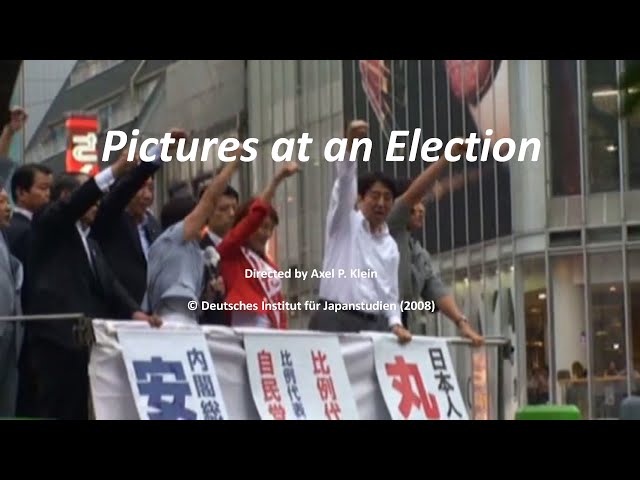
“Pictures at an Election” (the title refers to Mussorgsky’s suite “Pictures at an Exhibition” featuring at the beginning of the film) is a 68 min. documentary that covers the campaigns of those candidates who tried to win one of the five seats in Tokyo during the Upper House election in 2007. It shows Japan’s electoral machinery in full steam and focuses on the question of how Japanese candidates try to appeal to voters. The documentary depicts different strategies and techniques, and presents a lively picture of political culture in Japan.
Languages: English, Japanese.
Countries:
Japan
Movie: Pictures at an Election
Top 1 Billed Cast

Jack Merluzzi
Narrator
Video Trailer Pictures at an Election
All 1 videos
Pictures at an Election - Clip
Similar Movies

58%
Campaign(ja)
2007-10-06
Can a candidate with no political experience and no charisma win an election if he is backed by the political giant Prime Minister Koizumi and his Liberal Democratic Party? This cinema-verite documentary closely follows a heated election campaign in Kawasaki, Japan, revealing the true nature of "democracy."

100%
Grandson of a Monster(ja)
2023-03-17
The late Shinzo Abe was the longest-serving prime minister of all time, holding office for 2,822 consecutive days. While his hawkish foreign policy and "Abenomics" economic policies won him support, he also attracted public attention for his controversial words, actions and scandals. Nobusuke Kishi, a politician and the maternal grandfather of former Prime Minister Abe, was nicknamed the "Monster of the Showa Era" for his ability to manipulate the political and business worlds by walking the fronts and backs of society. The film explores the mysteries of his blood and upbringing that led him to adopt an extremely "forward-looking" political stance in order to realize his ambitions, which were imprinted in his childhood mind as his "grandfather's teachings". With black humor and satirical picture books, the film unravels who former Prime Minister Abe was and what he left behind for this country.

0%
She is going to be a Mayor on ◯/◯, the Movie(ja)
2024-01-02
A documentary following the campaign of Satoko Kishimoto during the 2022 mayoral election in Suginami Ward

0%
The Yoshida School(ja)
1983-04-09
Coinciding with the LDP presidential election of the entire national public, a masterpiece depicting the reverse side of Showa political history released, superimposed cast, a group image of real politicians centered on Shigeru Yoshida and political history after the war.

60%
The Fixer(ja)
1979-10-27
Political fixer Homei Yamaoka's misdeeds come to light, throwing Japanese politics into deadly confusion. But he's not going down without a fight.

60%
Organized Violence II(ja)
1967-06-29

70%
Beast Alley(ja)
1965-09-05
Desperate to escape her grueling life caring for her paralyzed husband, Tamiko murders him and burns down their home to start anew. She is soon entangled in the dark web of an influential, elderly power broker, becoming his mistress and a pawn in his political schemes. As she descends further into a downward spiral of moral decay, Tamiko realizes that the freedom she sought is merely a new form of entrapment.

0%
Facing to the Clouds(ja)
1962-05-01
A rookie newspaper journalist, Takema Sakaki, has a strong sense of justice. In the Diet Building he gets acquainted with a library worker, Reiko Nakafuji. Reiko's father was a member of the Diet who was assassinated six years ago. Through Reiko, Takema joins Tsūkai-kai, a group of young people who respect her late father's political ideas. With the assistance of Tsukai-kai, Takema eventually uncovers the political scandal related to postwar compensation which led to the murder of Reiko's father.

80%
Suit Yourself or Shoot Yourself: The Hero(ja)
1996-09-21
Yuji and Kosaku become involved with a brother and sister who want to drive a local yakuza gang member out of their neighborhood.

68%
Solar Eclipse(ja)
1975-09-06
When bribe money from a rigged election funnels into a dam construction project, collusion, lust, greed and even murder are on the ballot.

70%
The Sunday Runoff(ja)
2022-01-07
A comedy about how the world of politics really works! Tsutomu is a secretary for a member of the Japanese Parliament. After the latter suffers a heart attack, his daughter Yumi is chosen to fill his place in the next election because she seems easy to control. However, her unpredictable behavior soon throws the campaign out of control.

0%
The Politicians(ja)
1983-10-22
Who will be the next prime minister? As two candidates start to compete, political game and brutal murder ensue. And the existence of secret love letters changes the situation.

68%
Taira Clan Saga(ja)
1955-09-21
Japan, 1137. The Taira family, a samurai clan, becomes involved in the disputes between Emperor Toba and the monks of Mount Hiei.

68%
Bridge to the Sun(en)
1961-10-17
Tells the true story of American Gwen Terasaki, who falls in love with, then marries a Japanese diplomat. When World War II breaks out, they encounter animosity and trouble from both sides.

61%
Tales of a Golden Geisha(ja)
1990-06-02
Nayoko, a good-hearted geisha, brings luck to the men she sleeps with, even though most are scoundrels who don’t deserve it.

80%
The Making of Stranglehold(en)
2007-06-22
The Making of Stranglehold is a fantastic look into the development of the classic video game being the last time Chow Yun-Fat and John Woo collaborated together.

0%
Sperduti nel buio(it)
2014-04-09
Documentary about the lost 1914 film "Sperduti nel buio". Film historian Denis Lotto journeys across Europe following the trail of the lost movie.

65%
Roy Orbison: Mystery Girl - Unraveled(en)
2014-05-19
The discography of Roy Orbison (1936-1988) - which yielded some of the most heartfelt, passionate classics of the rock ‘n’ roll era - shined even brighter with the release of Mystery Girl, the last album Orbison recorded, in 1989. The commercial success of Mystery Girl was nothing short of impressive: the album was a Top 5 hit, eventually earning Orbison his first platinum award for over 1 million sales, and featured the worldwide Top 10 smash “You Got It.” Mystery Girl: Unraveled features a new hour-long documentary on the making of the album, executive produced by Roy’s sons. The documentary includes new interviews with those behind the album including Steve Cropper, Tom Petty, Mick Campbell and Jeff Lynne. In addition there are eight wonderful music videos, including an unreleased alternate video for “She’s a Mystery to Me” and three new videos for “The Way Is Love,” “You Got It” and “California Blue.

15%
Going to Hell: The Movie(en)
2004-06-15
The little man and his crew take the classic formula of skate, fun and filth to new levels of demented chaos. Add in a priest with a penchant for porn, escaped convicts, cracked skating, nude mud wrestling, prolific quantities of poo and a mentally deranged human torpedo and you'll understand why there's no doubt that Wee Man and his crew are going straight to hell. The extreme begins here.

68%
Hitler's Games, Berlin 1936(fr)
2016-08-23
Summer 1936 - The Berlin Olympics, organized by the Nazi regime on the eve of World War II, acted as a grand showcase for a Germany that was athletic, peaceful and rejuvenated. The violence and hate that until then had reigned in the streets of Berlin suddenly vanished. Adolf Hitler became the triumphant host of European countries he would soon try to invade or face in a deadly global conflict.