Loading Page
The World's Coolest LEGO Set!(2019)
Status: Released
Date: 2019-12-23
0%
0 Votes
Time: 0h 10m
Overview:
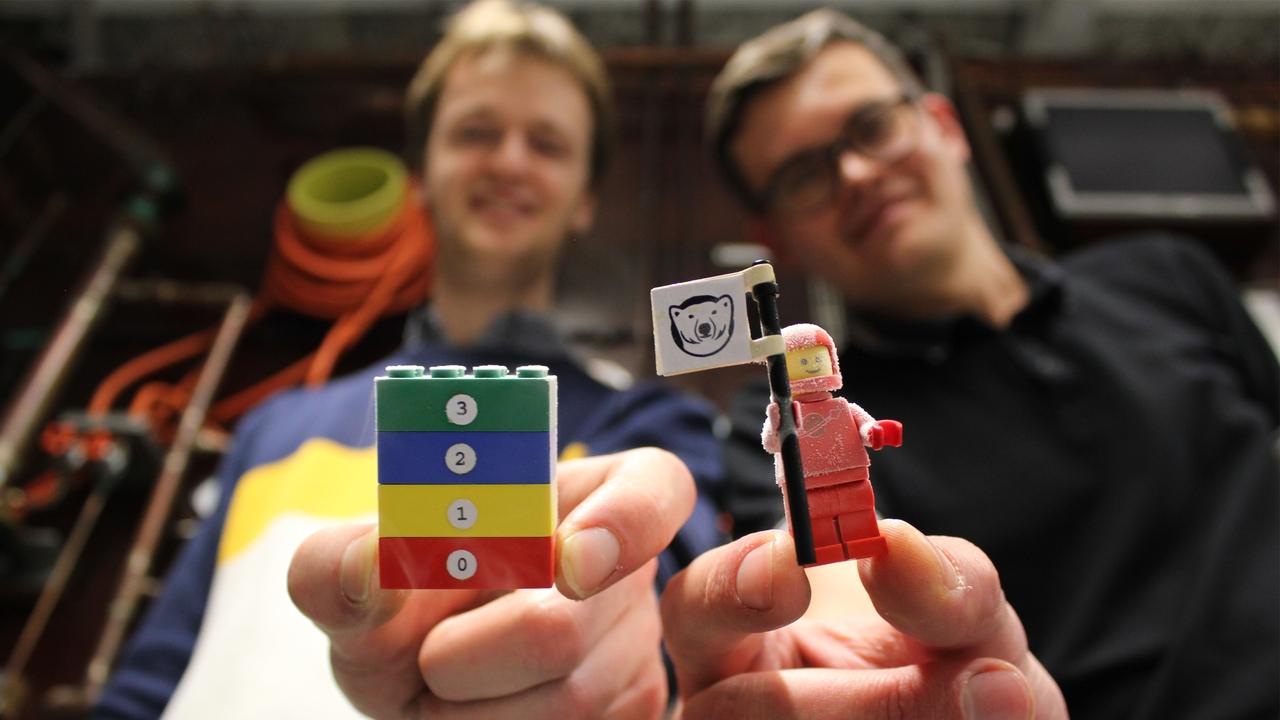
A world leading team of ultra-low temperature physicists at Lancaster University decided to place a LEGO figure and four LEGO blocks inside their record-breaking dilution refrigerator. This machine - specially made at the University - is the most effective refrigerator in the world, capable of reaching 1.6 millidegrees above absolute zero (minus 273.15 Centigrade), which is about 200,000 times colder than room temperature and 2,000 times colder than deep space.
Languages:
Countries:
United Kingdom
ProductionCompanies:
Hamster Productions
Movie: The World's Coolest LEGO Set!
Top 9 Billed Cast
HomePage
Overview
A world leading team of ultra-low temperature physicists at Lancaster University decided to place a LEGO figure and four LEGO blocks inside their record-breaking dilution refrigerator. This machine - specially made at the University - is the most effective refrigerator in the world, capable of reaching 1.6 millidegrees above absolute zero (minus 273.15 Centigrade), which is about 200,000 times colder than room temperature and 2,000 times colder than deep space.
Release Date
2019-12-23
Average
0
Rating:
0.0 startsTagline
Genres
Languages:
Keywords
Similar Movies

87%
Pioneers in Skirts(en)
2022-10-15
Pioneers in Skirts is an Emmy-nominated 60-min documentary following filmmaker Ashley Maria’s quest to peel back the layers of obstacles that can limit a woman or girl's pioneering ambition.

62%
Facebook: Cracking the Code(en)
2017-04-11
"What's on your mind?" It's the friendly Facebook question which lets you share how you're feeling. It's also the question that unlocks the details of your life and helps turn your thoughts into profits.

80%
The Lie Detector(en)
2023-01-03
In the first decades of the 20th century, when life was being transformed by scientific innovations, researchers made a thrilling new claim: they could tell whether someone was lying by using a machine. Popularly known as the “lie detector,” the device transformed police work, seized headlines and was extolled in movies, TV and comics as an infallible crime-fighting tool. Husbands and wives tested each other’s fidelity. Corporations routinely tested employees’ honesty and government workers were tested for loyalty and “morals.” But the promise of the polygraph turned dark, and the lie detector too often became an apparatus of fear and intimidation. Written and directed by Rob Rapley and executive produced by Cameo George, The Lie Detector is a tale of good intentions, twisted morals and unintended consequences.


66%
Black Holes: The Edge of All We Know(en)
2020-03-18
Black holes stand at the limit of what we can know. To explore that edge of knowledge, the Event Horizon Telescope links observatories across the world to simulate an earth-sized instrument. With this tool the team pursues the first-ever picture of a black hole, resulting in an image seen by billions of people in April 2019. Meanwhile, Hawking and his team attack the black hole paradox at the heart of theoretical physics—Do predictive laws still function, even in these massive distortions of space and time? Weaving them together is a third strand, philosophical and exploratory using expressive animation. “Edge” is about practicing science at the highest level, a film where observation, theory, and philosophy combine to grasp these most mysterious objects.

0%
Podfather(en)
2009-10-12
Documentary telling the story of silicon chip inventor Robert Noyce, godfather of today's digital world. Re-living the heady days of Silicon Valley's seminal start-ups, the film tells how Noyce also founded Intel, the company responsible for more than 80 per cent of the microprocessors in personal computers.

0%
Sunlight: YES(en)
2025-04-14
Pioneering Australian bio-artists SymbioticA showcase their “Sunlight, Soil & Shit (De)Cycle” project, the latest in a long line of potential technological solutions to the looming global food crisis. Will it save humanity from its doom? Where are the investors?

0%
Météores(fr)
2014-06-06

70%
The Lost Colony of Roanoke: New Evidence(en)
2022-05-08
In 1587, more than 100 English colonists settle on Roanoke Island and soon vanish, baffling historians for centuries; now, experts use the latest forensic archaeology to investigate the true story behind America's oldest and most controversial mystery.

0%
The Last Artifact(en)
2020-01-01
Just outside Paris, France, inside a high-tech vault, requiring three independently controlled keys, rests a small metallic cylinder about the diameter of a golf ball. Encased within three vacuum-sealed bell jars it may not look like much, but it is one of the most important objects on the planet. It affects nearly every aspect of our lives from the moment we are born, to the food we eat, the cars we drive, and even the medicines we take. The Last Artifact follows the high-stakes race to redefine the weight of the world reveals the untold story of one of the most important objects on the planet. The kilogram, the base unit of mass in the International System of Units, helped send humans to the moon and satellites into space. This small hunk of metal is the object against which all others are measured. Yet over time, its mass mysteriously eroded by the weight of an eyelash. A change that, unbeknownst to most, unleashed a crisis with potentially dire consequences.

65%
Passage of Venus(fr)
1874-12-09
Photo sequence of the rare transit of Venus over the face of the Sun, one of the first chronophotographic sequences. In 1873, P.J.C. Janssen, or Pierre Jules César Janssen, invented the Photographic Revolver, which captured a series of images in a row. The device, automatic, produced images in a row without human intervention, being used to serve as photographic evidence of the passage of Venus before the Sun, in 1874.

70%
The End of Quantum Reality(en)
2020-01-16
Almost one hundred years ago, the project to reduce the world to mathematical physics failed suddenly and completely: “One of the best-kept secrets of science,” physicist Nick Herbert writes, “is that physicists have lost their grip on reality.” The world, we are now told, emerges spontaneously, out of “nothing,” and constitutes a “multiverse,” where “anything that can happen will happen, and it will happen an infinite number of times.” Legendary reclusive genius Wolfgang Smith demonstrates on shockingly obvious grounds the dead end at which physics has arrived, and how we can “return, at last, to the real world.” The End of Quantum Reality introduces this extraordinary man to a contemporary audience which has, perhaps, never encountered a true philos-sophia, one as intimately at ease with the rigors of quantum physics as with the greatest schools of human wisdom.

62%
Cern and the Sense of Beauty(it)
2017-04-26
An exploration of the link between science and beauty through the work of scientists at CERN, in Geneva.

35%
Free Will(en)
2022-03-26
An in-depth investigation featuring world renowned philosophers and scientists into the most profound philosophical debate of all time: Do we have free will?

10%
What is the Theory of Relativity?(ru)
1964-01-15
In a compartment of the Moscow-Novosibirsk train, a young physicist meets famous film actors. The conversation accidentally comes to Einstein, and the woman begins to explain to her fellow travelers what the theory of relativity is. The actors are incidentally on their way to the shooting of a film about physicists, but they do not understand the subject at all.

80%
Rafale Confidential(fr)
2013-04-06

82%
The Deep Med(fr)
2020-09-12
The Mediterranean. Because people have been travelling there for thousands of years, it is believed to be without secrets. And yet, far below its surface, lie vast unexplored territories, luxurious gardens worthy of the finest tropical coral reefs. These natural wonders are inaccessible to the traditional diver, in a twilight zone, between 60 and 120 m, where there’s less than 1% of sunlight. If diving at such depths is always a challenge, staying there is a fantasy, a utopia that becomes reality in Planet Mediterranean. In the tradition of Commander Cousteau and his "houses under the sea," the team of diver-photographer Laurent Ballesta is undertaking a new world-record setting mission in complete freedom and without time limit.

85%
Moon: The Battles of Space(fr)
2019-01-02
July 20, 1969. Apollo 11 lands on the surface of the Moon. Such a feat was apparently performed to the greater glory of all mankind, but actually it marked the end of the space race disputed by the two great superpowers of the time in their eagerness to arrive before and the beginning of the spread of the Cold War into space. Nowadays, the struggle continues, but the main competitors and their purposes are others.

65%
Scotland's Einstein: James Clerk Maxwell - The Man Who Changed the World(en)
2015-12-02
Professor Iain Stewart reveals the story behind the Scottish physicist who was Einstein's hero; James Clerk Maxwell. Maxwell's discoveries not only inspired Einstein, but they helped shape our modern world - allowing the development of radio, TV, mobile phones and much more. Despite this, he is largely unknown in his native land of Scotland. Scientist Iain Stewart sets out to change that, and to celebrate the life, work and legacy of the man dubbed "Scotland's Forgotten Einstein".

50%
Pop! The Science of Bubbles(en)
2013-04-09
Physicist Dr Helen Czerski takes us on a journey into the science of bubbles - not just fun toys, but also powerful tools that push back the boundaries of science.