Loading Page

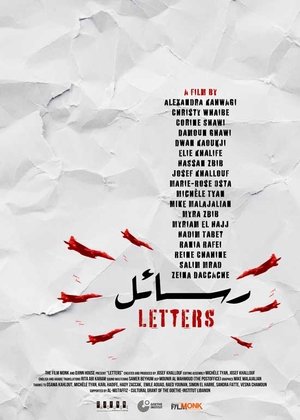
Letters(2025)
Status: Released
Date: 2025-01-10
0%
0 Votes
Languages: English, Arabic, French.
Countries:
Lebanon
ProductionCompanies: 
Movie: Letters
HomePage
Overview
Release Date
2025-01-10
Average
0
Rating:
0.0 startsTagline
Genres
Languages:
EnglishالعربيةFrançais
Recommendations Movies
72%
City of Ghosts(en)
2017-07-14
With unprecedented access, this documentary follows the extraordinary journey of “Raqqa is Being Slaughtered Silently”—a group of anonymous citizen journalists who banded together after their homeland was overtaken by ISIS—as they risk their lives to stand up against one of the greatest evils in the world today.
82%
2000 Meters to Andriivka(en)
2025-07-23
Amid the failing counteroffensive, a journalist follows a Ukrainian platoon on their mission to traverse one mile of heavily fortified forest and liberate a strategic village from Russian occupation. But the farther they advance through their destroyed homeland, the more they realize that this war may never end.
64%
Why We Fight: Prelude to War(en)
1942-05-27
Prelude to War was the first film of Frank Capra's Why We Fight propaganda film series, commissioned by the Pentagon and George C. Marshall. It was made to convince American troops of the necessity of combating the Axis Powers during World War II. This film examines the differences between democratic and fascist states.
75%
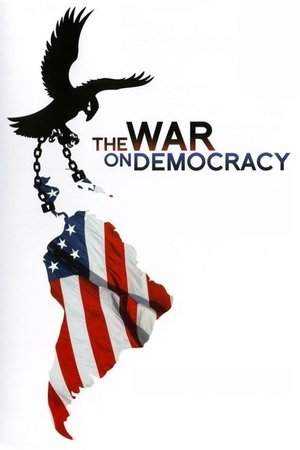
The War on Democracy(en)
2007-06-15
Set both in Latin America and the United States, the film explores the historic and current relationship of Washington with countries such as Venezuela, Bolivia and Chile. Pilger says that the film "...tells a universal story... analysing and revealing, through vivid testimony, the story of great power behind its venerable myths. It allows us to understand the true nature of the so-called "war on terror". According to Pilger, the film’s message is that the greed and power of empire is not invincible and that people power is always the "seed beneath the snow".

61%
The Battle of San Pietro(en)
1945-05-03
This documentary movie is about the battle of San Pietro, a small village in Italy. Over 1,100 US soldiers were killed while trying to take this location, that blocked the way for the Allied forces from the Germans. Preserved by the Academy Film Archive in 2005.
78%
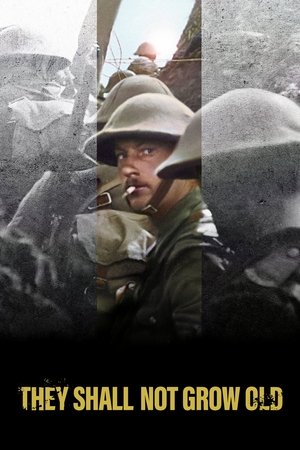
They Shall Not Grow Old(en)
2018-11-09
A documentary about World War I with never-before-seen footage to commemorate the centennial of Armistice Day, and the end of the war.
82%
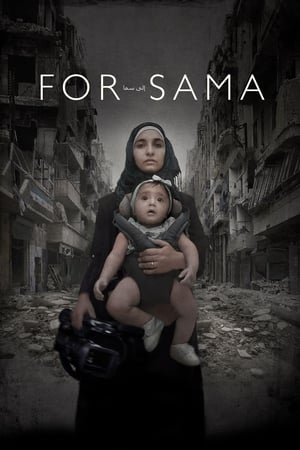
For Sama(en)
2019-07-26
A love letter from a young mother to her daughter, the film tells the story of Waad al-Kateab’s life through five years of the uprising in Aleppo, Syria as she falls in love, gets married and gives birth to Sama, all while cataclysmic conflict rises around her. Her camera captures incredible stories of loss, laughter and survival as Waad wrestles with an impossible choice– whether or not to flee the city to protect her daughter’s life, when leaving means abandoning the struggle for freedom for which she has already sacrificed so much.
65%
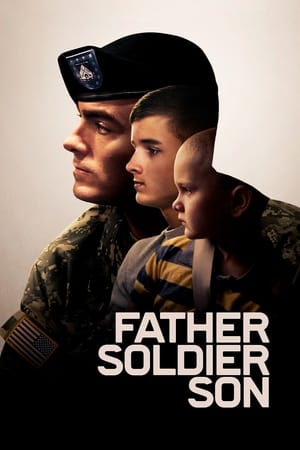
Father Soldier Son(en)
2020-04-15
When Sgt. First Class Brian Eisch is critically wounded in Afghanistan, it sets him and his sons on a journey of love, loss, redemption and legacy.
66%
Korengal(en)
2014-05-30
Korengal picks up where Restrepo left off; the same men, the same valley, the same commanders, but a very different look at the experience of war.
70%
The Scarlet and the Black(en)
1983-02-02
Fr. Hugh O'Flaherty is a Vatican official in 1943-45 who has been hiding downed pilots, escaped prisoners of war, and Italian resistance families. His activities become so large that the Nazis decide to assassinate him the next time he leaves the Vatican.
80%
20 Days in Mariupol(en)
2023-07-14
As the Russian invasion begins, a team of Ukrainian journalists trapped in the besieged city of Mariupol struggle to continue their work documenting the war's atrocities.
63%
The Hornet's Nest(en)
2014-05-09
Armed only with their cameras, Peabody and Emmy Award-winning conflict Journalist Mike Boettcher, and his son, Carlos, provide unprecedented access into the longest war in U.S. history: they are embed with U.S. troops during nine days of intense combat in Afghanistan.
72%
The Bloody Hundredth(en)
2024-03-14
Meet the real-life airmen who inspired Masters of the Air as they share the harrowing and transformative events of the 100th Bomb Group.
70%
The Beast(en)
1988-09-14
During the war in Afghanistan a Soviet tank crew commanded by a tyrannical officer find themselves lost and in a struggle against a band of Mujahadeen guerrillas in the mountains.
79%
Five Came Back(en)
2017-03-31
The extraordinary story of how Hollywood changed World War II – and how World War II changed Hollywood, through the interwoven experiences of five legendary filmmakers who went to war to serve their country and bring the truth to the American people: John Ford, William Wyler, John Huston, Frank Capra, and George Stevens. Based on Mark Harris’ best-selling book, “Five Came Back: A Story of Hollywood and the Second World War.”
58%
A Walk in the Sun(en)
1945-12-25
In the 1943 invasion of Italy, one American platoon lands, digs in, then makes its way inland to attempt to take a fortified farmhouse, as tension and casualties mount.

79%
Virunga(en)
2014-11-07
Virunga in the Democratic Republic of the Congo is Africa’s oldest national park, a UNESCO world heritage site, and a contested ground among insurgencies seeking to topple the government that see untold profits in the land. Among this ongoing power struggle, Virunga also happens to be the last natural habitat for the critically endangered mountain gorilla. The only thing standing in the way of the forces closing in around the gorillas: a handful of passionate park rangers and journalists fighting to secure the park’s borders and expose the corruption of its enemies. Filled with shocking footage, and anchored by the surprisingly deep and gentle characters of the gorillas themselves, Virunga is a galvanizing call to action around an ongoing political and environmental crisis in the Congo.
73%
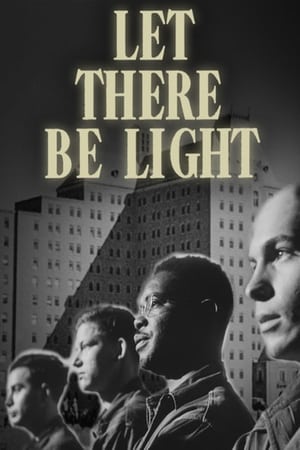
Let There Be Light(en)
1946-12-16
The final entry in a trilogy of films produced for the U.S. government by John Huston. Some returning combat veterans suffer scars that are more psychological than physical. This film follows patients and staff during their treatment. It deals with what would now be called PTSD, but at the time was categorised as psychoneurosis or shell-shock. Government officials deemed this 1946 film counterproductive to postwar efforts; it was not shown publicly until 1981.
64%
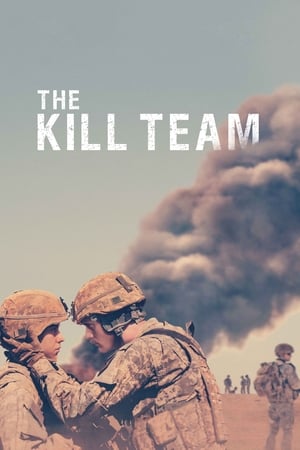
The Kill Team(en)
2019-10-17
When Andrew Briggman — a young soldier in the US Army during the invasion of Afghanistan — witnesses the murderous behavior of fellow soldiers, under the direction of a malevolent Sergeant, he faces a moral dilemma. His increasingly-violent platoon becomes suspicious that someone in their ranks has turned on them, and Andrew begins to fear for his safety. A fictionalized dramatization based on a true story.
72%
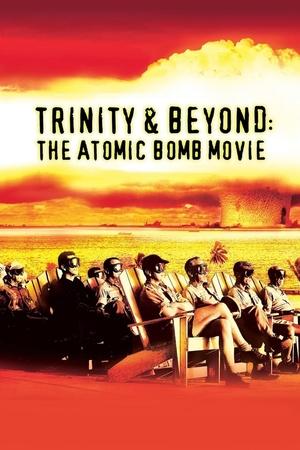
Trinity and Beyond: The Atomic Bomb Movie(en)
1995-09-29
"Trinity and Beyond" is an unsettling yet visually fascinating documentary presenting the history of nuclear weapons development and testing between 1945-1963. Narrated by William Shatner and featuring an original score performed by the Moscow Symphony Orchestra, this award-winning documentary reveals previously unreleased and classified government footage from several countries.