Loading Page

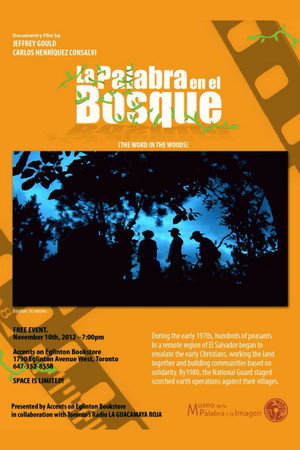
The Word in the Woods(2011)
Status: Released
Date: 2011-09-22
0%
0 Votes
Time: 0h 56m
Overview:
During the early 1970s, hundreds of peasants in a remote region of El Salvador began to emulate the early Christians, working the land together and building communities based on solidarity. By the late 1970s, thousands of peasants in northern Morazan organized to resist National Guard repression which often involved torture and executions. In 1980s, the military engaged in scorched earth operations against their villages, inaugurating a 12-year civil war. The Word in the Woods tells their stories. The film's protagonists must reflect upon their struggles in the light of current reality.
Languages: Spanish.
Countries:
El Salvador
ProductionCompanies:
Museo de la Palabra y la Imagen
Movie: The Word in the Woods
HomePage
Overview
During the early 1970s, hundreds of peasants in a remote region of El Salvador began to emulate the early Christians, working the land together and building communities based on solidarity. By the late 1970s, thousands of peasants in northern Morazan organized to resist National Guard repression which often involved torture and executions. In 1980s, the military engaged in scorched earth operations against their villages, inaugurating a 12-year civil war. The Word in the Woods tells their stories. The film's protagonists must reflect upon their struggles in the light of current reality.
Release Date
2011-09-22
Average
0
Rating:
0.0 startsTagline
Genres
Languages:
EspañolKeywords
Recommendations Movies
83%
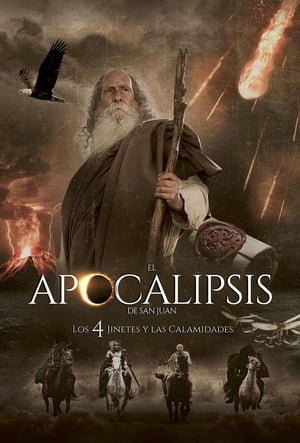
The Apocalypse of St John(es)
2024-10-07
Embark on an epic journey through time and faith with 'The Apocalypse of Saint John.' Join the Apostle John in a stunning visual narrative that unravels the visions of the End Times. Experience each vision like never before, with striking visual effects and epic scenes that immerse you in the apocalyptic narrative.

65%
Downloaded(en)
2013-06-20
A documentary that explores the downloading revolution; the kids that created it, the bands and the businesses that were affected by it, and its impact on the world at large.
68%
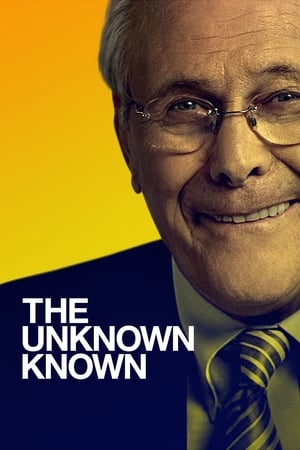
The Unknown Known(en)
2013-08-29
Former United States Secretary of Defense, Donald Rumsfeld, discusses his career in Washington D.C. from his days as a congressman in the early 1960s to planning the invasion of Iraq in 2003.
82%
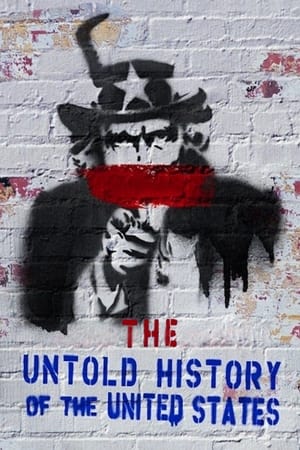
The Untold History Of The United States(en)
2012-11-12
Oliver Stone charts the history of the United States from the Second World War to the present.

76%
Night Will Fall(en)
2014-06-07
When Allied forces liberated the Nazi concentration camps in 1944-45, their terrible discoveries were recorded by army and newsreel cameramen, revealing for the first time the full horror of what had happened. Making use of British, Soviet and American footage, the Ministry of Information’s Sidney Bernstein (later founder of Granada Television) aimed to create a documentary that would provide lasting, undeniable evidence of the Nazis’ unspeakable crimes. He commissioned a wealth of British talent, including editor Stewart McAllister, writer and future cabinet minister Richard Crossman – and, as treatment advisor, his friend Alfred Hitchcock. Yet, despite initial support from the British and US Governments, the film was shelved, and only now, 70 years on, has it been restored and completed by Imperial War Museums under its original title "German Concentration Camps Factual Survey".

68%
Making Waves: The Art of Cinematic Sound(en)
2019-10-25
The history of cinematic sound, told by legendary sound designers and visionary filmmakers.
70%
In Search of the Last Action Heroes(en)
2019-09-01
The most comprehensive retrospective of the '80s action film genre ever made.
73%
Mea Maxima Culpa: Silence in the House of God(en)
2012-11-16
Alex Gibney explores the charged issue of pedophilia in the Catholic Church, following a trail from the first known protest against clerical sexual abuse in the United States and all way to the Vatican.
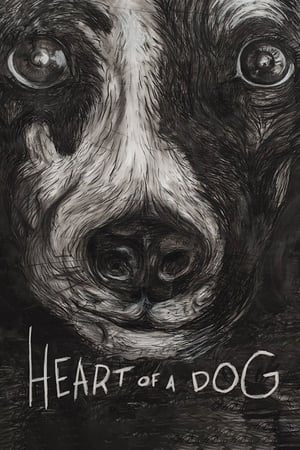
65%
Heart of a Dog(en)
2015-10-21
Lyrical and powerfully personal essay film that reflects on the deaths of her husband Lou Reed, her mother, her beloved dog, and such diverse subjects as family memories, surveillance, and Buddhist teachings.
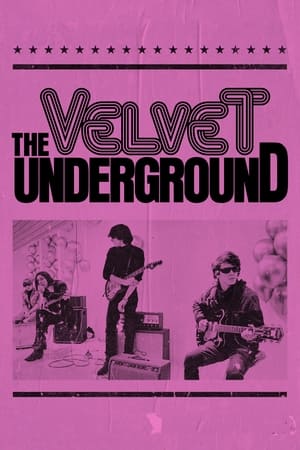
68%
The Velvet Underground(en)
2021-10-15
Experience the iconic rock band's legacy in the first major documentary to tell their story. Directed with the era’s avant-garde spirit by Todd Haynes, this kaleidoscopic oral history combines exclusive interviews with dazzling archival footage.
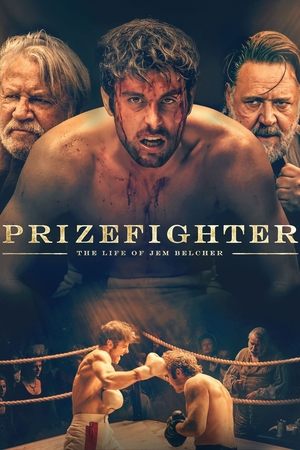
62%
Prizefighter: The Life of Jem Belcher(en)
2022-06-30
At the turn of the 19th century, Pugilism was the sport of kings and a gifted young boxer fought his way to becoming champion of England.
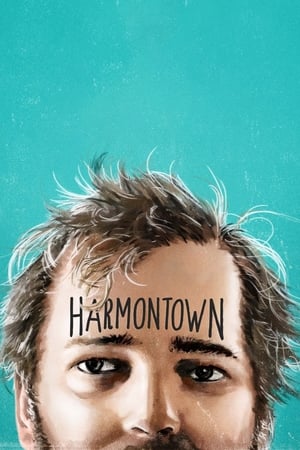
66%
Harmontown(en)
2014-03-08
A comedic, brutally honest documentary following self-destructive TV writer Dan Harmon as he takes his live podcast on a national tour.

70%
Visions of Light(en)
1992-09-17
Cameramen and women discuss the craft and art of cinematography and of the "DP" (the director of photography), illustrating their points with clips from 100 films, from Birth of a Nation to Do the Right Thing. Themes: the DP tells people where to look; changes in movies (the arrival of sound, color, and wide screens) required creative responses from DPs; and, these artisans constantly invent new equipment and try new things, with wonderful results. The narration takes us through the identifiable studio styles of the 30s, the emergence of noir, the New York look, and the impact of Europeans. Citizen Kane, The Conformist, and Gordon Willis get special attention.
76%
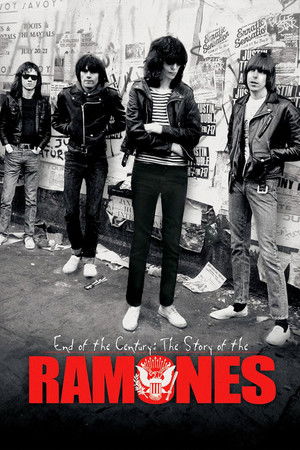
End of the Century: The Story of the Ramones(en)
2003-01-19
A years-in-the-making documentary on the legendary punk band the Ramones. Through a mixture of archival footage, archival and new interviews with all members of the band's various lineups, and new interviews with a number of their contemporaries, the film traces the peaks and valleys the band experienced over the course of its 20-plus year career before disbanding in 1995.
79%
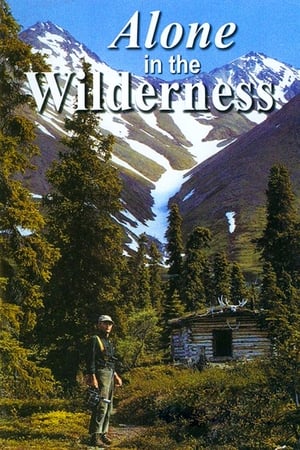
Alone in the Wilderness(en)
2004-10-08
Dick Proenneke retired at age 50 in 1967 and decided to build his own cabin in the wilderness at the base of the Aleutian Peninsula, in what is now Lake Clark National Park. Using color footage he shot himself, Proenneke traces how he came to this remote area, selected a homestead site and built his log cabin completely by himself. The documentary covers his first year in-country, showing his day-to-day activities and the passing of the seasons as he sought to scratch out a living alone in the wilderness.

61%
Naqoyqatsi(en)
2002-09-02
A visual montage portrait of our contemporary world dominated by globalized technology and violence.
68%
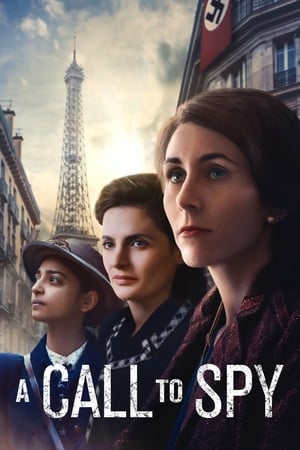
A Call to Spy(en)
2020-10-02
The story of Vera Atkins, a crafty spy recruiter, and two of the first women she selects for Churchill's "secret army": Virginia Hall, a daring American undaunted by a disability and Noor Inayat Khan, a pacifist. These civilian women form an unlikely sisterhood while entangled in dangerous missions to turn the tide of the war.
74%
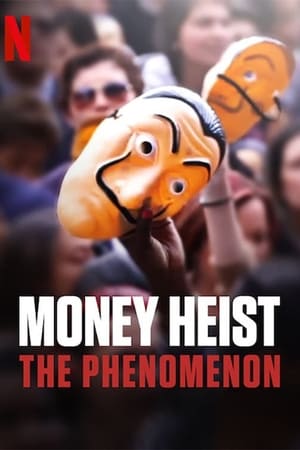
Money Heist: The Phenomenon(es)
2020-04-03
A documentary on why 'Money Heist' sparked a wave of enthusiasm around the world for a lovable group of thieves and their professor.
Similar Movies
0%
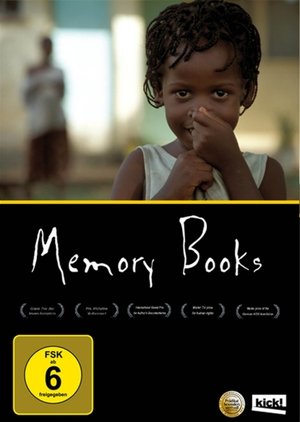
Memory Books(en)
2008-05-01
In Uganda, AIDS-infected mothers have begun writing what they call Memory Books for their children. Aware of the illness, it is a way for the family to come to terms with the inevitable death that it faces. Hopelessness and desperation are confronted through the collaborative effort of remembering and recording, a process that inspires unexpected strength and even solace in the face of death.
74%
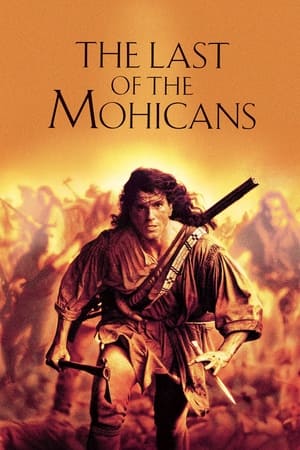
The Last of the Mohicans(en)
1992-08-26
In war-torn colonial America, in the midst of a bloody battle between British, the French and Native American allies, the aristocratic daughter of a British Colonel and her party are captured by a group of Huron warriors. Fortunately, a group of three Mohican trappers comes to their rescue.
20%
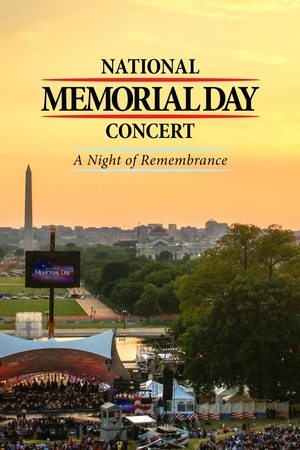
National Memorial Day Concert(en)
2023-05-28
On the eve of Memorial Day, a star-studded lineup will grace the stage for one of PBS' highest-rated programs. This multi-award-winning television event has become an American tradition, honoring the military service and sacrifice of all our men and women in uniform, their families at home and those who have made the ultimate sacrifice for our country.
80%
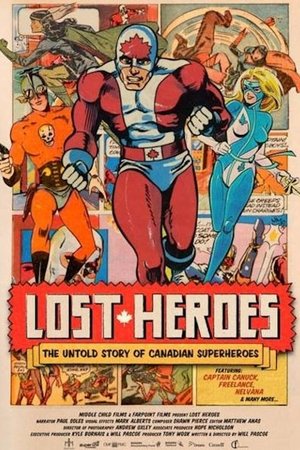
Lost Heroes(en)
2014-02-28
Lost Heroes is the story of Canada's forgotten comic book superheroes and their legendary creators. A ninety-minute journey to recover a forgotten part of Canada's pop culture and a national treasure few have ever heard about. This is the tale of a small country striving to create its own heroes, but finding itself constantly out muscled by better-funded and better-marketed superheroes from the media empire next door.
0%
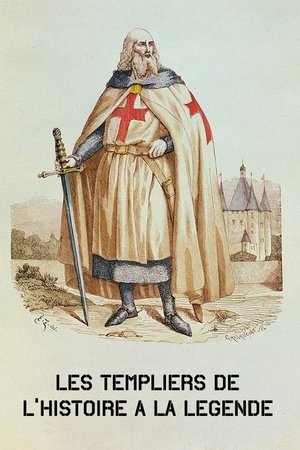
The Knights Templar: From History To Legend(fr)
2008-09-20
A fascinating exploration of the legends accredited to the mysterious religious and military order of the Knights Templar. The Order of the Templar, created after the first Crusade and disbanded by the King of France in 1307, gave birth to fabulous legends which persist to this day. Despite in-depth research, many enigmas still surround this mythical order and its legends - not least whether mysterious discoveries at Gisors and Oak Island can really hold the fabled Templar treasures. Now, this insightful documentary relives an epic adventure based on facts, places, puzzles and legends that feed faiths and have fascinated generations.
40%
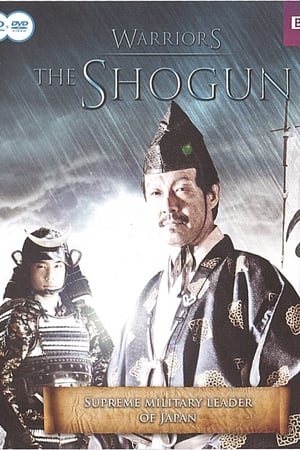
The Shogun(en)
2008-12-21
With cunning and courage the japanese warlord Tokugawa Ieyasu managed to unify Japan after 150 years of civil war.
67%
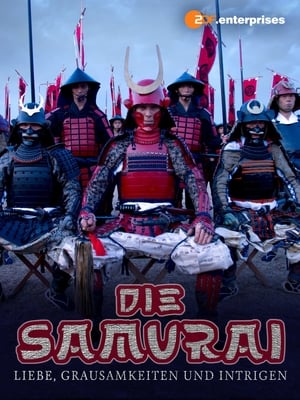
Samurai Headhunters(en)
2013-09-21
A documentary on the dark and brutal side of the Samurai warrior clans featuring the life of peasant Masa who is pressganged into the ruthless world of the Samurai.
67%
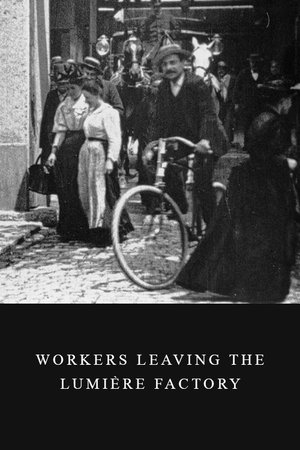
Workers Leaving the Lumière Factory(fr)
1895-03-22
Working men and women leave through the main gate of the Lumière factory in Lyon, France. Filmed on 22 March 1895, it is often referred to as the first real motion picture ever made, although Louis Le Prince's 1888 Roundhay Garden Scene pre-dated it by seven years. Three separate versions of this film exist, which differ from one another in numerous ways. The first version features a carriage drawn by one horse, while in the second version the carriage is drawn by two horses, and there is no carriage at all in the third version. The clothing style is also different between the three versions, demonstrating the different seasons in which each was filmed. This film was made in the 35 mm format with an aspect ratio of 1.33:1, and at a speed of 16 frames per second. At that rate, the 17 meters of film length provided a duration of 46 seconds, holding a total of 800 frames.
68%
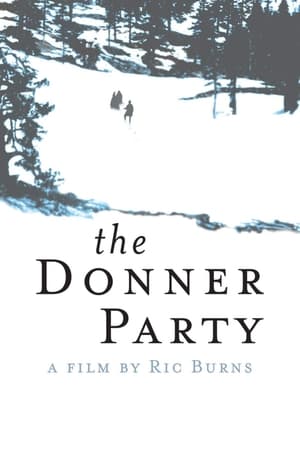
The Donner Party(en)
1992-10-28
Doomed attempt to get to California in 1846. More than just a riveting tale of death, endurance and survival. The Donner Party's nightmarish journey penetrated to the very heart of the American Dream at a crucial phase of the nation's "manifest destiny." Touching some of the most powerful social, economic and political currents of the time, this extraordinary narrative remains one of the most compelling and enduring episodes to come out of the West.
60%
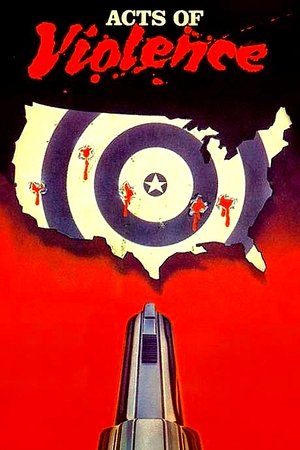
Acts of Violence(en)
1985-01-02
A riveting expose about the personalities of murderers and their motives. This 72 minute film covers the McDonalds' restaurant massacre, President Reagan's assassination attempt, serial murderer Henry Lee Lucas and others.
0%
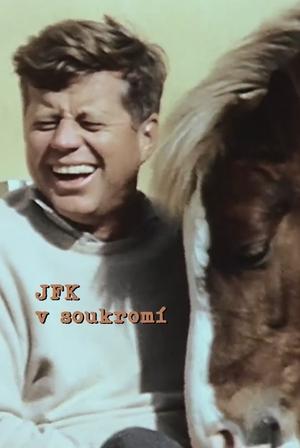
JFK: The Private President(en)
2013-01-01
In January 1961, a new generation in the guise of John F. Kennedy moved into the White House. All of a sudden politics were youthful, dynamic and sexy. During the brief period in which he was in office, the first pop star of politics accompanied America through the darkest days of the Cold War. At the same time, his signal to embark in new directions was eagerly welcomed by younger generations all around the world. Later on, Jackie Kennedy was to compare his presidency with Camelot - the legendary court of King Arthur. Yet, there were also dark sides to this popular president's life.
75%
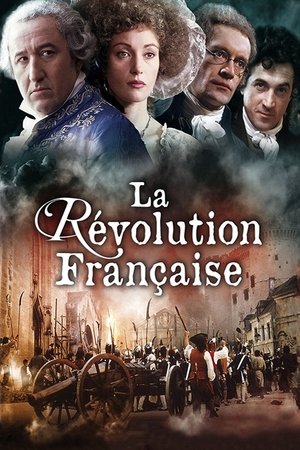
The French Revolution(fr)
1989-05-10
A history of the French Revolution beginning from the decision of the king to convene the Etats-Generaux in 1789 in order to deal with France's debt problem. Part one spans the event until August 10, 1792 (when the King Louis XVI lost all authority and was imprisoned). Part two carries the story through the end of the terror in 1794.
95%
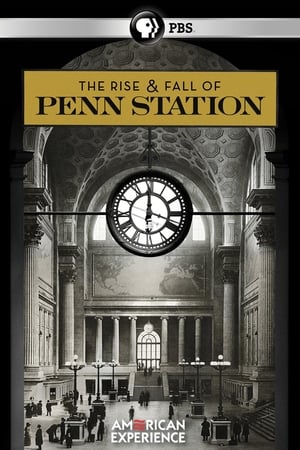
The Rise & Fall of Penn Station(en)
2004-02-18
In 1910, the Pennsylvania Railroad successfully accomplished the enormous engineering feat of building tunnels under New York City's Hudson and East Rivers, connecting the railroad to New York and New England, knitting together the entire eastern half of the United States. The tunnels terminated in what was one of the greatest architectural achievements of its time, Pennsylvania Station. Penn Station covered nearly eight acres, extended two city blocks, and housed one of the largest public spaces in the world. But just 53 years after the station’s opening, the monumental building that was supposed to last forever, to herald and represent the American Empire, was slated to be destroyed.
100%
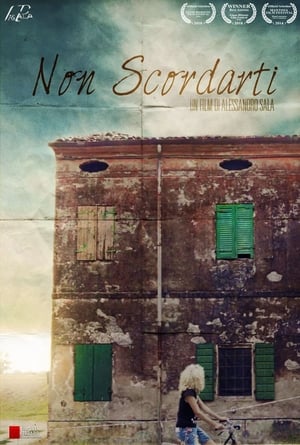
A Place of Our Own(it)
2014-03-23
76%
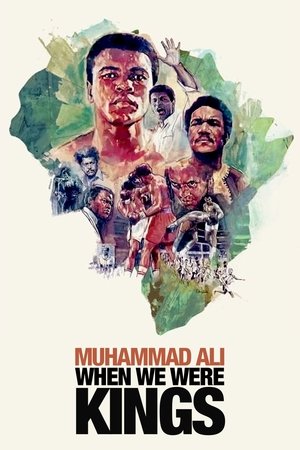
When We Were Kings(en)
1996-10-25
It's 1974. Muhammad Ali is 32 and thought by many to be past his prime. George Foreman is ten years younger and the heavyweight champion of the world. Promoter Don King wants to make a name for himself and offers both fighters five million dollars apiece to fight one another, and when they accept, King has only to come up with the money. He finds a willing backer in Mobutu Sese Suko, the dictator of Zaire, and the "Rumble in the Jungle" is set, including a musical festival featuring some of America's top black performers, like James Brown and B.B. King.
71%
Henry V(en)
1989-10-05
In 1415, in the midst of the Hundred Years' War, the young King Henry V of England embarks on the conquest of France.
100%
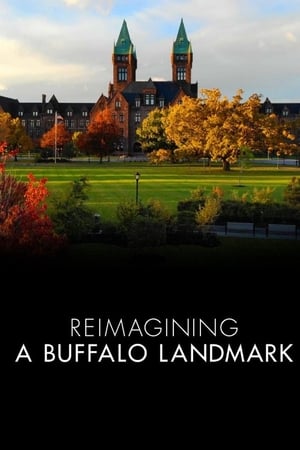
Reimagining A Buffalo Landmark(en)
2019-04-12
The Richardson Olmsted Campus, a former psychiatric center and National Historic Landmark, is seeing new life as it undergoes restoration and adaptation to a modern use.
92%
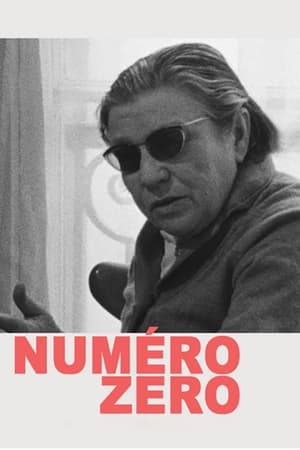
Numéro zéro(fr)
1971-01-01
A family portrait in which the director profiles his grandmother, Odette Robert. Eustache includes in the film the conditions of its production — he is seated at the table with her, pours her some whiskey, speaks with the camera operator, manipulates the clapboard at the head and tail of the reels, and even takes a phone call. Robert, who was seventy-one, speaks rapidly and tells the story of her life, starting from her early childhood in villages in the Bordeaux region of France. A shorter version of the film ("Odette Robert") was edited in 1980 to be broadcast on television on TF1. The complete film only gained exposure in 2002, when it was salvaged by Boris Eustache, Thierry Lounas, João Bénard da Costa, Jean-Marie Straub, and Pedro Costa.