Loading Page

Lost Mountain(2020)
Status: Released
Date: 2020-01-01
100%
1 Votes
Time: 0h 12m
Overview:
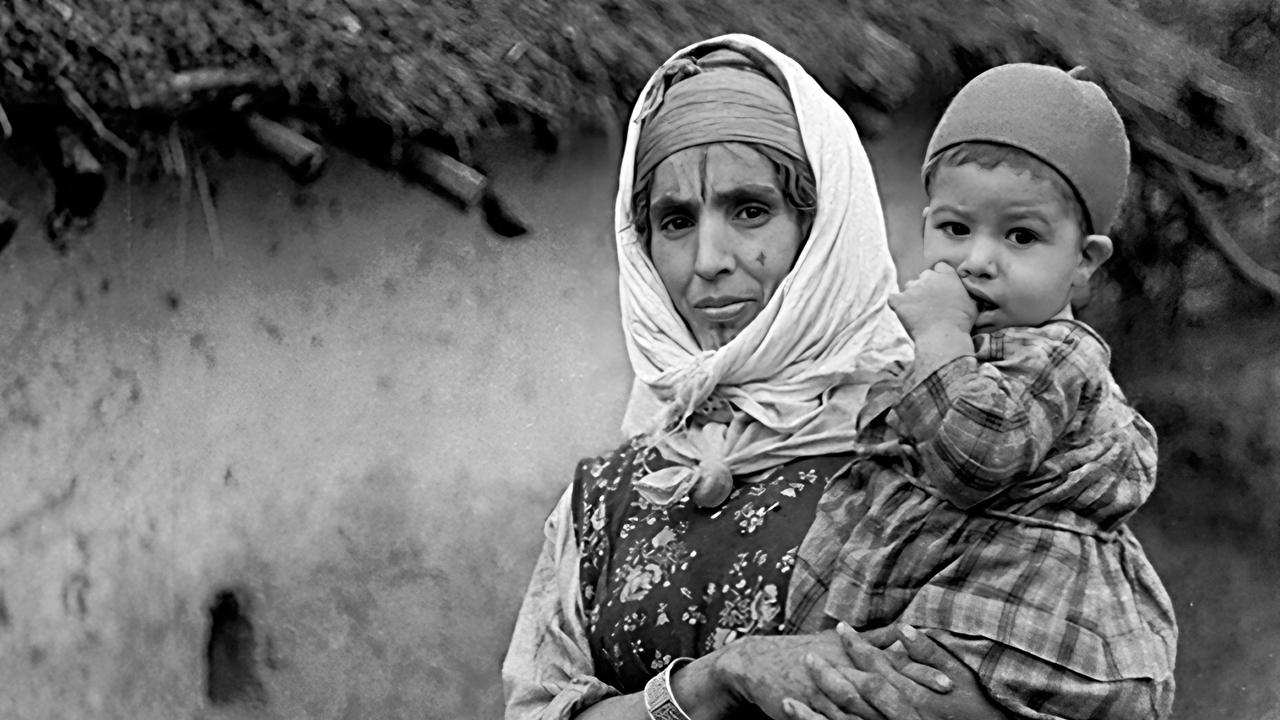
On November 1, 1954, the National Liberation Front of Algeria announced the war for the country's independence. France, colonizer since 1830, hastened to reinforce its military contingent in the four corners of the country and to prevent the advance of the rebels. A little Chaoui, born in a mountainous region of the country, sees his placid childhood collapse in the middle of a crossfire that he does not understand. The story, inspired by real testimonies, is constructed with images from the archives of the French army. From this apparently dissociated dialogue between image and word arises a sensitive homage to the memory that rests in the archives and to the ignored voice of its protagonists.
Languages: French.
Countries:
France
Movie: Lost Mountain
Top 2 Billed Cast
HomePage
Overview
On November 1, 1954, the National Liberation Front of Algeria announced the war for the country's independence. France, colonizer since 1830, hastened to reinforce its military contingent in the four corners of the country and to prevent the advance of the rebels. A little Chaoui, born in a mountainous region of the country, sees his placid childhood collapse in the middle of a crossfire that he does not understand. The story, inspired by real testimonies, is constructed with images from the archives of the French army. From this apparently dissociated dialogue between image and word arises a sensitive homage to the memory that rests in the archives and to the ignored voice of its protagonists.
Release Date
2020-01-01
Average
10
Rating:
5.0 startsTagline
Genres
Languages:
FrançaisKeywords
Recommendations Movies

69%
Destroy All Monsters(ja)
1968-08-01
At the turn of the century, all of the Earth's monsters have been rounded up and kept safely on Monsterland. Chaos erupts when a race of she-aliens known as the Kilaaks unleash the monsters across the world.

77%
Marriage Italian Style(it)
1964-12-18
During the bombing of Naples in World War II, a cynical businessman helps a naive prostitute, who spends the next two decades desperate to have him reciprocate her feelings.

74%
The Marriage of Maria Braun(de)
1979-03-23
Maria marries a young soldier in the last days of World War II, only for him to go missing in the war. She must rely on her beauty and ambition to navigate the difficult post-war years alone.

62%
Re-Generator(en)
2010-01-23
A plane containing a highly classified government project crashes outside of a small town in the US. Realizing the level of danger, the government tries to secretly fix the problem. As tensions grow, the situation gets out of control, and civilians from the town find themselves facing their worst nightmare: a genetically enhanced killing machine that doesn't know how to stop.

70%
The Little Girl Who Lives Down the Lane(en)
1976-12-25
13-year-old Rynn Jacobs lives in a New England beach town. Whenever the landlady inquires after Rynn's father, she claims that he's not available. But when the landlady's son, Frank, won't leave Rynn alone, she teams up with a neighbor Mario to maintain the dark family secret that she's been keeping to herself.

70%
Life Is Sweet(en)
1990-11-15
Just north of London live Wendy, Andy, and their twenty-something twins, Natalie and Nicola. Wendy clerks in a shop, Andy is a cook who forever puts off home remodeling projects, Natalie is a plumber and Nicola is jobless. This film is about how they interact and play out family, conflict and love.

75%
Love and Death(en)
1975-06-10
In czarist Russia, a neurotic soldier and his distant cousin formulate a plot to assassinate Napoleon.

73%
The Big Clock(en)
1948-03-18
George Stroud, a crime magazine's crusading editor, has to postpone a vacation with his wife - again - when a glamorous blonde is murdered and he is assigned by his publishing boss to find the killer. As the investigation proceeds to its conclusion, Stroud must try to disrupt his ordinarily brilliant investigative team as they increasingly build evidence that he is the killer.

74%
The Gospel According to St. Matthew(it)
1965-03-03
Along a rocky, barren coastline, Jesus begins teaching, primarily using parables. He attracts disciples; he's stern, brusque, and demanding. His parables often take on the powers that be, so he and his teachings come to the attention of the Pharisees, the chief priests, and elders. They conspire to have him arrested, beaten, tried, and crucified, just as he prophesied to his followers.

71%
Beau Travail(fr)
2000-05-03
Foreign Legion officer Galoup recalls his once glorious life, training troops in the Gulf of Djibouti. His existence there was happy, strict and regimented, until the arrival of a promising young recruit, Sentain, plants the seeds of jealousy in Galoup's mind.

71%
Buffalo '66(en)
1998-01-20
Billy is released after five years in prison. In the next moment, he kidnaps teenage student Layla and visits his parents with her, pretending she is his girlfriend and they will soon marry.

66%
Orchestra Rehearsal(it)
1979-02-22
An orchestra assembles for a rehearsal in an ancient chapel under the inquisitive eyes of a TV documentary crew, but an uprising breaks out.

64%
Re-Animated(en)
2006-12-07
Jimmy is the kid everybody ignores and uses. One day, he gets into a freak accident. The only way for him to survive is a brain transplant. He gets the brain of Milt Appleday, a famous cartoon creator. And when he wakes up, he can see cartoons!

83%
Stop Making Sense(en)
1984-10-19
A concert film documenting Talking Heads at the height of their popularity, on tour for their 1983 album "Speaking in Tongues." The band takes the stage one by one and is joined by a cadre of guest musicians for a career-spanning and cinematic performance that features creative choreography and visuals.

75%
Days of Heaven(en)
1978-09-13
In 1916, a Chicago steel worker accidentally kills his supervisor and flees to the Texas panhandle with his girlfriend and little sister to work harvesting wheat in the fields of a stoic farmer.

69%
King Kong vs. Godzilla(ja)
1962-08-11
The advertising director of Pacific Pharmaceuticals, frustrated with the low ratings of their sponsored TV program, seeks a more sensationalist approach. He orders his staff to Faro Island to capture King Kong for exploitation. As Godzilla re-emerges, a media frenzy generates with Pacific looking to capitalize off of the ultimate battle.


67%
True Stories(en)
1986-10-10
A small but growing Texas town, filled with strange and musical characters, celebrates its sesquicentennial and converge on a local parade and talent show.

81%
The World of Apu(bn)
1959-05-01
Apu, now a jobless ex-student dreaming vaguely of a future as a writer, is invited to join an old college friend on a trip up-country to a village wedding.

Similar Movies

64%
Mariner of the Mountains(fr)
2023-09-28
Filmmaker Karim Aïnouz decides to take a boat, cross the Mediterranean, and embark on his first journey to Algeria. Accompanied by the memory of his mother, Iracema, and his camera, Aïnouz gives a detailed account of the journey to his father’s homeland, interweaving present, past, and future.

80%
Phantasia(xx)
2024-03-13
X-ray images were invented in 1895, the same year in which the Lumière brothers presented their respective invention in what today is considered to be the first cinema screening. Thus, both cinema and radiography fall within the scopic regime inaugurated by modernity. The use of X-rays on two sculptures from the Bilbao Fine Arts Museum generates images that reveal certain elements of them that would otherwise be invisible to our eyes. These images, despite being generally created for technical or scientific purposes, seem to produce a certain form of 'photogénie': they lend the radiographed objects a new appearance that lies somewhere between the material and the ethereal, endowing them with a vaporous and spectral quality. It is not by chance that physics and phantasmagoria share the term 'spectrum' in their vocabulary.

85%
Algeria in Flames(ar)
1958-01-02
These are the first images shot in the ALN maquis, camera in hand, at the end of 1956 and in 1957. These war images taken in the Aurès-Nementchas are intended to be the basis of a dialogue between French and Algerians for peace in Algeria, by demonstrating the existence of an armed organization close to the people. Three versions of Algeria in Flames are produced: French, German and Arabic. From the end of the editing, the film circulates without any cuts throughout the world, except in France where the first screening takes place in the occupied Sorbonne in 1968. Certain images of the film have circulated and are found in films, in particular Algerian films. Because of the excitement caused by this film, he was forced to go into hiding for 25 months. After the declaration of independence, he founded the first Algerian Audiovisual Center.

80%
The Lives of Albert Camus(fr)
2020-01-22
Albert Camus died at 46 years old on January 4, 1960, two years after his Nobel Prize in literature. Author of “L'Etranger”, one of the most widely read novels in the world, philosopher of the absurd and of revolt, resistant, journalist, playwright, Albert Camus had an extraordinary destiny. Child of the poor districts of Algiers, tuberculosis patient, orphan of father, son of an illiterate and deaf mother, he tore himself away from his condition thanks to his teacher. French from Algeria, he never ceased to fight for equality with the Arabs and the Kabyle, while fearing the Independence of the FLN. Founded on restored and colorized archives, and first-hand accounts, this documentary attempts to paint the portrait of Camus as he was.

70%
De Gaulle, the Last King of France(fr)
2017-03-27
Charles de Gaulle, the first president (1958-1969) of the Vth Republic, France’s current system of government, left his mark on the country . He was statesman of action and has been compared to a monarch. This film depicts the general’s personality through the great events of his presidential term, at a time when the world was undergoing considerable changes.

100%
Sawt Echaâb(ar)
1961-01-01
“La Voix du Peuple,” composed of archival photographs by René Vauthier and others, exposes the root causes of the armed conflict of the Algerian resistance. Participating in a war of real images against French colonial propaganda, these images aimed to show the images that the occupier had censored or distorted, by showing the extortions of the French occupation army: torture, arrests and arbitrary executions, napalm bombings, roundabout fires, erasing entire villages from the map, etc. This is what the French media described as a “pacification campaign”.

100%
Frantz Fanon, trajectoire d'un révolté(fr)
2021-11-07
Frantz Fanon alone embodies all the issues of French colonial history. Martinican resistance fighter, he enlisted, like millions of colonial soldiers, in the Free Army out of loyalty to France and the idea of freedom that it embodies for him. A writer, he participated in the bubbling life of Saint-Germain with Césaire, Senghor and Sartre, debating tirelessly on the destiny of colonized peoples. As a doctor, he revolutionized the practice of psychiatry, seeking in the relations of domination of colonial societies the foundations of the pathologies of his patients in Blida. Activist, he brings together through his action and his history of him, the anger of peoples crushed by centuries of colonial oppression. But beyond this exceptional journey which makes sensitive the permanence of French colonialism in the Lesser Antilles at the gates of the Algerian desert, he leaves an incomparable body of work which has made him today one of the most studied French authors across the Atlantic.

81%
The Fence(ar)
2003-10-03
The Fence is a cry! In the aftermath of the civil war which bloodied Algeria, Tariq Teguia interviews the young people of Bab El Oued who express their anger. In the fixed shots in which they testify, Tariq Teguia alternates wanderings in a car which extend those of Ferrailles d’anticipations. And it is the violence of confinement that dominates, coupled with the desire for something impossible elsewhere.


100%
Abd El-Kader(fr)
2014-01-14
Illustrated with archival photographs, animations and live action, this film explores the history and historical and spiritual heritage of Emir Abd El-Kader. Algerian leader of the 19th century, was admired by Abraham Lincoln and celebrated to this day by the Red Cross as a great humanitarian. Emir Abd el-Kader, the man who challenged the French armies from 1832 to 1847 before creating the bases of a real Algerian state, is today considered by independent Algeria as one of the most outstanding figures. of its history. The nobility of his attitude after his capture and the very effective protection he brought to the Christians of Damascus at the end of his life also earned him great prestige among his former adversaries. A documentary told in dialectal Arabic by the voice of Amazigh Kateb.

100%
Gerboise Bleue(fr)
2009-02-11
"Gerboise bleue", the first French atomic test carried out on February 13, 1960 in the Algerian Sahara, is the starting point of France's nuclear power. These are powerful radioactive aerial shots carried out in areas belonging to the French army. Underground tests will follow, even after the independence of Algeria. From 1960 to 1978, 30,000 people were exposed in the Sahara. The French army was recognized recognized nine irradiations. No complaint against the army or the Atomic Energy Commission has resulted. Three requests for a commission of inquiry were rejected by the National Defense Commission. For the first time, the last survivors bear witness to their fight for the recognition of their illnesses, and revealed to themselves in what conditions the shootings took place. The director goes to the zero point of "Gerboise Bleue", forbidden access for 47 years by the Algerian authorities

100%
An Unhealed Wound - The Harkis in the Algerian War(fr)
2010-09-20
It's the unforgivable story of the two hundred thousands harkis, the Arabs who fought alongside the French in the bitter Algerian war, from 1954 to 1962. Why did they make that choice? Why were they slaughtered after Algeria's independence? Why were they abandonned by the French government? Some fifty to sixty thousands were saved and transferred in France, often at pitiful conditions. This is for the first time, the story of this tragedy, told in the brilliant style of the authors of "Apocalypse".

100%
Our Algeria(ar)
1959-01-01
"Djazaïrouna", produced by the cinema service of the Provisional Government of the Algerian Republic (GPRA), is a montage film intended to inform the international community at the UN in 1959 on the objectives pursued by the Algerian resistance during the war of 'Algeria. Independence in Algeria (1954-1962). In 1959, Djamel-Eddine Chanderli and Mohammed Lakdar-Hamina produced Djazaïrouna (Our Algeria) from images taken by René Vautier and Doctor Pierre Chaulet. This film, completed a little later and will result in the film “The Voice of the People”. This documentary on the history of Algeria through a montage of current events, traces the political and military actions of the A.L.N, the demonstrations of December 1960, and the attack on a fortified French base on the border between Algeria and Tunisia.

0%
I Exist(ar)
1982-01-02
Composed of three parts, this montage film addresses all aspects relating to the role of women in Algerian society: their ambitions, the role of the State and the help of organizations that were created during the struggle for female emancipation. .

100%
Fernand Pouillon, Une architecture habitée(fr)
2017-01-01
In this documentary, Marie-Claire Rubinstein reveals to us, through the testimonies of the inhabitants who live there, the architectural achievements of the French urban planner Fernand Pouillon in Algiers. In particular the vast complexes of hundreds of social housing units, including the most famous Diar E Saâd (1953), Diar El Mahçoul (1954) and Climat de France (1957). The historical context, during the war of independence is related by the historian Benjamin Stora and Nadir Boumaza. This documentary also evokes the personality of Fernand Pouillon in a post-colonial context.

100%
Fernand Pouillon, Le roman d'un architecte(fr)
2003-01-01
Constructing freestone buildings on the cheap, Pouillon made a name for himself at the end of the 1940s in Aix-en-Provence and Marseille, shaking up his peers who only dreamed of towers and concrete bars. In Algiers, until Independence, he built in record time thousands of homes for the poorest, real urban projects inspired by traditional forms. In the Paris region, to build comfortable buildings quickly and well, nestled in the greenery, he becomes a promoter: this too adventurous bet leads him to prison and retains his reputation. Not very explicit about this complex affair, but seduced by a contemporary architecture that combines technical inventiveness and ancient references, Christian Meunier films by multiplying the angles of view. Today's lively atmospheres are interspersed with archive footage, while Pouillon's writings are read off. Moved, his collaborators evoke a demanding and generous man, with an infectious passion.

100%
On The Trail Of Emir Abd El-Kader(fr)
2004-01-01
Abdelkader ibn Muhieddine (Arabic: عبد القادر بن محي الدين (ʿAbd al-Qādir ibn Muḥyiddīn), also known as Emir Abdelkader, or Abdelkader El Djezairi (Abdelkader the Algerian), born September 6, 1808 in El Guettana, in the regency of Algiers, and died on May 26, 1883 in Damascus, then in the Ottoman Empire and in present-day Syria, is an Algerian emir, religious and military leader. Barely 20 years old, he federates the tribes and led a struggle against the conquest of Algeria by France in the middle of the 19th century.After his surrender, he was held captive in France before going into exile in Syria where he devoted himself to poetry and established great relations friendship with Paris, which showered him with honors after having intervened in favor of the persecuted Christians in Syria, he intervened by force to protect the Christian families who came to take refuge in large numbers in the Algerian district. of certain death.

70%
Pornotropic(fr)
2020-09-30
When French writer Marguerite Duras (1914-96) published her novel The Sea Wall in 1950, she came very close to winning the prestigious Prix Goncourt. Meanwhile, in Indochina, France was suffering its first military defeats in its war against the Việt Minh, the rebel movement for independence.

65%
A People on the March(fr)
1963-01-02
In 1962, René Vautier, together with some Algerian friends, organised the audio-visual formation centre Ben Aknoun to encourage a "dialogue in images" between the two factions. Together with his students he made a film that shows the history of the Algerian War and of the ALN (National Liberation Army), and life during the reconstruction.

85%
Algeria's Bloody Years(fr)
2002-01-01
Documentary series in two parts: 1. A people without a voice (80'), 2. A land in mourning (78'). Part 1: A people without a voice: October 88, the Algerian Republic is faltering, the film goes back to the sources of this tragedy and explains how the face to face between the Islamists and those in power began. The interruption of the legislative elections of December 91, followed shortly after the assassination of President Boudiaf in June 92, plunged Algeria into chaos. Part 2: A land in mourning: the cycle of violence that leads to massacres and the economic and geopolitical underside of the war. More than 100,000 deaths, an incredible degree of barbarity, massacres, apparently incomprehensible... Behind the official window of power and its artificial political scene, hides a shadow power.