Loading Page
Her Anti-WTO(2006)
Status: Released
Date: 2006-02-11
0%
0 Votes
Time: 1h 54m
Overview:
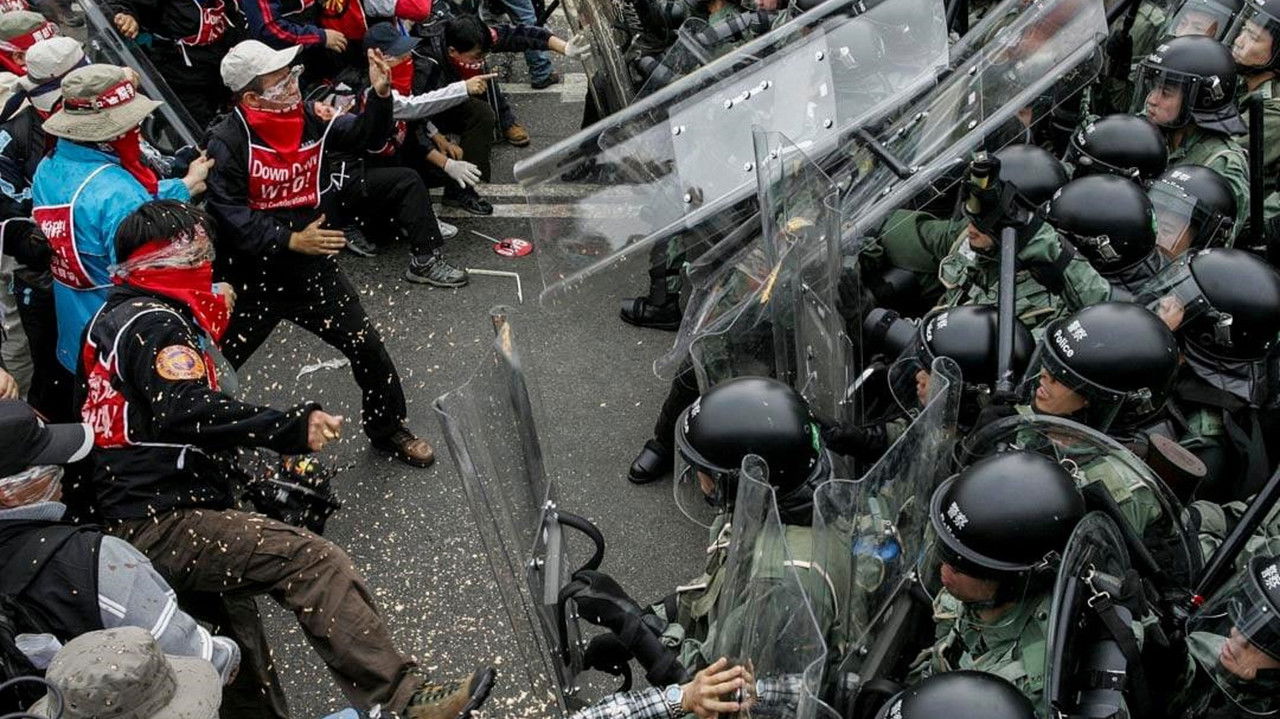
The 2005 World Trade Conference in Hong Kong was the starting point of the "direct action" that emerged from the Hong Kong protest movement. It was also the first time the Hong Kong police used a large number of tear-gas and beanbag rounds on the street after the 1967 riots. Outside the conference, there were many Hong Kong protestors. Why and how did they get involved in this movement centered on Korean farmers?
Languages: Cantonese.
Countries:
Hong Kong
Movie: Her Anti-WTO
HomePage
Overview
The 2005 World Trade Conference in Hong Kong was the starting point of the "direct action" that emerged from the Hong Kong protest movement. It was also the first time the Hong Kong police used a large number of tear-gas and beanbag rounds on the street after the 1967 riots. Outside the conference, there were many Hong Kong protestors. Why and how did they get involved in this movement centered on Korean farmers?
Release Date
2006-02-11
Average
0
Rating:
0.0 startsTagline
Genres
Languages:
广州话 / 廣州話Keywords
Similar Movies

60%
Punk Rock Vegan Movie(en)
2023-01-25
The ongoing relationship between the worlds of punk rock and animal rights and how the music became a breeding ground for vegan activism.


67%
The Brave Class(es)
2017-06-02
Three college students start a social experiment to prove that reality changes according to the words we use to describe it. Through research, activist actions, and artistic interventions, they analyze the importance of language in the way we understand the world. The documentary includes analysis from more than 20 international experts and leaders in the fields of political communication and information.

70%
Rebellion(en)
2019-09-10
As the 'one country two systems' policy in Hong Kong has slowly eroded, resentment among the territory's citizens has steadily grown. What began as a series of spontaneous protests against an extradition law in March 2019 has now escalated in to a full-blown popular uprising that shows no signs of abating. ABC Four Corners reports from the frontline of the action, capturing extraordinary footage of the growing tension and violence.

74%
Do Not Split(en)
2020-01-24
The story of the 2019 Hong Kong protests, told through a series of demonstrations by local protestors that escalate into conflict when highly armed police appear on the scene.

71%
The Yes Men Are Revolting(en)
2014-09-04
Activist-pranksters Andy Bichlbaum and Mike Bonnano pull the rug out from under mega-corporations, government officials and a complacent media in a series of outrageous stunts designed to draw awareness to the issue of climate change.

48%
Bruce Lee: Tracking the Dragon(en)
2016-10-25
Bruce Lee expert John Little tracks down the actual locations of some of Bruce Lee's most iconic action scenes. Many of these sites remain largely unchanged nearly half a century later. At monasteries, ice factories, and on urban streets, Little explores the real life settings of Lee's legendary career. This film builds on Little's earlier film, Pursuit of the Dragon, to present a comprehensive view of Lee's work that will change the way you see the films.

0%
Oproerkraaiers(nl)
2020-12-07

73%
The Monopoly of Violence(fr)
2020-09-30
As anger and resentment grow in the face of social inequalities, many citizens-led protests are being repressed with an ever-increasing violence. In this documentary, David Dufresne gathers a panel of citizens to question, exchange and confront their views on the social order and the legitimacy of the use of force by the State.

80%
A Gentle Glow(en)
2017-11-29
The camera floats quietly to capture the beauty that emerges from the mundane. Accompanied by Ryuichi Sakamoto's composition, Arseny Tarkovsky's poem celebrates life.

0%
Lai Man-wai: Father of Hong Kong Cinema(cn)
2002-01-01
In the life of Mr. Lai Man-wai, he had seen the most turbulent times of recent Chinese history. From the fall of the Qing Dynasty to the founding of the Republic, from the Sino-Japanese War to the founding of the People’s Republic. With a patriotic spirit, he joined the revolution and used the theatre to promote the revolutionary course. For a ‘stronger China’, and ‘education for all’, he chose film as his life long goal and career. Lai was more than the father of Hong Kong cinema was; he was also one of the pioneers of the Chinese cinema. He made Hong Kong’s first short fiction film ‘Zhuangzi Tests His Wife’. He opened the first Chinese owned cinema, the New World Cinema, in Hong Kong…. In the several decades, Lai had devoted his life and fortune in writing this glorious inaugural chapter in early Chinese film history. The technical enhancement, the introduction of foreign techniques and equipment were all part of his contribution to the Chinese cinema.

72%
Snowden's Great Escape(en)
2015-01-12
Tells the story of how Edward Snowden managed to evade capture by the US. For the first time Snowden tells the story of how he managed to escape so that not to have to spend the rest of his life in an American prison.

69%
The Lovers and the Despot(en)
2016-09-22
Hong Kong, 1978. South Korean actress Choi Eun-hee is kidnapped by North Korean operatives following orders from dictator Kim Jong-il.

80%
Beyond Barricades(en)
2020-10-03
Beyond Barricades is a documentary on political punk band Anti-Flag, featuring interviews with Tom Morello, Billy Bragg, Tim McIlrath, Brian Baker & More. The film explores the trials and tribulations of playing politically charged music and devoting your life to activism.


0%
Another Home(cn)
2025-01-17
Cheung Chau, once a fishing village in Hong Kong, has transformed into a tourist spot. Ri-Tai, a food stall run by A-Cheung, reflects local life, absurdities, and societal realities. A-Cheung spends his days playing games with customers like Plumpy, forming bonds that transcend generations. However, the onset of COVID-19 disrupts this sense of community, leaving the island deserted and questioning whether Ri-Tai's simple way of life will vanish.

0%
Andy Warhol: Made in China(en)
1989-01-01
A look at the man behind the legend, capturing the real Andy Warhol, as an artist and as a person, as he travels through China, from Hong Kong's glitter to the mystique of Peking's Forbidden City. Set in the Far East, the story begins with the opening of the most elegant jet set watering hole in Asia, Hong Kong's “I Club,” whose owner, a young Chinese millionaire, decided to try an experiment: to transplant the most advanced, far-out Western culture to the Far East in a multimillion-dollar club that offers everything from restaurants and bars, to a health club and even an art gallery. Warhol is invited to attend the opening as a guest of honor showing his “Celebrity Portraits.” The result of this cultural experiment was varied. Emotions from the “I Club” and Warhol's work ranged from outrage to indifference to wonder.

60%
Yellowing(cn)
2016-05-08
The turmoil that has overtaken Hong Kong since its return to Chinese sovereignty in 1997 has spawned a new generation of young, passionately committed activist filmmakers; they want to tell Hong Kong's story with Hong Kong voices. And the best indie documentary to have emerged so far from the HKSAR is this year's Yellowing, by Chan Tze Woon, a 29-year-old with degrees in policy studies and film production. Hong Kong's fraught, tense relationship with its mainland Chinese overseers came to a head with the Umbrella Movement of 2014. A crowd of protesters stormed Civic Square on September 27. The next day police shocked most residents of the HKSAR by attacking the growing crowds with volleys of tear gas, whereupon a wide cross section of Hong Kongers occupied the streets in several areas and stayed for almost 6 weeks. Chan took his camera on the streets for 67 days during these events.

70%
Rather Be Ashes Than Dust(cn)
2024-10-04
Memories of his four-year journey focused on the Hong Kong protests. Narrated in the first person, is rich with reflections and contemplations, most intertwined with feelings of guilt.

73%
Joshua: Teenager vs. Superpower(en)
2017-01-20
When the Chinese Communist Party backtracks on its promise of autonomy to Hong Kong, teenager Joshua Wong decides to save his city. Rallying thousands of kids to skip school and occupy the streets, Joshua becomes an unlikely leader in Hong Kong and one of China’s most notorious dissidents.