
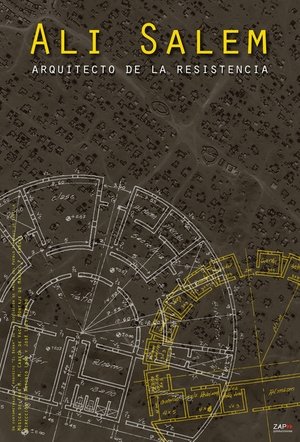
Ali Salem, architect of resistance(2008)
Ali Salem Hamudi Mohamed - Yahdih, was born in 1955 in El Aaiún (Western Sahara). He completed his secondary schooling in the "Spanish" Sahara. A scholarship allowed him to enrol at the Universidad de la Peninsula in 1975, but Morocco's invasion of the Sahara led him to return to the city of his birth and go into exile with his people, participating in the resistance and helping to organise the Tindouf Refugee Camps (Algeria). In 1980, the Polisario Front and the Government of Cuba offered him the opportunity to study Architecture at the University of Havana. On his return to the Camps in 1985 he worked for the SADR's Department of Construction. He designed more than twenty public buildings, including town halls, schools and nursery schools, and also collaborated with international aid organisations to build hospitals and training colleges. All of these buildings were built collectively by the Saharan people. ;In 1999 he emigrated to Spain. His family joined him five years later.
Movie: Ali Salem, architect of resistance
HomePage
Overview
Ali Salem Hamudi Mohamed - Yahdih, was born in 1955 in El Aaiún (Western Sahara). He completed his secondary schooling in the "Spanish" Sahara. A scholarship allowed him to enrol at the Universidad de la Peninsula in 1975, but Morocco's invasion of the Sahara led him to return to the city of his birth and go into exile with his people, participating in the resistance and helping to organise the Tindouf Refugee Camps (Algeria). In 1980, the Polisario Front and the Government of Cuba offered him the opportunity to study Architecture at the University of Havana. On his return to the Camps in 1985 he worked for the SADR's Department of Construction. He designed more than twenty public buildings, including town halls, schools and nursery schools, and also collaborated with international aid organisations to build hospitals and training colleges. All of these buildings were built collectively by the Saharan people. ;In 1999 he emigrated to Spain. His family joined him five years later.
Release Date
2008-01-01
Average
0
Rating:
0.0 startsTagline
Genres
Languages:
EspañolKeywords
Similar Movies

Occupation, the 27th Picture(hr)
We encounter the controversial Croatian film director Lordan Zafranovic in voluntary exile in Prague. The film follows his rise from a talented outsider to the celebrated Yugoslav director of the acclaimed war film, 'An Occupation in 26 Pictures'. His life story is an unconventional depiction of a rise and fall that reveals compromises made in order to survive artistically during communism, as well as the missed opportunities and miscalculations that led to his inability to adapt in later years. Is the charismatic Zafranovic a national traitor or a victim of historical circumstances in which the only thing he wanted to do, in his own words, was to be himself and make films?

Cheikh El Hasnaoui, from the White House to the Blue Ocean(fr)
Cheikh El-Hasnaoui is an Algerian singer who left his country in 1937 without ever setting foot there again. Between 1939 and 1968 he composed most of his repertoire in France. For many years the Algerian cafes of Paris were the stages of his shows. With a handful of artists of his generation, he laid the foundations of modern Algerian song. A fervent defender of women's rights, he claims, as a pioneer, the fight for identity for a plural Algeria. At the end of the Sixties, he ended his artistic career. On July 6, 2002 he died in Saint-Pierre de la Réunion, where he is buried to this day. This 80-minute documentary follows in the footsteps of this extraordinary character. From Kabylia to Saint-Pierre de a Réunion via the Casbah of Algiers and the belly of Paris.


Shâd Bâsh(fr)

L'Exode(fr)

Ernest Cole: Lost and Found(fr)
More than 60,000 of Ernest Cole’s 35mm film negatives were inexplicably discovered in a bank vault in Stockholm, Sweden. Most considered these forever lost, especially the thousands of pictures he shot in the U.S. Told through Cole’s own writings, the stories of those closest to him, and the lens of his uncompromising work, the film is a reintroduction of a pivotal Black artist to a new generation and will unravel the mystery of his missing negatives.


Voltige(uk)
Anna, a twelve-year-old Ukrainian gymnast, has fled her war-torn country and recently settled in Montreal with her mother, younger brother, and grandmother. Confronted by the past, the challenges of exile, and a deep need for belonging, she seeks to rebuild her identity and regain her balance. Through her child’s perspective, the documentary explores the reality of life after war, questioning what endures and what is missing, even when one has found refuge.


Sons of the Clouds: The Last Colony(es)
The political upheaval in North Africa is responsibility of the Western powers —especially of the United States and France— due to the exercise of a foreign policy based on practical and economic interests instead of ethical and theoretical principles, essential for their international politic strategies, which have generated a great instability that causes chaos and violence, as occurs in Western Sahara, the last African colony according to the UN, a region on the brink of war.

The Rebel(it)
The adventures of Guido Picelli, a man who was a leading light in the history of twentieth-century Italy and Europe. Guido Picelli fought untiringly for the affirmation of social justice and opposed every form of totalitarianism.

Lost land(fr)
Straddling a 2,400-kilometer-long wall constructed by the Moroccan army, the Western Sahara is today divided into two sections — one occupied by Morocco, the other under the control of the Sahrawi National Liberation Movement’s Polisario Front. Drawing from stories of flight, exile, interminable waiting and the arrested, persecuted lives on both sides of that wall, this film bears witness to the Sahrawi people, their land, their entrapment in other people’s dreams. In an esthetic that sublimates the real, Lost Land resonates like a score that juxtaposes sonorous landscapes, black-and-white portraits and nomadic poetics.

The Wind(ar)
The tragedy of the Syrian people: War, conflict, loss, migration, exile, asylum, detention, drowning… A deserted place. Abandoned people. Abandoned country. The doors slammed shot; the doors are now locked - the keys thrown away...for what seems forever.

Tent City(en)
The story of a group of Cubans who arrived in Miami during the Mariel Boatlift and were housed in an improvised camp in the heart of the city. Everyone lived together —men and women, homosexuals and heterosexuals, separated only by cloth curtains that hung from ropes suspended between the beds, like floating walls.


The Exiles(id)
During the 1965 mass killings to eliminate the Indonesian Communist Party, the new regime banned scholars in the Soviet Union and China, forcing them into exile across Europe. This documentary follows those displaced individuals as they navigate the Netherlands, Czech Republic, Sweden, Germany, and Indonesia, reflecting on the traumatic events that uprooted their lives.


Hamada(es)
Filled with vitality, humor and unexpected situations, Hamada paints an unusual portrait of a group of young friends living in a refugee camp in the middle of nowhere. Western Sahara is known as “the last colony in Africa” and this conflict is the longest and one of the least known ongoing disputes in the continent, but the Sahrawi people refuse to become invisible.